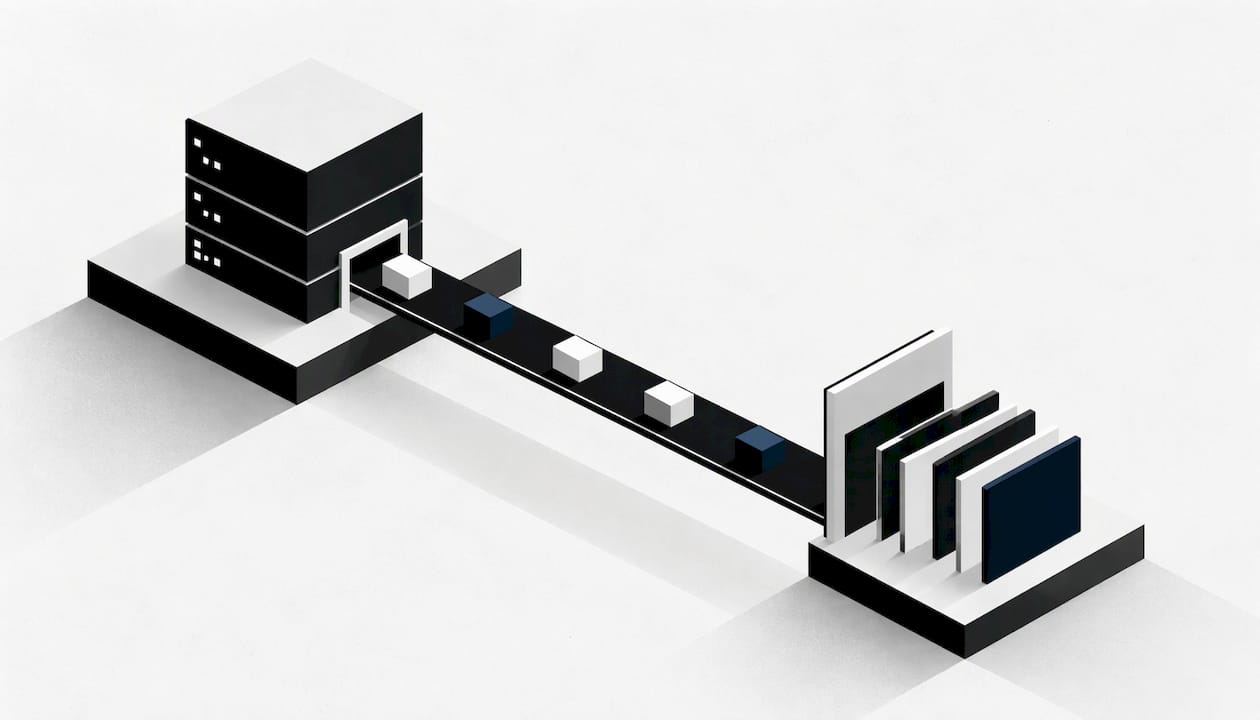
A real-time data feed is a continuous stream of records, delivered within moments of being created rather than in a nightly file or a weekly export. If your company runs one, or runs the systems that could produce one (CRM, support desk, messaging, payments), you hold an asset that AI data buyers pay for. The way you sell it matters as much as the data itself: a single offer sets a single price, while several buyers bidding in sealed rounds set a market. That is the case we make here, after the basics.
TL;DR
- A real-time feed processes records as they arrive, while batch data is gathered and processed at fixed intervals.
- A feed has three parts: ingestion, processing and a destination. Your existing CRM, email, chat and support systems already generate the raw material.
- Value comes from freshness, coverage, history and how much the data changes a buyer’s results, and privacy handling decides whether a deal can close at all.
- Selling to one buyer leaves money on the table. Bright Info runs sealed bids among multiple AI buyers, costs sellers nothing and is paid only when a deal closes.
Table of Contents
- What a real-time data feed is
- What real-time feeds look like in practice
- How a feed is built: ingestion, processing, destination
- What makes a feed valuable
- Preparing your systems before you offer data
- Why one offer is the wrong way to sell
- How the process works
- Live feed or archive: which should you offer?
- Our perspective
- Find out what your data is worth
- FAQ
- Sources
What a real-time data feed is
IBM defines real-time data streaming as processing data points as they arrive, often milliseconds after they are generated. Batch processing is the opposite: datasets are aggregated and analyzed at fixed intervals. Think of a stock ticker versus an end-of-day spreadsheet.
A TDWI explainer on databases versus streams adds a useful distinction. Data in a database is persistent and can be reprocessed. A stream is transient and has to be handled as it passes, with records arriving in sequence and continuous queries running over a sliding window.
That does not mean streamed data disappears. Teradata notes that streaming data can be kept for later analysis: Apache Kafka, a widely used streaming platform, retains data in topics for a configurable period, and longer-term data can be offloaded to databases or data lakes. In practice, a company’s live feed and its archive are two views of the same data. The live view shows what is happening now. The archive shows what has happened over years.
What real-time feeds look like in practice
The best-known feeds come from finance. Dow Jones’ Elementized News Feed delivers machine-readable economic and corporate event data in milliseconds, covering more than 350 global macroeconomic events and more than 4,000 companies, each time-stamped to the millisecond. Bloomberg’s Real-Time Events Data pushes corporate earnings KPIs for more than 10,000 companies and economic releases for up to 3,000 indicators across more than 100 countries.
Those are market feeds, and most businesses do not run one. But the same pattern applies to ordinary operating data:
- Support tickets created as customers write in
- CRM updates as deals move through stages
- Team messages and email as work happens
- Point-of-sale transactions as they ring up (see our guide to point of sale data and what it can be worth)
- Code commits, call recordings and financial exports
Each is a stream of time-stamped events, and each accumulates into a history that grows more valuable the longer it runs.
How a feed is built: ingestion, processing, destination
IBM describes streaming architecture in three stages. Ingestion captures unbounded data through connectors and APIs. Processing filters, enriches, transforms and analyzes it as it arrives. The destination is wherever it is used right away, such as an app or dashboard, or stored in a data lake, lakehouse or warehouse.
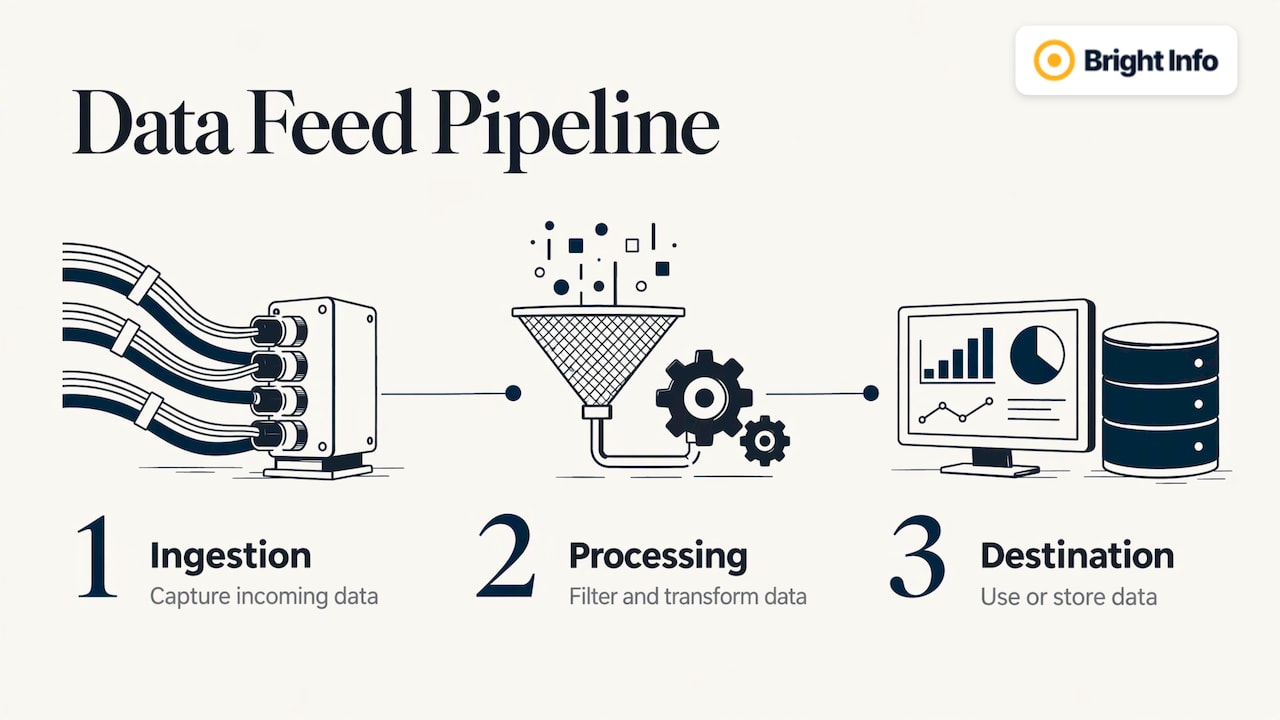
If you already run a CRM, a help desk and a messaging platform, you have the ingestion layer and probably the storage layer. An AWS Big Data post shows how enrichment works on a simple stock-quote feed, adding indicators such as a 5% price-move alert. It also observes that cloud costs now let small and mid-size companies become data providers and monetize enriched feeds. The infrastructure is no longer the barrier it was.
TechTarget’s guide to data as a service describes the pipeline from the buyer’s side: data is sourced, cleaned, validated and normalized, stored in the cloud and delivered through APIs, downloadable files, real-time streaming feeds and portals. Delivery format is a choice. A buyer may take a live stream, but a licensed, de-identified file or archive is also a legitimate way to deliver the same underlying data.
What makes a feed valuable
Buyers pay for outcomes, so value follows a few properties:
- Freshness. How soon after an event the record reaches the buyer.
- Coverage. How many customers, products, regions or interactions the data spans.
- History. How many years sit behind the feed. A stream with three or more years of archive tells a buyer far more than a stream that started last month.
- Quality and consistency. Stable schemas, few gaps and clean fields. IBM points to observability, meaning monitoring data quality metrics to catch schema changes and data drift, as a core requirement for streaming pipelines.
- Uniqueness. Data a buyer cannot get anywhere else.
A practical test before you approach anyone: can you describe, in two sentences, what the data contains, how far back it goes and how it is stored? If so, you are ready for a valuation conversation. Our guide to company data valuation for AI licensing goes deeper on how those properties translate into a number.
Preparing your systems before you offer data
You do not need to build a streaming platform to sell data. The preparation that matters is more basic:
- Inventory the sources. List each system that holds company data (email, Slack, CRM, tickets, documents, call recordings, code, financial exports), how long it has been running and who administers it.
- Check the history. Companies with established systems and more than three years of records are in the strongest position, and teams of roughly 20 to 500 people tend to have enough volume to be interesting.
- Confirm who owns what. Customer contracts, vendor terms and employee agreements can restrict how data is used. Have counsel review them before you sign anything.
- Plan for de-identification. Names, emails, phone numbers and other personal details need to be removed or masked before a buyer sees anything.
The last point carries the most weight. IBM warns that streams can carry sensitive data or personal information subject to privacy regulations, so security and governance such as encryption and access controls belong in the design from the start. RisingWave’s guide adds encryption in transit and at rest, strong authentication and authorization, and monitoring for unusual activity such as volume spikes. In the US, requirements vary by state and by the type of data, so your attorney, not a blog, decides what your files may contain.
Why one offer is the wrong way to sell
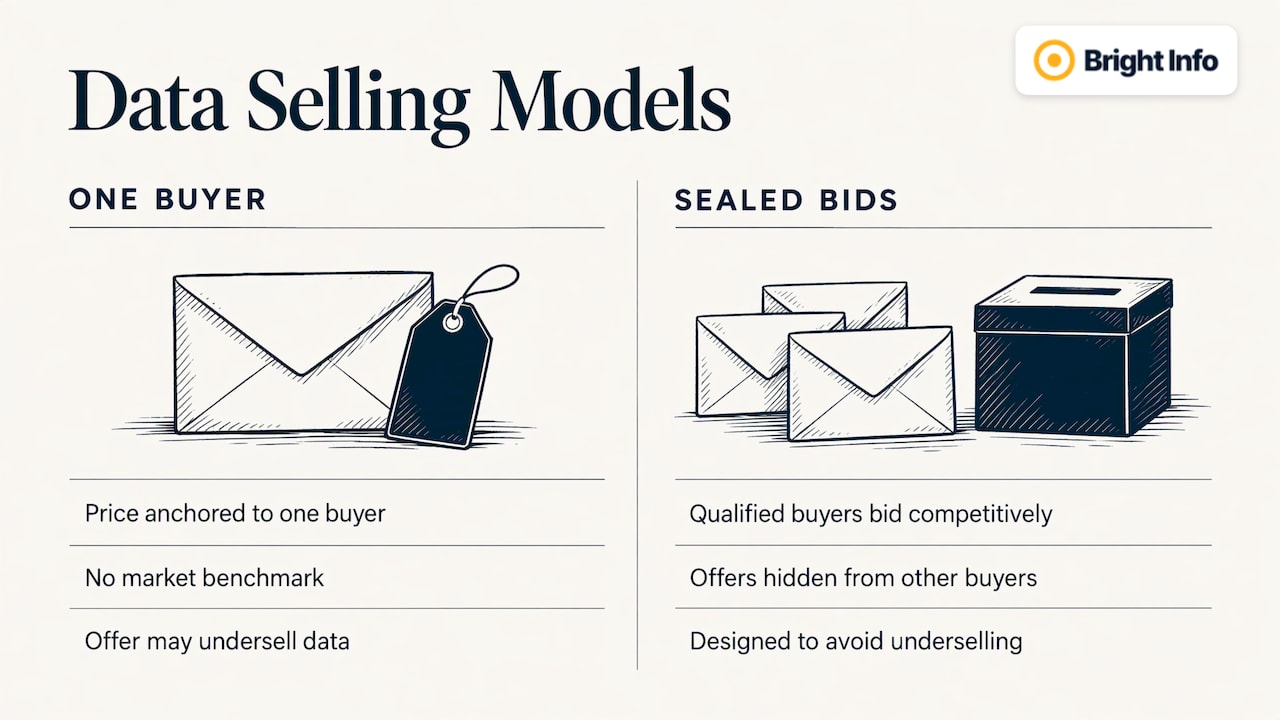
Here is the problem with the usual route. A buyer approaches you, or you approach one buyer, and the conversation anchors to that buyer’s number. You have no way to know whether it is high or low, because no one else has looked at the data.
Pricing evidence for data is thin and wide. Market feeds with published rate cards show how much terms matter: price depends on whether use is internal or external, and on who receives it. Company operating data has no rate card at all, so the price is whatever the room will bear. The only way to learn what that is, is to put the data in front of several qualified buyers at once.
That is the model we built. Bright Info is a sell-side broker: we work for the data owner, not for the buyers. We invite every qualified buyer to bid competitively in sealed bids, so each buyer prices the data without seeing the others’ offers. The point is to avoid underselling. In our experience of how these deals are valued, company data typically falls between $100K and $4M, and the spread inside that range depends on the factors above.
How the process works
Here is what the process looks like from the seller’s chair.
- Two-minute intake. You tell us what systems you have and how long they have run.
- Free valuation. You get a view of what your data may be worth before you commit to anything.
- Privacy first. De-identification is done by an independent partner that you approve. No company data moves until a deal is signed.
- Sealed bids. Multiple AI data buyers bid on the de-identified data, and you see the terms side by side.
- Legal review and license terms. You keep control of the license terms, and the agreement is reviewed before signing. Our AI data licensing agreement seller checklist lists what to look for.
- Close. The buyer you choose pays our commission. You never pay a fee, and we are paid only if a deal closes.
Because the commission comes from the winning buyer rather than from you, and we do not favor any particular buyer, our incentive is to run the strongest process for the seller. If you want to see who is on the other side of the table, our profiles of data marketplaces describe what buyers of different kinds purchase and pay.
Live feed or archive: which should you offer?
The research on streaming itself is clear that fresher is not always better. The question is what the buyer does with the data. Some buyers need continuous updates. Others are building models or agent-training environments from the record of how a business actually operates, and for them the depth and structure of years of history count at least as much as speed.
We suggest you do not decide this alone, or before bids arrive. Present the full picture (what you have, how far back it goes, how fresh the newest records are) and let buyers tell you which format they will pay for. Competitive bids reveal that quickly. For CRM data in particular, see our page on CRM data monetization for AI training, and for the wider landscape, what data monetization means and how companies do it.
Our perspective
Most executives who ask us about real-time feeds are really asking a different question: what is the data we generate every day worth, and to whom?
Our view is that the technology is the easy part. Your systems already capture the events. The hard parts are pricing and protection. Pricing, because a single buyer’s offer tells you what that buyer will pay, not what the data is worth. Protection, because the data comes from your customers and your people, and it should not leave your control until the deal is signed and the identifying details are removed.
That is why we work only for the seller. We ask every qualified buyer to bid, we use an independent de-identification partner that you approve, and we keep you in charge of license terms. We have no bias toward any buyer, and we are paid only when you are.
If you have been running your systems for a few years, you are likely sitting on more value than you think.
Erik
Find out what your data is worth
If you run a company with established systems and several years of history, the quickest next step is a free valuation. It starts with a two-minute intake, costs nothing, and you pay nothing unless a deal closes. We handle the buyer invitations, the sealed bids and the license terms, and your data stays put until you sign.
Start at Bright Info, or read how we approach selling company data to AI companies first. Our security and data handling page explains how your information is protected throughout.
FAQ
What does real-time data mean?
It means data processed within moments of being created, often milliseconds, instead of in scheduled batches. A live price ticker is the classic case. Business systems such as CRMs and support desks produce the same kind of continuous event data.
What is an example of a data feed?
A market data feed that pushes prices or corporate events the moment they occur is the standard example, such as the Dow Jones and Bloomberg event feeds described above. Inside a company, a stream of new CRM records or support tickets works the same way.
Can a company sell its real-time data?
Yes. Companies license operating data such as email history, CRM records, support tickets and documents to AI data buyers. The data is de-identified first, and the license sets out what the buyer may do with it. Typical values run from $100K to $4M, and sealed competitive bids are how we help sellers find the right price within that range.
Do I need a streaming platform to monetize my data?
No. Your existing systems and their history are what buyers evaluate. We start with a short intake and a free valuation, and your data does not move until a deal is signed.
What does it cost to work with Bright Info?
Nothing for the seller. The winning buyer pays our commission, and only if a deal closes.
Sources
- What Is Real-Time Data Streaming? (IBM)
- Databases vs. Data Streams (TDWI)
- What Is Streaming Data? (Teradata)
- Elementized News Feed (Dow Jones)
- Bloomberg Real-Time Events Data press release
- Publish and enrich real-time financial data feeds (AWS)
- What is data as a service (TechTarget)
- Stream Processing Trends Every Data Leader Should Know (RisingWave)
Recommended
- Data Monetization: What It Means and How Companies Do It
- Data Monetization Strategy
- Data Monetization Companies: 32 Compared (2026)
- Data marketplaces: profiles of 16 companies
More from the blog
- Data for AI Agents: What Agents Use and What Yours Is Worth
- Invoice Datasets: What They Contain and What They're Worth
- How to License Codebase Data to AI Buyers
- All posts
Find out what your company's data is worth
Bright Info runs a sealed bid among AI data buyers for your record. You pay nothing unless a deal closes.
Get your data valued