
AI agents run on three kinds of company data: structured records (CRM, transactions, inventory), semi-structured files (JSON, XML, HTML) and unstructured content (email, documents, support tickets, chat). That data matters in two ways. You can connect it to agents that work inside your business. You can also license a de-identified copy to the AI labs and builders who train agents. This guide covers both, with the most space on how to prepare the data and protect it.
TL;DR
- Agents use structured, semi-structured and unstructured data. AWS lists customer records, transactions, inventory, JSON, XML, support tickets and email archives as usable inputs.
- Data is agent-ready when it is reachable under approved permissions, joined across systems, trustworthy and current enough for the decision.
- A smaller, well-documented dataset with clear provenance can be worth more, and be easier to license, than a huge messy one.
- If you license data to AI buyers, insist on de-identification, record-level exclusions, a ban on re-identification and precise definitions of what the buyer may do.
- Competitive sealed bids from several buyers give you a better read on value than a single offer.
Table of Contents
- What counts as data for AI agents
- How agents access and work with that data
- When is your data ready for an agent
- How to prepare and connect your data
- The other side: AI builders need your data too
- How to judge what your data is worth
- Protecting privacy and control when you share data
- Why more than one buyer matters
- Find out what your data is worth
- FAQ
- Sources
What counts as data for AI agents
An agent is a model that can retrieve information and take actions. It is only as good as the information it can reach. Three categories cover almost everything.
Structured data. Customer records, transactions, inventory levels, financial exports. It answers quantitative questions: how many, how much, when.
Semi-structured data. Files stored as HTML, JSON or XML, such as API responses, logs and configuration exports.
Unstructured data. Documents, support tickets, call recordings, email archives and team chat. This is where policy, reasoning and context live. Galaxy's enterprise-context framework describes documents and conversations as the layer that explains the numbers, alongside structured metrics, metadata and lineage, and memory from earlier sessions.
Microsoft's guidance names concrete enterprise sources: CRM pipeline data, ERP inventory and orders, IT service tickets, IoT telemetry, internal APIs and Microsoft 365 content from SharePoint, OneDrive, Exchange and Teams. OpenAI's documentation gives similar examples: Salesforce customer data, Zendesk support data and Confluence process data.
If your company has been running on these systems for years, you already hold the raw material. The question is how agents get to it, and whether it is in shape to be trusted.
How agents access and work with that data
There are three common patterns.
Retrieval over documents
Text is split into chunks, converted to vector embeddings and stored in a vector database. At question time the agent pulls the most relevant passages and adds them to the prompt. This is retrieval-augmented generation (RAG). Databricks recommends chunking documents, applying metadata filters and supplying only the relevant passages to the model at inference time.
Queries over structured systems
Structured-data agents work differently. A 2026 arXiv paper explains that they translate a natural-language request into an executable query, usually SQL, run it against a database or warehouse and summarize the result. They do not synthesize an answer from retrieved passages the way document agents do.
OpenAI's documentation adds practical detail for databases with no REST API. Middleware can accept a formal query, run it and return records. Hosted agents may sit outside your firewall, so the exposed API must be reachable from their infrastructure, and service accounts should preferably be read-only.
Agentic retrieval and tool protocols
Microsoft recommends agentic retrieval for governed knowledge access: the agent plans and runs a retrieval loop over one or more knowledge sources instead of a fixed search pipeline. Agents can also reach data through APIs and the Model Context Protocol (MCP), as the AWS guide describes.
Whichever pattern you choose, one rule holds. Agents should respect existing permissions, sensitivity labels and user identity rather than bypass source-system security.
When is your data ready for an agent
Human analysts notice when a number looks wrong. Agents often do not. That is why readiness matters more than volume.
The Twistag AI-Native Playbook offers a simple four-part test. Data is ready when it is:
- Reachable through approved permissions.
- Joined across systems so the same customer, product or vendor is one entity.
- Trusted for reliability.
- Current enough for the decision at hand.
McKinsey's data-readiness guidance goes further. It says structured and unstructured data should be governed as reusable data products with canonical schemas, aligned entities, quality thresholds, sensitivity rules and lineage. Microsoft's AI-ready data framework lists interoperability, documentation and context, ownership, lineage and quality, and notes that labels, column names, usage guidance and audit logs help agents interpret data correctly.
KPMG frames the goal as a trusted search surface, so that agents see a full view of business reality and not limited database snippets.
How to prepare and connect your data
You do not need a multi-year program to start. Work through these steps in order.
- Pick the decision first. KPMG's roadmap suggests starting with the sources likely to shape a high-value AI decision: customer, product, transaction, finance and risk data, plus policies, contracts, communications and historical records.
- Layer the data. AWS describes lakehouse architectures with raw, cleaned and curated zones, with pipelines for embeddings, RAG chunking, metadata enrichment and quality checks.
- Add a business context layer. Google Cloud's guidebook describes a layer that connects raw data to the agent's reasoning, built on metadata augmentation and cataloging.
- Define tools with explicit schemas. Databricks also recommends output validation, least-privilege permissions, time-bound credentials, lineage tracking and centralized audit logs.
- Document your retrieval choices. Microsoft advises recording which retrieval method each source uses and which authentication and permissions apply.
- Treat ingestion like a product. McKinsey argues that batch, real-time, structured and unstructured data should enter through consistent pipelines, with common definitions and automated quality checks.
Agents can do some preparation at runtime. AWS notes that specialized transformation pipelines give you better scale and reliability.
Deloitte adds the quality angle: cleansing, validation and monitoring help keep data accurate, representative and unbiased, while access controls limit who can view or change sensitive records.
The other side: AI builders need your data too
Most searches on this topic come from teams wanting to feed agents. There is a second market. The labs and builders creating agents need real-world examples of how businesses actually work: how a support ticket becomes a resolution, how a deal moves through a CRM, how engineers discuss a bug. Public web text rarely shows that.
That is why operational company data has become a licensable asset. It includes Slack and email history, CRM records, support tickets, codebases, documents, call recordings and financial exports. If you want the full background, our guide to how companies license data for AI training covers the deal structure, and our piece on financial datasets for AI shows how quality checks affect value. Even something as specific as procurement data can fit.
How to judge what your data is worth
No public price list exists for company data, so value comes from a few tests. A Fraunhofer ISST practitioner framework says valuation should consider three things: whether the data is legally usable, whether it is technically accessible and whether it is high quality. Provenance sits underneath all three.
Law firm Nixon Peabody makes a point that surprises many owners. A large dataset may be worth little if valuable portions must be excluded. A smaller, well-documented dataset with clear provenance may be more useful for training and easier to license.
A quick self-check:
| Question | Strong signal | Weak signal |
|---|---|---|
| Do you have the right to license it? | Clear ownership, no customer contracts barring it | Unclear terms, third-party content mixed in |
| Can it be exported? | Clean exports from CRM, chat, ticketing | Locked in tools with no export |
| How deep is the history? | Several years of consistent records | Recent, patchy or migrated data |
| How sensitive is it? | Personal data can be removed reliably | Personal data woven through free text |
| Is it documented? | Field definitions, source systems, dates | No one knows what the columns mean |
Bright Info's own working range for company data is $100K to $4M, and the position in that range depends on the factors above. It is our estimate, not a guarantee, and every dataset differs. Companies with 20 to 500 staff and more than three years of history are the ones we most often see with strong candidates.
Protecting privacy and control when you share data
Licensing data does not mean handing it over. The safeguards below are the ones to demand in any deal.
- De-identification by default, using recognized standards. The Singapore IMDA trusted data sharing framework points to standards such as NIST's for de-identification methods.
- Record-level exclusions for sensitive material, so whole categories of records can be left out.
- Contractual prohibitions on re-identification.
- An independent de-identification provider. Nixon Peabody lists this among the security safeguards for AI data transactions.
- Precise legal definitions. The license should cover not only the original data but also derived assets: embeddings, model weights and fine-tuned outputs.
Also know which rights attach to your data. A 2025 European Commission study notes datasets can be protected by database rights, copyright, trade secrets, patents and Data Act entitlements. It also lists the license terms to check: use scope, no-challenge clauses, confidentiality, reverse engineering and security measures. Those rules are European, so have a lawyer in your own jurisdiction review the contract. Your data protection counsel should confirm what personal data your records contain before anything is exported.
Our security and data handling page explains how we approach this.
Why more than one buyer matters
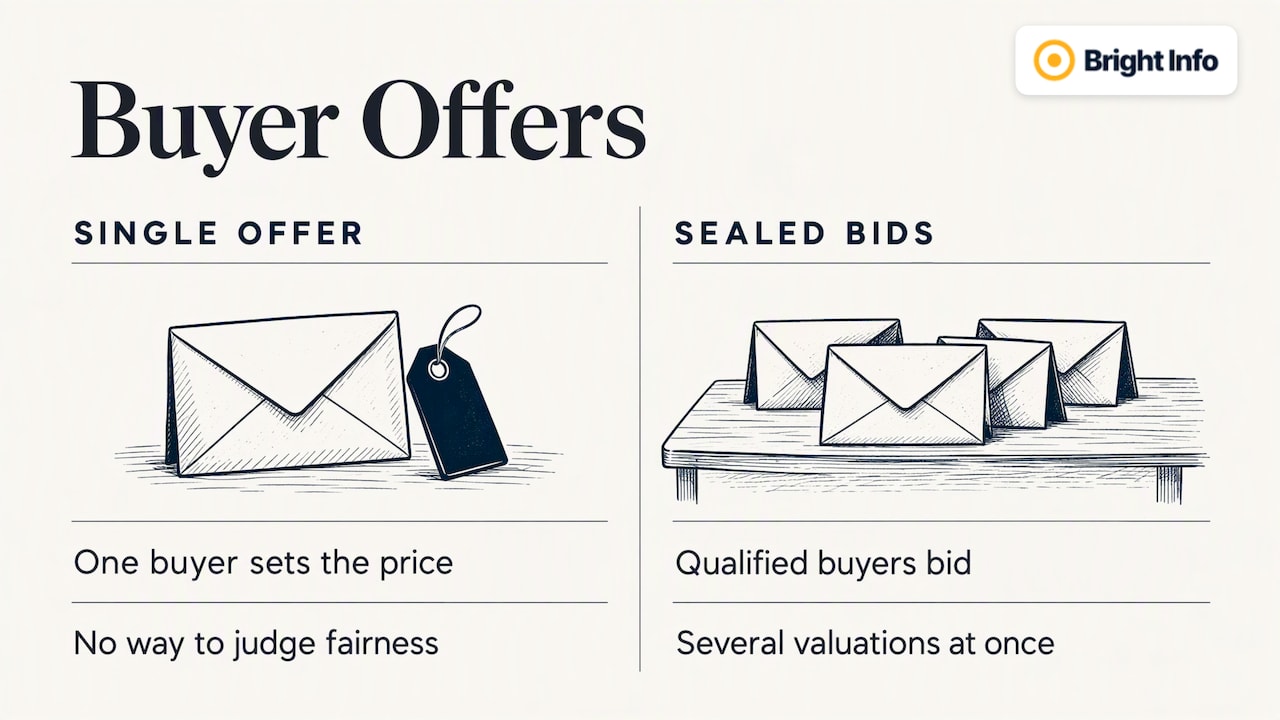
A single offer tells you what one buyer will pay. It says nothing about what the data is worth to the other buyers. When AI labs, data vendors, builders of agent-training environments and data marketplaces each need different material, their valuations differ widely. A sealed-bid process gives you several numbers at once.
If you are comparing the types of firms in this space, our comparison of data monetization companies sorts them by what they do and who they represent.
Perspective
We built Bright Info on one belief: the data owner should hold the leverage. Most companies that get approached by an AI buyer receive one number and a deadline. They have no way to know whether it is fair.
So we work as a sell-side broker. We represent the company that owns the data, not the buyers. We invite every qualified buyer to bid in a sealed process, and we have no commission bias toward any of them, because the winning buyer pays us and only if a deal closes. Sellers pay nothing.
Privacy is not an afterthought. Company data is de-identified by an independent, owner-approved partner, and nothing moves until a deal is signed. You keep strict control over the license terms, including what derived assets the buyer can create.
For executives, the practical advice is simple. Do not wait until your data is perfect. Know what you have, find out what the market will pay, and decide with real bids in hand.
Erik
Find out what your data is worth
If you have years of email, CRM records, tickets or chat history, a free valuation is the quickest way to learn whether it is a licensable asset. The intake takes about two minutes, there are no upfront fees, and you pay nothing unless you choose a bid and a deal closes.
Start on the Bright Info valuation page and tell us which systems you run and how far back the records go.
FAQ
What data do AI agents need to work well?
They need data that is reachable, joined across systems, trustworthy and current. That means structured records for numbers and unstructured documents, tickets and conversations for context. Metadata, lineage and clear field documentation help agents interpret both correctly.
Can agents use my data without breaking security rules?
Yes, if they inherit your existing controls. Microsoft's guidance says agents should respect permissions, sensitivity labels and user identity. OpenAI's documentation recommends read-only service accounts for database access. Ask your security team to review each connection before go-live.
Can I license my company's data to AI companies?
Often yes, if you own the rights and can remove personal and confidential information. Standard safeguards include independent de-identification, record-level exclusions and a ban on re-identification. Have counsel review the license, including how it treats embeddings and model weights.
Does a bigger dataset always sell for more?
No. A large set may lose much of its value if sensitive portions must be excluded. A smaller, well-documented set with clear provenance can be more useful for training and easier to license.
Does it cost anything to get a valuation?
Not with us. Sellers never pay Bright Info. We are paid a commission by the winning buyer, and only if a deal closes.
Sources
- Building a Data Foundation for Agentic AI, AWS
- Data architecture for AI agents across your organization, Microsoft Learn
- Data retrieval with GPT Actions, OpenAI
- Beyond Document Retrieval, arXiv
- Enterprise Context Management for AI Agents, Galaxy
- How do you build agentic applications with access to company data, Databricks
- Data foundations agents can use, Twistag AI-Native Playbook
- AI data readiness, McKinsey
- Scaling agentic AI with data transformations, McKinsey
- AI-ready data, Microsoft Inside Track
- AI-ready data for enterprise AI, KPMG
- DataAgents Guidebook, Google Cloud
- AI data readiness, Deloitte
- A Practitioner Framework for Enterprise Data Valuation, Fraunhofer ISST
- Five diligence questions before you buy AI training data, Nixon Peabody
- Trusted Data Sharing Framework, IMDA
- Data licensing and data-related provisions in technology transfer agreements, European Commission
Recommended
- AI Data Licensing: How Companies License Data for AI Training
- Financial Dataset AI: Types, Quality Checks and Value
- Data Monetization Companies: 32 Compared (2026)
- Procurement Data: What It Includes and How to Use It
More from the blog
- Supply Chain Datasets: Where to Find Them and What to Check
- Secure Data Sharing: How to Share Business Data Safely
- Procurement Data: What It Includes and How to Use It
- All posts
Find out what your company's data is worth
Bright Info runs a sealed bid among AI data buyers for your record. You pay nothing unless a deal closes.
Get your data valued