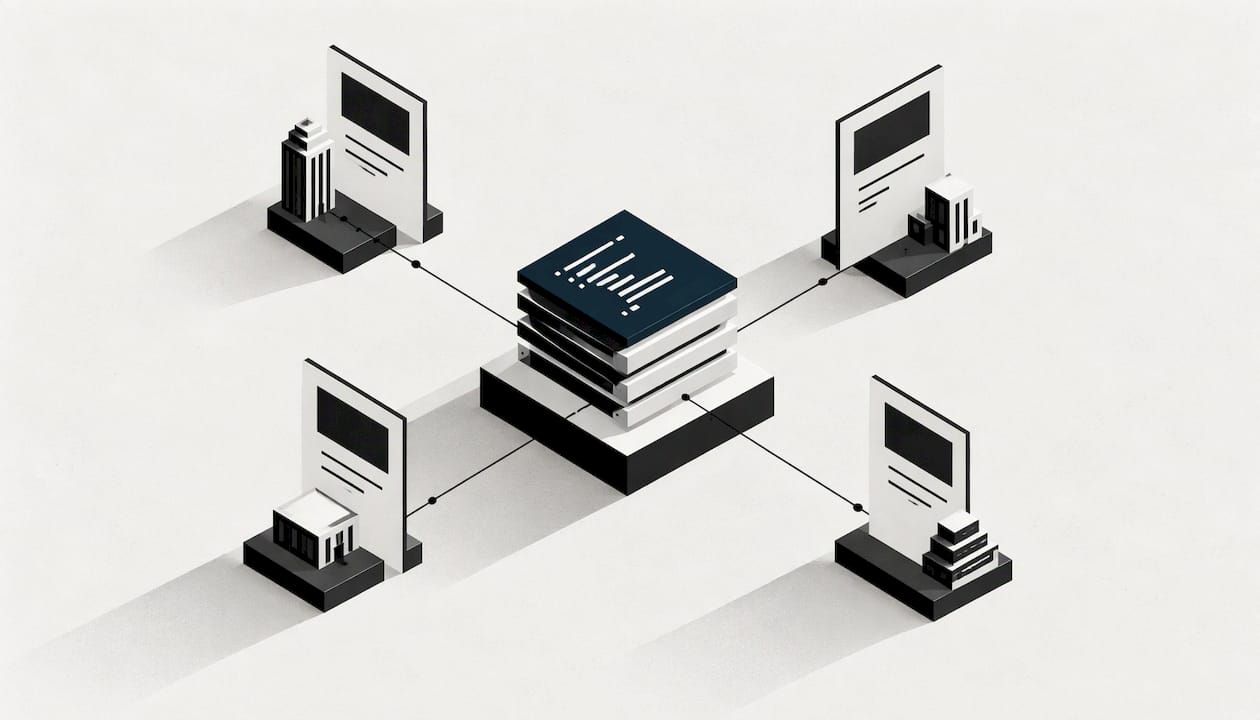
You monetize codebase data by licensing it to AI developers as training material: the private repositories, plus the engineering record around them (tickets, pull requests, reviews, docs, support logs). The way to avoid underselling it is to present it to several qualified buyers at once and let them bid against each other, after the data has been de-identified and the license terms are pinned down. Bright Info is a sell-side broker that runs this process for the data owner. It has no upfront fees and is paid only if a deal closes, by the winning buyer.
TL;DR
- Code alone is rarely the whole asset. The surrounding record of decisions, tickets, reviews and customer context is what makes a dataset valuable to AI buyers.
- Published figures are wide: a single buyer’s first offer can sit far below what a competitive process produces, so one offer is a weak basis for pricing.
- Before any data leaves, secrets must be purged from git history, customer and employee identifiers removed, and third-party code excluded or cleared.
- Privacy is not reversible once data trains a model, so the license terms and de-identification need review before you sign, not after.
- Bright Info runs sealed bids among multiple AI data buyers, with no cost to you unless a deal closes.
Table of Contents
- What codebase data actually means
- Why the code alone usually isn’t the asset
- What codebase data sells for
- How to prepare codebase data for sale
- The risks to settle before you sign
- Why competing bids beat a single offer
- The sell-side route
- Our perspective
- Related reading for sellers
- FAQ
- Sources
What codebase data actually means
When buyers say “codebase data,” they mean more than a zip file of source. A software company produces a layered record:
- Source code in private repositories, including commit history.
- Engineering workflow: pull requests, code reviews, issue and ticket history, design docs, runbooks.
- Surrounding context: team chat, email threads, customer support tickets, and the product tools that tie them together.
The layers matter because AI developers are not buying code to run it. They are buying examples of how real software gets built, argued over, broken and fixed. Reporting on the market for shuttered-startup data found that rarer languages and full context loops, meaning issue trackers and design tools together with emails, customer records and support logs, command the highest prices from AI labs. A repo with ten years of linked tickets and reviews is a different product from the same repo with the history squashed.
That is also why a company with more than three years of history and a team of 20 to 500 people usually has more to sell than it assumes. The longer and more connected the record, the more it resembles the working environments AI builders want to train agents on.
Why the code alone usually isn’t the asset
One founder who was offered $200,000 for his company’s code turned it down, reasoning that the continuously written record of decisions, stalls and retries mattered more than the code itself, according to a report on the offer. Whatever you think of his choice, the logic is useful for pricing: buyers who ask only for the repository are quoting a price for the smallest part of what you hold.
There is a practical lesson here. If you take the first bid on the narrowest slice, you may license away material that a different buyer would have valued far more highly as a bundle. Splitting the asset into products (code, engineering documentation, support and customer-context records) and inviting buyers to bid on each is a decision to make deliberately, before you accept anything.
What codebase data sells for
The published numbers are wide, and they come from different kinds of deals, so treat them as a range of outcomes rather than a quote:
- A report on a dead-startup data marketplace described individual company datasets selling for $10,000 to $100,000.
- A 2026 guide to selling software company data describes buyers paying from $50,000 up to $500,000 for code and from $100,000 to more than $3 million for engineering documentation, tickets and workflows.
- Bright Info’s own experience framing is that company data typically lands between $100K and $4M, depending on what the dataset contains and how many qualified buyers compete for it.
The spread is the point. A shuttered company selling an archive in a hurry and an operating company presenting a deep, current, well-organized record to several buyers are not in the same market. Which of those you are in is largely decided by your preparation and by how many buyers see the data.
How data gets valued
Economists describe three conventional ways to value data: by what it cost to produce, by what comparable data sells for, or by the income it can generate. A Bureau of Economic Analysis working paper lists these three approaches and notes that features of data make valuation hard. For a codebase, cost-based thinking (“we spent $8 million building this”) is the usual trap: buyers pay for what the data does for their models, not for what it cost you. The market-based view, what comparable datasets actually fetch in competing bids, is the one that moves the number. If you want a starting estimate before you approach anyone, a company data valuation built around that view is the sensible first step.
How to prepare codebase data for sale
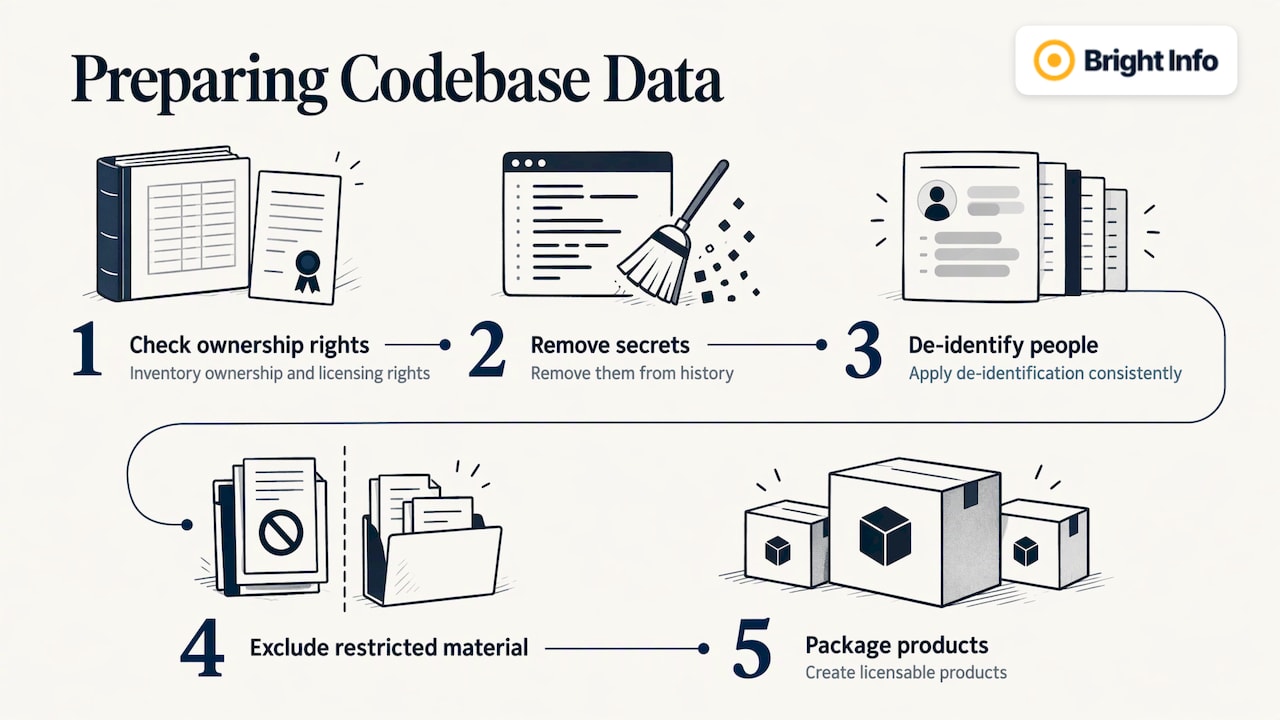
Preparation decides whether a deal is possible at all and whether it exposes you to liability later. These are the working steps.
1. Inventory what you own and what you may license
List every repository and system that holds engineering history. For each one, confirm who owns the contents. Vendored third-party source, open-source components under restrictive licenses, and code written for clients under contracts that assign ownership to them all need to be excluded or cleared. Customer contracts and employee agreements may also limit what you can license. This is a job for counsel, and it is far cheaper before a buyer is in the room.
2. Remove secrets from history, not just the working tree
API keys, tokens and credentials must be rotated and then removed from git history, not merely deleted from the current files, because history is exactly what a buyer receives. A 2026 preparation guide also recommends replacing production test fixtures with synthetic records.
3. De-identify people consistently
Customer names in pull requests and tickets need replacing with consistent codes across every repository, so that the dataset keeps its structure (the same customer is still recognizable as one entity) without revealing who it is. Engineer names and emails in commits should be pseudonymized or covered by consent. Inconsistent replacement breaks the very context that makes the dataset valuable.
Be precise about the term. Under European data protection law, pseudonymized data is still personal data, and data subjects’ rights continue to apply. If your team or customers include people in the EU or UK, that raises the bar for how thoroughly identity must be removed.
4. Decide what stays out entirely
Some material should not be offered at any price: unreleased security vulnerabilities, regulated customer data, anything under a confidentiality obligation you cannot waive. Drawing this line early keeps the offer clean and the sale defensible.
5. Package it as products
Decide whether you are offering code, engineering workflow records, support and customer-context data, or all of them, and whether any buyer gets exclusivity. Each choice changes both price and risk.
The risks to settle before you sign
The risk side is the reason many owners hesitate, and the hesitation is reasonable. A few points deserve plain statements.
Privacy cannot be undone. Once personal data has been used to train a model, it can become embedded in the model, so a mistake in de-identification is not fixable later by asking for deletion. The review has to happen before the data moves.
Employee messages are sensitive. A privacy policy expert quoted in coverage of one such offer warned that internal messages sold without employee consent, imperfect anonymization, and embedded trade secrets and customer data can make a license cost far more than its price. If your dataset includes chat or email, the consent and notice position for your staff matters.
US sale rules may apply. Under California’s privacy law, a “sale” of personal information covers communicating it to a third party for valuable consideration, not only exchanges of cash for lists. If personal information survives in the data you license, check with a privacy lawyer whether this applies to you.
License terms are the real contract. The scope of use, whether the buyer can resell or sublicense, exclusivity, audit rights, deletion obligations and what happens if the buyer is acquired all sit in the license. A seller checklist for AI data licensing agreements covers the clauses to read first.
None of this is a reason to leave value on the table. It is a reason to sell through a process in which privacy and legal review come before any data transfer.
Why competing bids beat a single offer
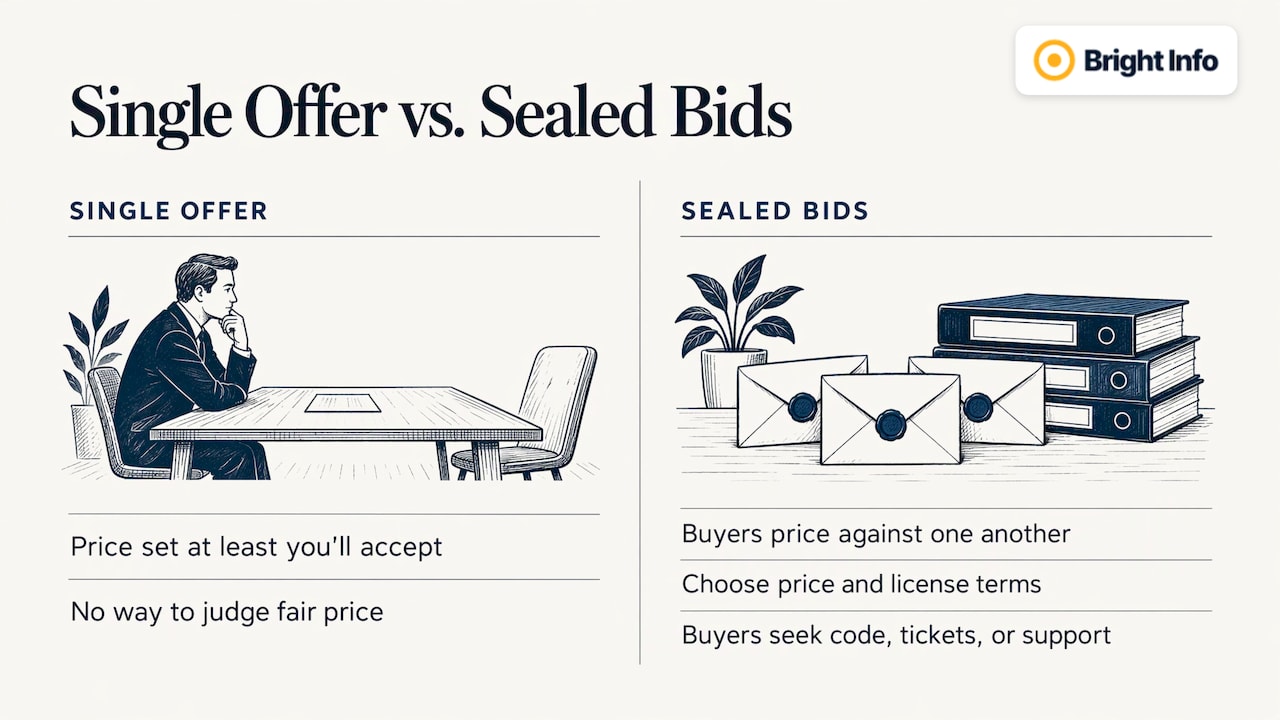
A lone buyer approaching you has an obvious incentive: price the asset at the least you will accept. Without other bids, you have no way to tell whether $200,000 is a fair price or a fifth of it. The market is also moving quickly. One marketplace reported more than 350 companies listed since April and a ninefold rise in prospective buyers, and buyer appetites differ: some want the code, others want the tickets and workflows, others want support transcripts to train agents.
That difference is what a competitive process exploits. When several buyers see the same de-identified description of your data and submit sealed bids, each has to price against the others rather than against your ignorance. You then choose on price and on license terms together, not on whoever called first.
The sell-side route
If you handle this yourself, you carry the buyer search, the NDAs, the de-identification vendor, the legal review and the negotiation, while having no market reference for price. A sell-side broker takes those tasks and represents you, the owner, rather than the buyers.
Promo: get bids on your codebase data
Bright Info works as a sell-side broker for company data licensing. You complete a two-minute intake, and Bright Info invites every qualified buyer to bid in sealed bids on your de-identified data, covering sources such as codebases, Slack, email, CRM records, support tickets, documents and call recordings. Sellers pay nothing upfront and nothing at all unless a deal closes, and the commission comes from the winning buyer, not from you. Bright Info does not move any of your company data until a deal is signed. De-identification is handled by an independent partner that you approve.
If you want a number before deciding anything, start with a free valuation.
Our perspective
Most owners we talk to assume their code is the product and the rest is clutter. We see it the other way around: the history of how a team worked is often the more distinctive asset, and it is exactly what a single buyer’s first offer tends to ignore.
That is why we do not represent buyers. We work for the data owner, invite every qualified buyer to bid, and keep control of the license terms with you. No data moves until a deal is signed, and the de-identification is done by an independent partner you approve, so the privacy question is answered before the commercial one.
Selling data should not feel like a gamble on whether the first caller is the best caller. It should feel like an auction you run on your own terms. For a company with years of engineering history, that is the difference between a quick check and a result you will not regret.
Erik
Related reading for sellers
Code is one of several data types that can be licensed. If your company also holds team chat, email or customer records, these pages cover the neighboring questions: how data monetization works in general, how to monetize email data, whether Slack data can be licensed and how CRM data is monetized for AI training. Together with code and tickets, they often make up a single, more valuable dataset.
FAQ
Can a company really sell its source code to AI companies?
Yes, as a license rather than an outright sale. You keep the code and grant a buyer defined rights to use it for model training or agent environments. The scope, term, exclusivity and deletion obligations are all set in the license, so the contract matters as much as the price.
What makes codebase data more valuable?
Rarer programming languages and connected context raise value. Reporting on the market found that issue trackers, design tools, emails and support logs tied to the code add to what buyers pay. Depth of history and clean, consistent de-identification also help.
Do I have to hand over my data before I know the price?
Not with Bright Info. No company data moves until a deal is signed, and the process begins with a short intake and a free valuation. Buyers bid on a de-identified description, and you choose the winning bid and terms.
What does it cost to sell through Bright Info?
Sellers pay nothing. Bright Info earns a commission from the winning buyer only when a deal closes, so there are no upfront fees and no charge if no deal happens.
Is de-identified data still regulated?
Often yes. Pseudonymized data remains personal data under European guidance, and US state laws such as California’s can treat licensing personal information as a sale. Have a privacy lawyer review your dataset and jurisdictions before you sign.
Sources
- What Fetches Top Dollar On The Dead Startup Data Market (Upstarts Media)
- Value of Data (Bureau of Economic Analysis working paper)
- They Offered Adam Liska $200,000 for His Code (IQ Source)
- How Data Brokers Sell Your Information to AI Companies (PrivacyOn)
- How to Sell Software Company Data to AI Companies (ddiy.co)
- Pseudonymisation under GDPR: EDPB’s Latest Guidelines (McCann FitzGerald)
- CCPA (CPRA): What Constitutes a Sale of Personal Information? (TermsFeed)
Recommended
- Data Monetization: What It Means and How Companies Do It
- Data Monetization Strategy
- How to Negotiate a Data Sale and Avoid Underselling
More from the blog
- Data Licensing: What It Is and How Businesses Do It
- Data Monetization: What It Means and How Companies Do It
- Enterprise Data Exchange: What It Is and How It Works
- All posts
Find out what your company's data is worth
Bright Info runs a sealed bid among AI data buyers for your record. You pay nothing unless a deal closes.
Get your data valued