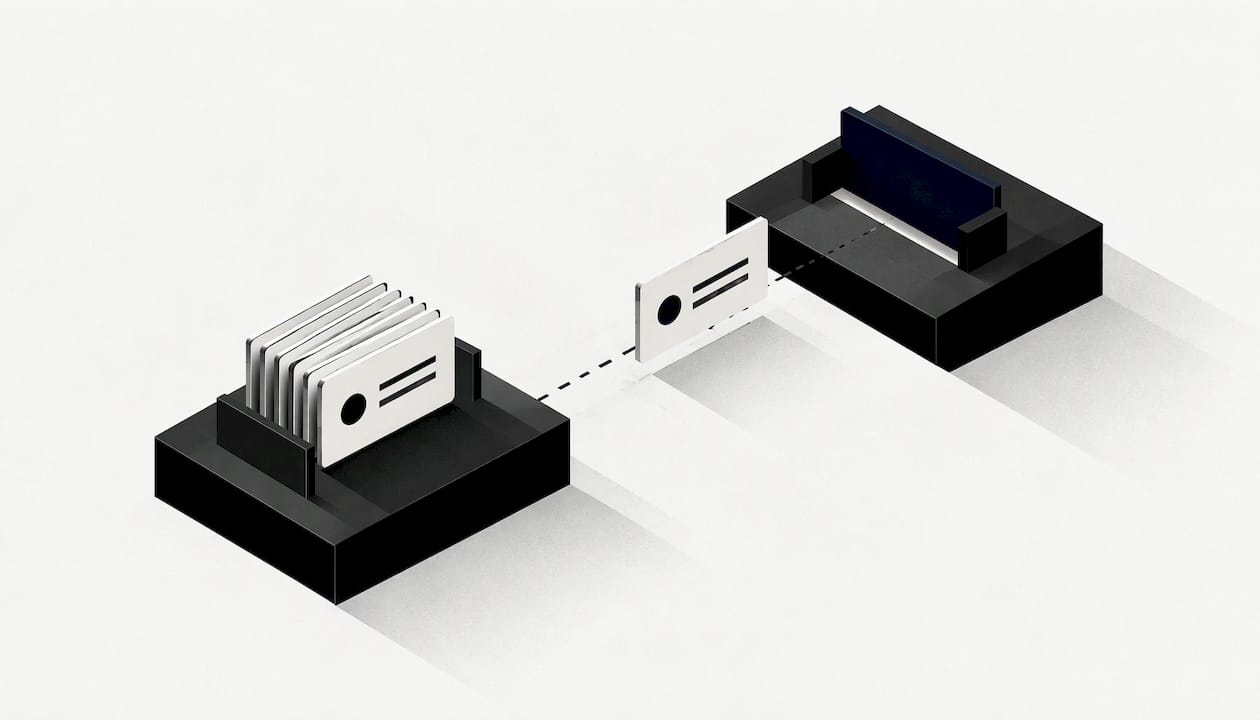
Data licensing is a contract in which the owner of a dataset lets another party use it on defined terms, while the owner keeps ownership. For a business, that means you can earn from the records you already hold, such as email, CRM entries, support tickets and documents, without selling the company or handing over the asset for good. The details that decide whether a deal is good sit in the license: what the buyer may do, for how long, whether it is exclusive, and how privacy is protected.
This guide explains what data licensing means, who owns business data, what a license can grant, which terms matter, and how to run a process that does not leave money on the table.
TL;DR
- A data license grants permission to use data on set terms. You keep ownership and control, and the buyer gets only the rights written into the agreement.
- Before you license anything, confirm you hold the rights to it. Only the owner can grant permissions to others.
- The terms drive value: scope of use, exclusivity, AI training rights, security, payment structure and exit. Price follows from those, not the other way round.
- Inviting several qualified buyers to bid against each other usually tells you more about your data's worth than a single offer.
- Bright Info is a sell-side broker for company data licensing. It is free for sellers and is paid only if a deal closes.
Table of Contents
- What data licensing means
- Who owns business data, and what can you license?
- Why businesses license data
- What a data license agreement usually covers
- What a data licensing platform does
- A practical path to licensing your company data
- Our perspective: why competition changes the outcome
- Get a free valuation of your company data
- FAQ
- Sources
What data licensing means
A license is permission. A data license agreement is a legal contract that lets another party use data on specified terms while the owner retains ownership and control. You are not transferring the asset, you are renting out defined rights to it.
That is the answer to the question "what is an example of a data license?" People meet them in several forms:
- Open licenses. Open data licences let users access, use and share data, sometimes requiring attribution or that derivative works carry the same licence. Government and research datasets often use these.
- Bespoke licenses. The EU's open data training material notes that some licences are custom-made by the publisher to include specific conditions for use. Most commercial deals fall here.
- Commercial subscriptions. A financial data feed or a market-data service sold by subscription is a license with fees attached.
- Business data licensed for AI. A company licenses de-identified internal records so an AI developer can train, fine-tune or evaluate models on them. This is the newest category, and the one most owners of operating companies ask about today.
The common thread is the same in every case: the license, not the data itself, defines what the other side can do.
Who owns business data, and what can you license?
Ownership is the first question a buyer's lawyers will ask, so answer it before you go to market.
In the United States, raw facts are often not copyrightable. Law firm Vorys notes that while raw data is often not protected by copyright, database compilations can be. Because protection is patchy, businesses commonly state ownership in the contract and convey only specific license rights. In practice, the contract does much of the work that copyright cannot.
The Digital Curation Centre's guidance makes the practical point plainly: you must establish your underlying intellectual property rights before licensing, because only the owner can grant permissions to others. Its guide is aimed at research data, but the logic holds for any dataset.
For an operating company, that check usually means asking:
- Did we create this data, or collect it from someone else? Records generated by your own staff and systems are the clearest case. Data you received under another party's terms may be restricted.
- What do customer contracts and privacy notices allow? If customers or partners supplied the content, their agreements may limit reuse.
- Does personal information appear in it? Names, emails and call recordings need de-identification before they leave your hands.
- Do employees or contractors have any claim? Check that internal agreements cover the work product in your systems.
- Is any third-party material embedded? Code, documents and attachments may carry their own licenses.
The European Commission's 2025 study adds a note of realism: data portfolios can have tangled legal statuses because protection regimes vary and are sometimes unclear. That is a reason to get a lawyer to review the grant, not a reason to wait.
Why businesses license data
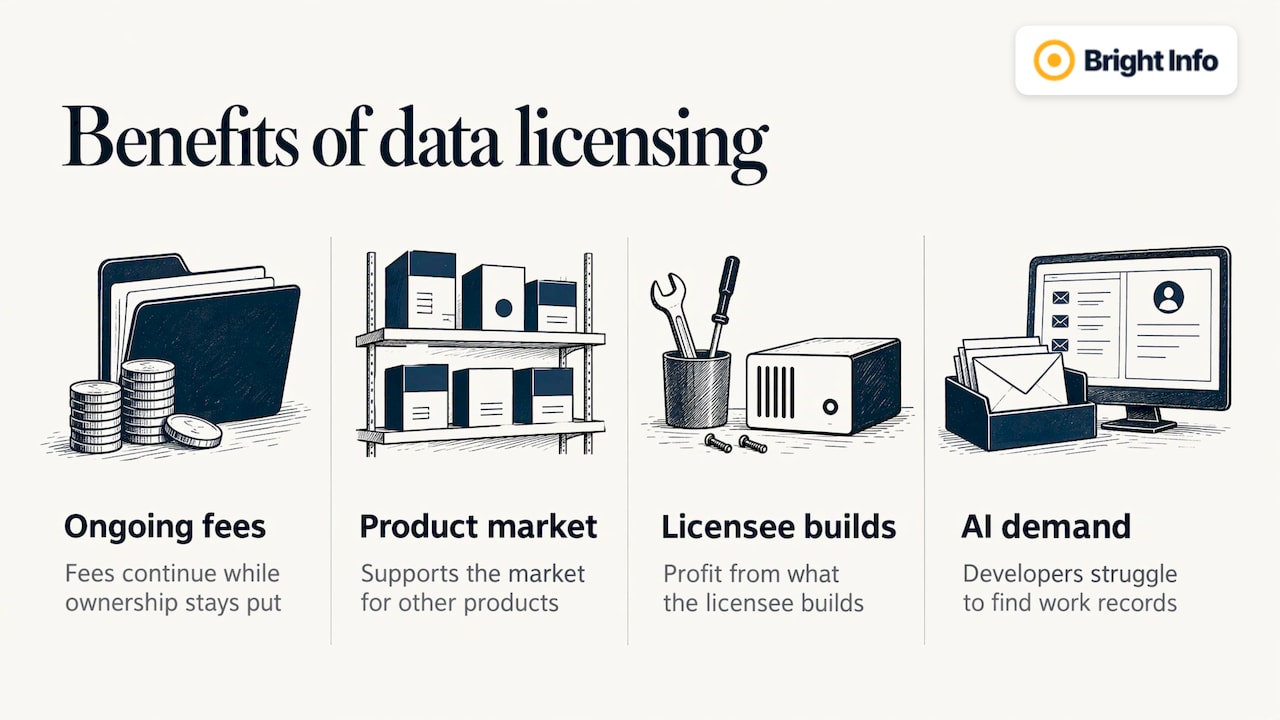
The appeal is simple: the data already exists, and licensing turns it into revenue while you keep it. Venable's 2024 presentation points out that licensing offers the owner ongoing fees while ownership stays put, and that this could ultimately be more profitable than a one-off sale.
The European Commission study describes further upsides: licensing can commercialize data, support the market for the licensor's other products, and create chances to profit from what the licensee builds with it. If you are weighing how recurring revenue from licensing fits next to your core business, those are the questions to put on paper.
There is also a timing argument. Companies that have run for years on Slack, email, a CRM and a ticketing system hold a detailed record of how work actually gets done. That record is exactly what developers of AI systems struggle to find elsewhere. If you want the market background, our guide to how companies license data for AI training walks through how those deals are structured.
What a data license agreement usually covers
No two agreements are identical, but the same clauses show up again and again. Sprintlaw's 2026 guide lists permitted use, payment, confidentiality, data security, delivery methods and restrictions on AI training or redistribution among the typical subjects, along with exit processes.
Here is how to read each one as a seller.
| Term | What it decides | What to look for |
|---|---|---|
| Permitted use | What the buyer may do with the data | A narrow, named purpose beats a general one |
| Exclusivity | Whether you can license the same data to others | Exclusive rights usually change the price and should be time-limited |
| AI training rights | Whether models may learn from the data and what happens to them | Clear limits on outputs, retention and resale |
| Confidentiality and security | How the buyer stores and protects the data | Named controls, audit rights, breach notice |
| Delivery | How and when data moves | Transfer only after signature, in agreed formats |
| Payment | Fee structure | Subscription, usage-based fees or minimum commitments |
| Term and exit | How long the license lasts and what happens after | Deletion or return obligations at the end |
Two older but still useful practice points come from Fried Frank's 2017 note on data as intellectual property. Agreements can specify exclusivity, giving the licensee sole rights or letting the licensor keep using or licensing the data, and they often include restrictions against reverse engineering, disassembling or de-compiling the data.
How pricing is structured
Sprintlaw describes the pricing factors as subscription models, usage-based fees and minimum commitments. For company data licensed to AI developers, the figure usually depends on the volume and history of the records, how clean and de-identified they are, how rare the data type is, and how exclusive the rights are. Nothing here is a fixed rate card. That is exactly why a single quote tells you so little.
Competition and standardization
Two wider points are worth knowing. The Commission study flags that data licensing can raise competition risks such as self-preferencing or the exchange of sensitive information between rivals, which matters if you license to several parties in the same industry. And an academic study from the Open Data Institute argues that standardized licence terms can build trust and reduce legal uncertainty in the AI ecosystem. Expect more templated language over time, but for now most business deals are negotiated.
What a data licensing platform does
A platform can mean different things. Inside a company, a data catalog can store license details and restrictions so people can see which dataset they may access and how they may use it. Outside, a marketplace or broker connects sellers with buyers.
The two ways to license are direct and intermediated:
- Direct. You approach a buyer yourself. It is quick to start, but you see one offer, you do not know what others would pay, and your team carries the legal and technical work.
- Through a broker or marketplace. Someone runs the outreach, structures the process and helps with the contract. What matters is whom that party works for. A sell-side broker represents the data owner. Others represent buyers or take a cut from both sides.
If you are comparing the field, our overview of data monetization companies compared sorts the options by type so you can see where each fits.
A practical path to licensing your company data
Whether you work alone or with a broker, the sequence is much the same.
- Inventory what you hold. List systems, years of history and approximate volume: email, chat, CRM, support tickets, codebases, documents, call recordings, financial exports.
- Confirm rights. Work through the ownership checklist above with counsel.
- Plan de-identification. Decide how personal and sensitive information will be removed, and who does it. An independent party you approve is better than the buyer doing it.
- Get a valuation range. Test the market before you anchor on a number.
- Invite multiple qualified buyers. Competition sets the price more reliably than negotiation with one party.
- Negotiate the license, not just the fee. Use the table above. A higher headline price with broad training rights and no deletion clause can be worth less than a lower one with tight terms.
- Move data only after signature. Delivery should follow the executed agreement.
For a sense of how one data type is judged, see our note on financial datasets for AI, which covers types, quality checks and value. The same logic of quality, coverage and cleanliness applies across other categories, including procurement data.
Our perspective: why competition changes the outcome
We started Bright Info because we saw owners accept the first offer for data they did not know how to value. A single bid is not a price, it is one buyer's opening position.
Our approach is sell-side. We work for the company that owns the data, not for the people buying it. We invite every qualified buyer to bid in a sealed process, so each one has to put forward its best terms without seeing the others. We believe that is the most honest way to find out what your data is worth. Owners tell us the range we see is typically $100K to $4M, and that is why we do not want anyone to guess.
Privacy is a condition of the deal, not an afterthought. We rely on an independent, owner-approved de-identification partner, and no company data moves until a deal is signed. Because we are paid by the winning buyer only when a deal closes, we have no reason to favor one buyer over another, and sellers never pay us.
If you hold years of internal records, you probably hold more value than you think. The right first step is to find out, at no cost and with no commitment.
Erik
Get a free valuation of your company data
If your company has roughly 20 to 500 staff and more than three years of history in systems like Slack, email, CRM or ticketing, you are the kind of seller we built this for. The intake takes about two minutes, there are no upfront fees, and you pay nothing unless a deal closes. You can also read how we handle privacy on our security and data handling page.
Start your free data valuation and see what competing buyers might offer for the data you already have.
FAQ
What does data licensing mean?
It means the owner of data gives another party permission to use it under a written agreement. The owner keeps ownership, and the licensee gets only the rights the contract lists, such as a permitted purpose, a time period and security duties.
How do I monetize my data?
The most common route is licensing it for ongoing or one-time fees while you retain ownership. First confirm you have the rights, then de-identify personal information, then find out what several buyers would pay before you agree to terms. A sell-side broker can run that process for you.
Do I lose ownership when I license my data?
Not by default. A license grants defined permissions, and ownership stays with you unless the contract says otherwise. Read the clauses on exclusivity, AI training, derived outputs and exit carefully, and have counsel review them before signing.
Is business data licensing different from open data licensing?
Yes. Open licenses are public, standard permissions that let anyone reuse a dataset, sometimes with attribution. Business data licenses are private contracts negotiated with a specific buyer, with fees, confidentiality and tailored limits on use.
Sources
- Data License Agreement Guide For US Businesses, Sprintlaw
- Reuser's guide to open data licensing, Open Data Institute
- Why do we need to license?, data.europa.eu
- Key Contract Terms and Conditions for AI Products and Services, Vorys
- How to License Research Data, Digital Curation Centre
- Data licensing and data-related provisions in technology transfer agreements, European Commission
- Considerations for Your Data Licensing Arrangement, Venable
- Data as IP and Data License Agreements, Fried Frank
- Unlocking data collaboration, Open Data Institute
- Data licenses, Fair Process Framework
- Unlocking the Potential of Channel Partnerships, Iris
Recommended
- AI Data Licensing: How Companies License Data for AI Training
- Data Monetization Companies: 32 Compared (2026)
- Procurement Data: What It Includes and How to Use It
- Financial Dataset AI: Types, Quality Checks and Value
More from the blog
- Invoice Datasets: What They Contain and What They're Worth
- Data for AI Agents: What Agents Use and What Yours Is Worth
- Supply Chain Datasets: Where to Find Them and What to Check
- All posts
Find out what your company's data is worth
Bright Info runs a sealed bid among AI data buyers for your record. You pay nothing unless a deal closes.
Get your data valued