
A data monetization strategy is a plan for turning the data you already hold into real money, either by making your business run better, by building data into what you sell, or by selling or licensing the data itself. Most companies should start with the one opportunity that is easiest to prove, then expand. For companies with years of email, CRM, chat and support history, licensing de-identified data to AI buyers is now a serious option, and the way you run the sale matters as much as the decision to sell.
TL;DR
- Data monetization has three routes: improve work, wrap data around your products, or sell information. Pick one first and build from there.
- Before anything else, inventory your data and confirm you hold the rights to use, resell or license it.
- Value data with three lenses: what it cost to create, what comparable deals show, and what income it can produce.
- Rights, privacy and security decide whether a deal is possible, so handle them before you approach any buyer.
- If you want to license data to AI buyers, a sell-side process with several competing bidders protects you from underselling.
Table of Contents
- What a data monetization strategy actually covers
- The main data monetization opportunities
- Which opportunity should you pursue first?
- A step-by-step plan
- How to value your data
- Manage rights, privacy and security before you approach buyers
- Perspective: why competition changes the outcome
- Measure whether it is working
- Sell your company data to AI buyers
- Common mistakes to avoid
- FAQ
- Sources
What a data monetization strategy actually covers
Researchers at MIT's Center for Information Systems Research define data monetization as converting data into money through three approaches: improving work, wrapping products with data-fueled features, and selling information offerings. Their test for whether monetization has happened is simple: money comes in, or less money goes out.
Gartner frames it in a similar way, as using data to obtain quantifiable economic benefit. It splits the methods into internal ones, such as measurable performance gains and better decisions, and external ones, such as data sharing for better terms with partners, bartering information, selling data outright, or offering information products and services.
That gives you a working map:
| Route | What you do | Example of the payoff |
|---|---|---|
| Improve | Use your data to cut costs or decide faster | Lower operating expense, better pricing decisions |
| Wrap | Add data-driven features to existing products | Higher retention, premium tiers |
| Sell | License or sell data or insights to third parties | New revenue line, often one-off or recurring |
A business data strategy is the wider plan for collecting, governing and using data. Monetization is the part of it that asks one more question: which of these assets is worth real money to someone outside the company?
The main data monetization opportunities
Internal, or indirect, monetization
This is the route most companies already take without calling it monetization. Teradata describes indirect monetization as using your own data for process improvement, product development, sales or marketing so that revenue or profitability rises. IBM adds that value shows up as revenue growth and as cost optimization, including productivity gains, infrastructure savings and lower operating expenses.
If you are looking at broader ways to lift revenue before you sell any data, these ways to increase revenue can help you decide how much of the gain should come from the core business.
External, or direct, monetization
Direct monetization means selling or trading information to another party. Teradata's examples include sales to adtech firms, data-as-a-service tools, embedded analytics and partner data sharing. Gartner notes that data brokers prepare context data, and banks offer payment information services to retailers.
Deloitte lists five product forms for external monetization: raw data feeds, recurring data sets, packaged insights, packaged expert capacity and data-powered products. It says raw feeds are the most exposed to commoditization and price pressure, while recurring data sets and packaged insights are more durable.
A newer opportunity: licensing company data to AI buyers
AI labs and agent builders need real working data: how companies communicate, how tickets get resolved, how deals move through a CRM, how code and documents evolve. Companies with several years of that history sit on material that did not exist as a product a few years ago. Our guide to AI data licensing explains what buyers look for and how licenses are structured.
Which opportunity should you pursue first?
MIT Sloan Management Review authors Barbara Wixom and Jeanne Ross recommend identifying the most promising opportunity and starting there, so the effort builds capacity for the next one. Deloitte puts the central question this way: the issue is no longer whether data has value, but whether it is valuable enough to external buyers to support a new business model.
A practical way to choose is to score each asset on five questions:
- Is it distinctive? Would a buyer find the same thing elsewhere?
- Is it defensible? Is it hard for others to copy or rebuild?
- Do you hold the rights? Can you document that you may license it?
- Does the math work? Will the revenue exceed the cost of preparing and delivering it?
- Can you sustain it? Is there an owner, and will it still exist next year?
These mirror the sequential pass/fail gates described by Willem Koenders: distinctive customer value, defensibility, rights and risk, unit economics and operational sustainability. An asset that fails the rights question stops there, however attractive it looks.
McKinsey adds that the strongest strategies begin with a sharp view of your proprietary advantage, whether that is privileged access to quality data, deep customer knowledge or domain-specific infrastructure. It also describes three maturity stages: internal optimization, opportunistic monetization and full marketplace monetization.
A step-by-step plan
Several frameworks agree on the order of work. The Software Engineering Institute outlines five steps for a direct strategy: inventory and evaluate your data, find customers and survey the market, identify the analysis that maximizes value, choose a delivery model that fits your capabilities, and prototype before committing resources.
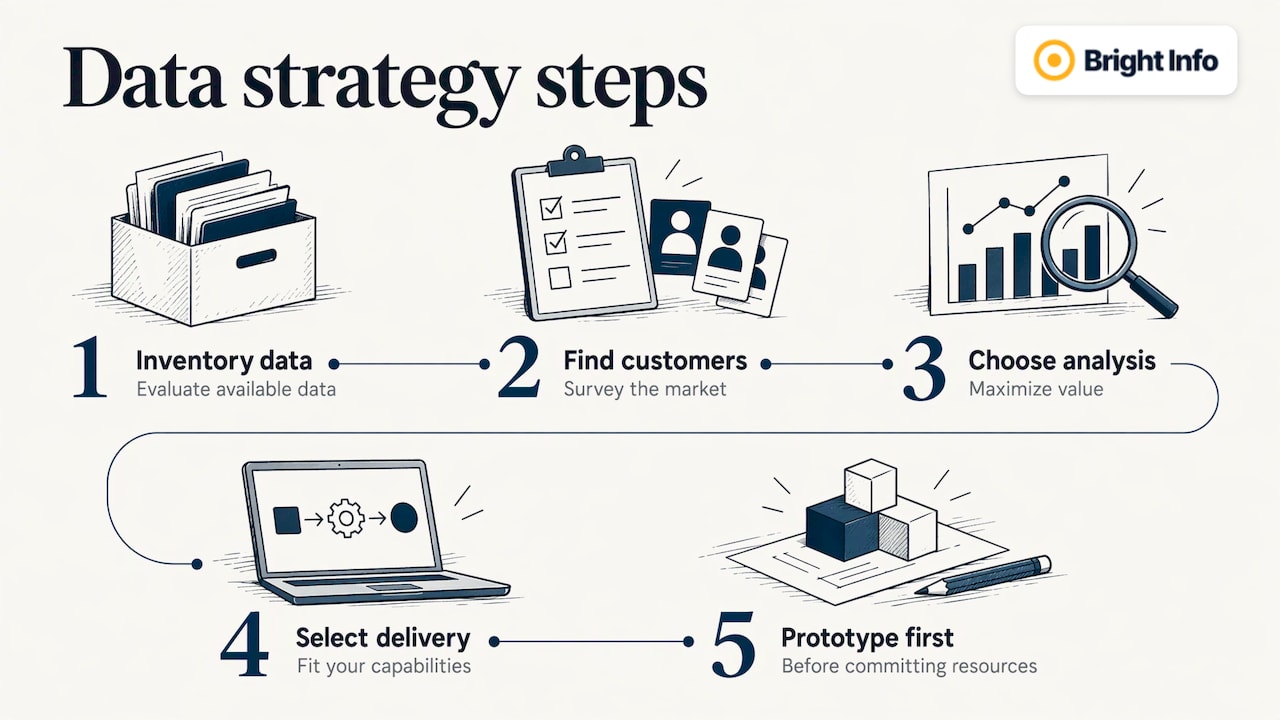
Here is how that looks in practice.
Step 1: Inventory what you hold
List every system that stores history: email, chat, CRM, support tickets, call recordings, documents, code repositories, financial exports. Note how many years each covers, how many people produced it and how clean it is. Companies often find assets they never thought of as sellable. A procurement data archive or a set of invoice datasets can be worth more than owners expect.
Step 2: Confirm rights and constraints
Check contracts, customer terms, employee agreements and third-party platform terms. Ask what you may use, resell or create derivative works from. We cover the rights and risk questions in more detail below.
Step 3: Survey buyers and pick a model
Decide whether you want a one-time license, a recurring data feed, or an insight product. MIT CISR research recommends matching your strategy to your current abilities and long-term aspirations. A company without a data product team usually gets further with a one-time license of existing history than with building a subscription product from scratch.
Step 4: Value the asset
Pricing gets its own section next.
Step 5: Run a pilot or a controlled sale
Start small, measure, then widen. WGA Advisors suggests a 90-day plan: an inventory and task force in the first 30 days, prioritization of two or three opportunities by day 60, and pilots with defined success metrics by day 90.
How to value your data
Data has no list price. There are three standard approaches, and each answers a different question.
- Cost approach. What would it cost to recreate the data? This gives a floor, not a price. Revelate describes it as providing upper and lower bounds based on reproduction or replacement cost.
- Market approach. What have comparable assets sold for? It relies on observable transactions, which are scarce for company data, so competing offers are the best evidence you can create.
- Income approach. What net cash flow can the data produce? This suits data that buyers will pay for repeatedly as it refreshes.
Tata Consultancy Services suggests setting a base price from costs such as acquisition, storage and IT, then adjusting for consumer value, ROI, risk, exclusivity and competitor prices. It also notes that the same dataset can be priced differently for different buyers. That point matters most: value depends on who is looking at the data and what they can do with it.
MIT CISR adds that information businesses should understand their profit formula and use beta programs or free prototypes to get early feedback on value and pricing.
For company data licensed to AI buyers, our own view is that the range is wide. We see outcomes that typically run from $100K to $4M, depending on volume, years of history, uniqueness and how clean the rights position is. That range is our own observation, not a published benchmark, and your figure depends on your data.
Manage rights, privacy and security before you approach buyers
Monetization fails most often at the legal step, so do it early. PwC's CFO guidance says to bring legal, risk, compliance and finance into the product lifecycle and focus on four areas: rights, compliance, reputation and controls. Rights means confirming and documenting your usage, resale and derivative rights.
Privacy law raises the stakes. A 2025 comparative study reports that GDPR fines can reach €20 million or 4% of global annual turnover, whichever is greater, and that CCPA penalties go up to $2,500 per unintentional and $7,500 per intentional violation. It points to safeguards such as encryption and pseudonymization. Rules differ by country and state, so have counsel review the specific data and where its subjects live.
Practical safeguards to put in place:
- De-identify data through an independent process you approve, so names, emails and other personal identifiers are removed before anyone outside sees it.
- Do not move any data until a license is signed.
- Keep contract terms explicit about permitted use, duration, exclusivity and what the buyer may not do. PwC's Middle East paper notes that data's non-rivalrous, partially exclusive nature calls for clear contracts.
- Review how data is shared and stored. Our guide to secure data sharing walks through the options, and our security and data handling page describes how we handle information.
Perspective: why competition changes the outcome
We broker company data licenses from the seller's side, and the biggest pattern we see is simple: one offer is never a price, it is a starting point.
Most owners who sell data receive a single approach, from one buyer who knows what they want and how little they need to pay. The owner has nothing to compare it with. We invite every qualified buyer to bid in a sealed process, so the market sets the price rather than the first buyer.
We also think the order of operations matters. Privacy comes first, through an owner-approved, independent de-identification partner. No company data moves until a deal is signed. And because we work for the data owner, not for buyers, license terms stay under the owner's control.
For sellers there is no upfront fee. The commission is paid by the winning buyer only if a deal closes, so our incentive is the same as yours: a strong, clean deal.
Erik
Measure whether it is working
A strategy needs numbers to survive its second year. PwC recommends looking at revenue quality, margin and cash contribution, and scalability and discipline, with data-specific measures such as recurring versus one-time revenue, customized versus standard offerings, governance exceptions and remediation trends.
KPMG's survey of data product leaders found that 53% measure value through revenue growth, and only 35% have achieved extensive value from data product initiatives. The same survey shows internal monetization as the most common top strategy at 52%, ahead of data-as-a-service at 44%.
For a licensing deal, track four things: net proceeds after costs, time from first conversation to signature, how many bidders took part, and whether license terms left you free to use your own data. For internal use, track the cost or time saved against the baseline you set before you started.
Sell your company data to AI buyers
If your company has more than three years of history and a team of roughly 20 to 500, the licensing route may be the fastest way to produce a result. We run a free valuation: you complete a two-minute intake, and we show you what your data may be worth to AI labs and other buyers.
There is no cost to you. We are paid by the winning buyer only if a deal closes. Get a free valuation of your company data, or see how the alternatives compare in our guide to data monetization companies.
Common mistakes to avoid
- Treating data as a side project. Deloitte calls for treating monetization as a growth and productization agenda, and says buyers increasingly expect rights clarity and auditability as part of the product.
- Pricing before you know the buyers. A dataset is worth different amounts to different people, so test more than one.
- Skipping the rights review. A great asset with unclear rights cannot be sold.
- Accepting the first offer. Without a second bid you cannot tell whether the price is good.
- Moving data before the contract. Hold data back until terms are signed.
FAQ
How do I monetize my company's data?
Start with an inventory of what you hold, then confirm your rights to use and license it. Next, choose one route: improve internal work, add data to your products, or sell or license it. Pick the opportunity with the clearest buyer and the cleanest rights, and prove it before expanding.
What is the difference between direct and indirect data monetization?
Direct monetization means selling, trading or licensing data or information products to another party. Indirect monetization uses your data inside the business to cut costs, improve decisions or raise sales. Many companies begin indirectly and add a direct route once their data is well governed.
How much is company data worth?
It depends on volume, years of history, uniqueness, quality and rights. Valuation methods based on cost, comparable deals and income each give a different view. Competing bids from several buyers are the strongest evidence of real market value. Our own typical range for company data licensing is $100K to $4M, which varies by dataset.
Do I need to pay a broker to sell my data?
With Bright Info, sellers pay nothing upfront and nothing in fees. The winning buyer pays a commission only when a data license deal closes, so you can request a valuation without cost.
Sources
- What is Data Monetization? MIT CISR
- Data Monetization, Gartner glossary
- How to Monetize Your Customer Data, Gartner
- IBM, Data Monetization Strategy
- Teradata, What is Data Monetization?
- Deloitte, Data monetization strategy
- MIT Sloan Management Review, How to Monetize Your Data
- Willem Koenders, Not all data is monetizable
- McKinsey, Intelligence at scale
- SEI, Craft a Direct Data Monetization Strategy
- MIT CISR, Maximizing Returns from Data Monetization Strategies
- WGA Advisors, Data Monetization Strategy for C-Suite Leaders
- Revelate, Data Products: Pricing and Go-to-Market Strategy
- Tata Consultancy Services, Data Commercialization
- MIT CISR, Shifting to a Product Mindset for Data
- PwC, Data monetization for CFOs
- PwC Middle East, Data monetisation and beyond
- Digital Privacy in the Age of Surveillance: A Comparative Study
- KPMG, Unlocking value with data products
- ExpressPlanner, 9 ways to increase revenue without raising prices
Recommended
- Data Monetization Companies: 32 Compared (2026)
- AI Data Licensing: How Companies License Data for AI Training
- Secure Data Sharing: How to Share Business Data Safely
More from the blog
- Point of Sale Data: What It Is and What It Can Be Worth
- Enterprise Data Exchange: What It Is and How It Works
- AI Training Costs: What Models Cost and What Data Is Worth
- All posts
Find out what your company's data is worth
Bright Info runs a sealed bid among AI data buyers for your record. You pay nothing unless a deal closes.
Get your data valued