
An invoice dataset is an organized collection of invoices, plus the labels and metadata that let AI models learn to read them. Public ones are mostly small research sets used to train and test OCR. Your own invoice history is a different asset: larger, messier, and often more valuable to buyers because it reflects real production cases. This guide covers both sides: what is inside a dataset, how models use it, and what to check before you license your own.
TL;DR
- An invoice dataset pairs invoice files (PDF, image, or text) with annotations such as supplier, invoice number, date, line items, taxes, and totals.
- Public datasets range from hundreds to tens of thousands of documents. Real company invoice archives can cover far more layouts and edge cases.
- Value depends on completeness, consistency, accuracy, timeliness, usage restrictions, and your legal right to share the data.
- Invoices contain personal and commercial data, so de-identification, consent, and contract terms come before any transfer.
- If you want to know what your invoice records could fetch, a sell-side broker can run a sealed-bid process with several buyers.
Table of Contents
- What an invoice dataset is
- What real public datasets look like
- What a typical record contains
- How AI teams use invoice datasets
- Real versus synthetic invoice data
- What makes an invoice dataset valuable
- Privacy, ownership, and legal checks before you share
- A note on recruiting data
- Preparing your invoice data for buyers
- Our perspective
- Find out what your invoice data is worth
- FAQ
- Sources
What an invoice dataset is
An invoice dataset is a structured collection of invoices built to train and evaluate AI models that read, extract, and process invoice data. According to one data vendor's explainer, it includes the invoice files, annotations, and metadata describing where each invoice came from.
Three layers matter:
- The documents. Scanned PDFs, photos, digital-native PDFs, or exported images.
- The text layer. OCR output, or the text extracted directly from the file.
- The labels. The ground truth a model learns from: which string is the invoice number, which is the total, which rows are line items.
Annotations can include bounding boxes and key-value pairs that link a label such as "Invoice No." to its value. That shows a model both where to look and what the text means, as the same explainer describes.
If you are mapping your own records against this definition, a privacy compliance platform can help you document what personal data your files hold before anyone outside the company sees them.
What real public datasets look like
Public invoice datasets are a useful reference point for what buyers consider a "dataset." Three examples show the range.
MIDD. The Multi-Layout Invoice Document Dataset has 630 scanned invoice PDFs from four layouts, built for key-information extraction and named-entity recognition. It uses 11 labels covering supplier and buyer names and GST numbers, invoice number and date, and the grand total. Annotations ship in IOB, spaCy, and JSON, with IOB files also converted to CSV.
Voxel51 invoice images. This Hugging Face dataset stores invoice images, OCR text, and JSON annotations. The JSON includes item descriptions, quantities, and total prices.
InvoiceBenchmark. Its dataset card shows how far annotation can go. It covers VAT-inclusive versus VAT-exclusive prices, discounts, English, German, and Swiss number formats, table or paragraph layouts, inconsistent subtotals, reverse charge, mixed VAT rates, credit notes, and single-item invoices.
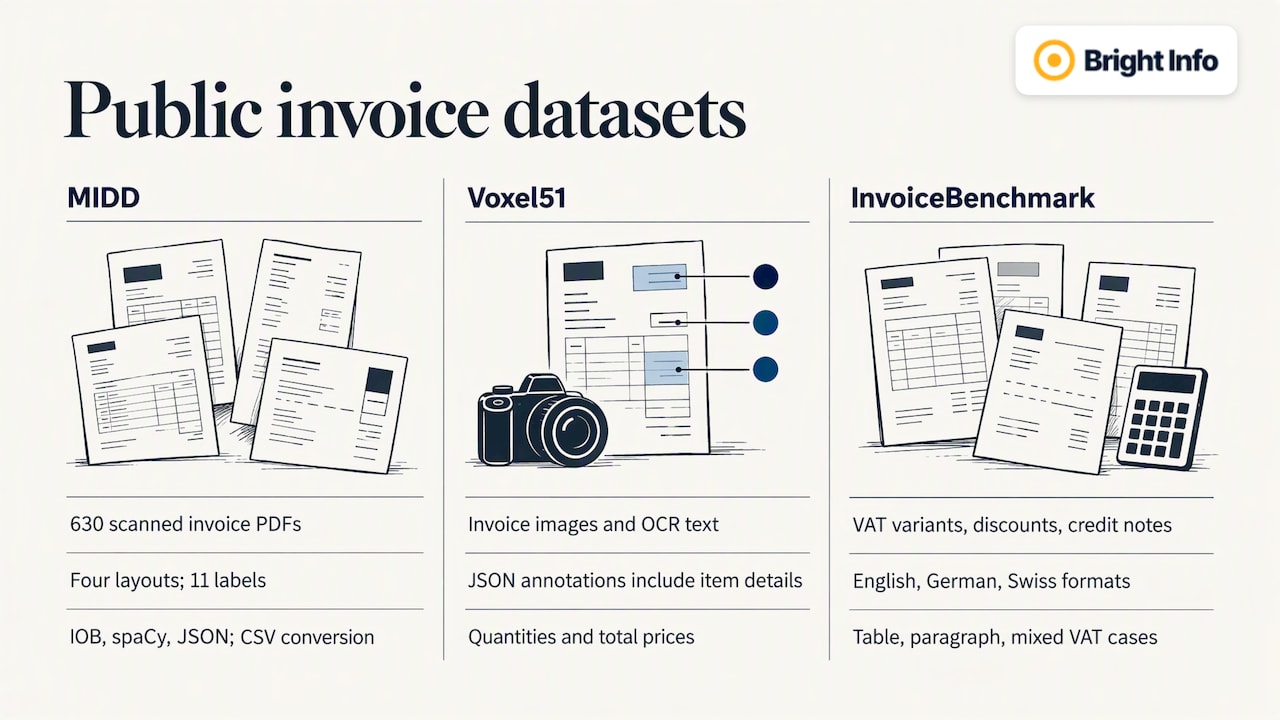
The pattern: the more edge cases are labeled, the more the dataset resembles real accounts payable work rather than a clean demo.
What a typical record contains
| Field group | Examples | Why models need it |
|---|---|---|
| Header | Supplier, buyer, invoice number, issue date, due date | Core extraction targets |
| Line items | Description, quantity, unit price, line total | Hardest part of the layout |
| Tax and totals | VAT or sales tax, discounts, subtotal, grand total | Arithmetic consistency checks |
| Layout | Bounding boxes, tables, logos, stamps | Generalizing across suppliers |
| Metadata | Source, language, currency, date range | Filtering and licensing |
| Corrections | Approvals, disputes, credit notes, re-issues | Teaching models about exceptions |
A company's own archive often has the last row, which public sets rarely do. That is where the commercial interest tends to sit.
How AI teams use invoice datasets
Datasets train and test OCR and document AI models to extract vendor names, invoice numbers, dates, line items, taxes, and totals across different layouts, according to the explainer cited above.
Evaluation is its own discipline. An academic survey on invoice information extraction describes scoring at the field and document levels, using exact and relaxed matching, tolerance windows for numeric fields, and F1 scores. In practice that means a model is not judged on "did it read the page" but on whether it got the total right to the cent and the invoice number character for character.
This is why labeling quality and consistency count as much as volume. A thousand carefully reconciled invoices can be worth more to a team building an accounts payable agent than ten thousand with mismatched totals.
Real versus synthetic invoice data
Both have a place. TechTarget's overview says synthetic data can support rare-case augmentation, privacy-sensitive applications, controlled system testing, and initial model development, while real data captures real-world complexity and is required for final validation.
For invoices, that translates roughly like this:
- Synthetic invoices suit early prototyping, stress tests for unusual tax formats, and demos where no customer record may be touched.
- Real invoices suit final validation, because production documents carry crumpled scans, odd supplier templates, handwritten notes, and conflicting totals.
One finance software company argues that reliability depends on the long tail of real corrections and ambiguities, not just clean headers and totals. That is a vendor's perspective, but it matches what buyers tell sellers: they pay attention to whether data represents difficult production cases.
What makes an invoice dataset valuable
Singapore's data regulator publishes a guide to valuing data for sharing. It says value depends on usefulness, completeness, consistency, accuracy, timeliness, exclusivity, usage restrictions, and associated risks. It also advises assessing your rights to use or share the data.
Applied to invoices, here is a practical checklist:
- Completeness. Are line items, tax breakdowns, and attachments present, or only headers?
- Consistency. Do vendor names, currencies, and date formats follow stable conventions across years and systems?
- Accuracy. Do subtotals, taxes, and totals reconcile? Are corrections and credit notes linked to the originals?
- Timeliness and depth. Several years of history across many suppliers shows seasonality and supplier changes.
- Layout diversity. Many suppliers and formats help models generalize.
- Exclusivity. Can the buyer be the only licensee, or is the license non-exclusive? This changes the economics.
- Restrictions and risk. Customer contracts, personal data, and confidentiality clauses all reduce what you may license.
Invoices rarely travel alone. Purchase orders, contracts, and payment records add context, and our guides on procurement data and financial datasets for AI show how those adjacent records are assessed.
Privacy, ownership, and legal checks before you share
Invoices contain names, addresses, bank details, tax IDs, and pricing agreed with specific customers or suppliers. Treat each as a separate question.
Do you have the right? The valuation guide above says organizations should assess their rights to use or share data. Also check your customer and supplier contracts for confidentiality clauses, since an invoice is a record of a deal with someone else.
Is the compilation protected? The same Singapore guide notes that raw data itself cannot be copyrighted, but a compilation with sufficient creativity in selection, arrangement, or annotation may be. That is a Singapore perspective, so ask counsel how it applies in your jurisdiction.
Who owns mixed data? The University-Industry Demonstration Partnership notes that ownership can be hard to establish in databases combining data from different sources, so providers may take a stewardship role.
What does the contract limit? The ICC's guide for small business says data-sharing contracts can limit recipients to in situ access or specify permitted purposes and how long data may be retained or used. Those are the terms to negotiate hardest.
Security versus privacy. The same ICC guide separates the two: security protects against unauthorized access, while privacy law applies to personal data. You need both.
In practice, de-identify before anything moves, and keep a record of what was removed. Talk to your attorney about personal data in invoices, especially if you have customers or staff outside the US. For how we handle this, see our security and data handling page.
A note on recruiting data
People searching for invoice datasets sometimes also look for recruiting data. The two are not the same kind of asset. Invoices are mostly commercial records. Recruiting records such as resumes, interview notes, and application histories are about individuals, and they raise sharper privacy and fairness questions. If you hold both, assess them separately, and have counsel review recruiting data before it is included in any license. We do not make claims here about specific legal thresholds for it.
Preparing your invoice data for buyers
You do not need to clean everything first. You do need to know what you have.
- Inventory the sources. Accounting system, AP automation tool, email attachments, shared drives.
- Estimate coverage. Years of history, number of suppliers or customers, share with line items, share with approvals attached.
- Check rights. Which contracts restrict sharing? Which records include personal data?
- Decide on exclusivity. Would you license once to one buyer, or to several on narrower terms?
- Plan de-identification. Choose an approach that an independent, owner-approved party carries out only after a deal is signed.
- Get a market read. A single offer tells you what one buyer will pay. Several sealed bids tell you what the data is worth.
Our overview of AI data licensing explains how these deals are structured, and our comparison of data monetization companies describes the types of intermediaries you can choose from.
Our perspective
Most companies we talk to have never thought of their invoices as a licensable asset. They think of them as paperwork. But years of invoices across many suppliers, with approvals, corrections, and credit notes attached, are exactly the long-tail production data that AI teams building finance agents want.
The mistake we see is accepting the first offer. One buyer sets one price, and you have no way to know whether it is fair. We built Bright Info as a sell-side broker: we represent the data owner, invite every qualified buyer to bid in sealed bids, and keep commission bias out of the picture because the winning buyer pays us, only if a deal closes.
We also think privacy is not a feature to bolt on. Our approach is that no company data moves until a deal is signed, and de-identification is done by an independent partner the owner approves. License terms, including purpose, duration, and exclusivity, should be as visible to you as the price.
If your invoice archive is clean, deep, and legally yours to license, it is worth finding out what it is worth before someone tells you.
Erik
Find out what your invoice data is worth
Bright Info is a sell-side broker for company data licensing. You complete a short intake, and we invite multiple AI data buyers to compete in sealed bids for your de-identified data. There are no fees for sellers, and we are paid only if a deal closes, by the winning buyer. Companies we work with typically have 20 to 500 staff and more than three years of history. Our valuation guidance puts typical company datasets in the range of $100K to $4M, though your result depends on your data.
Start with the free valuation, and read how we describe our sources and methodology first if you want to see the approach.
FAQ
Where can I find a free invoice dataset?
Research datasets such as MIDD, the Voxel51 collection on Hugging Face, and InvoiceBenchmark are published openly, and each has its own license and documentation. Read the license before using one commercially. Small public sets are fine for prototypes but rarely reflect the messiness of production invoices.
Can I use synthetic invoices instead of real ones?
Yes, for early development, rare-case testing, and privacy-sensitive work. Real data remains the standard for final validation, according to TechTarget. Many teams use synthetic data to extend coverage and real data to prove it works.
Is it legal to sell or license my company's invoices?
It depends on your contracts, the personal data in the records, and the law where you and your customers operate. You need the right to share the data, and the terms should state permitted purposes and retention. Have an attorney review the specifics before you sign anything.
What makes one invoice dataset worth more than another?
Completeness, consistency, accuracy, timeliness, exclusivity, usage restrictions, and risk, per the Singapore valuation guide. Records that reflect real corrections and edge cases tend to interest buyers more than clean, uniform ones.
Sources
- Understanding Invoice Dataset for AI and OCR Model
- Multi-Layout Invoice Document Dataset (MIDD)
- Voxel51 high-quality invoice images for OCR
- InvoiceBenchmark dataset card
- Invoice Information Extraction: Methods and Performance
- The data moat that makes finance AI trustworthy
- Synthetic data vs. real data for predictive analytics
- Guide to Valuation for Data Sharing
- Contract Accord 14: Data
- ICC Data Management Guide for Small Business
Recommended
- Financial Dataset AI: Types, Quality Checks and Value
- Procurement Data: What It Includes and How to Use It
- AI Data Licensing: How Companies License Data for AI Training
- Data Monetization Companies: 32 Compared (2026)
More from the blog
- Data for AI Agents: What Agents Use and What Yours Is Worth
- Supply Chain Datasets: Where to Find Them and What to Check
- Secure Data Sharing: How to Share Business Data Safely
- All posts
Find out what your company's data is worth
Bright Info runs a sealed bid among AI data buyers for your record. You pay nothing unless a deal closes.
Get your data valued