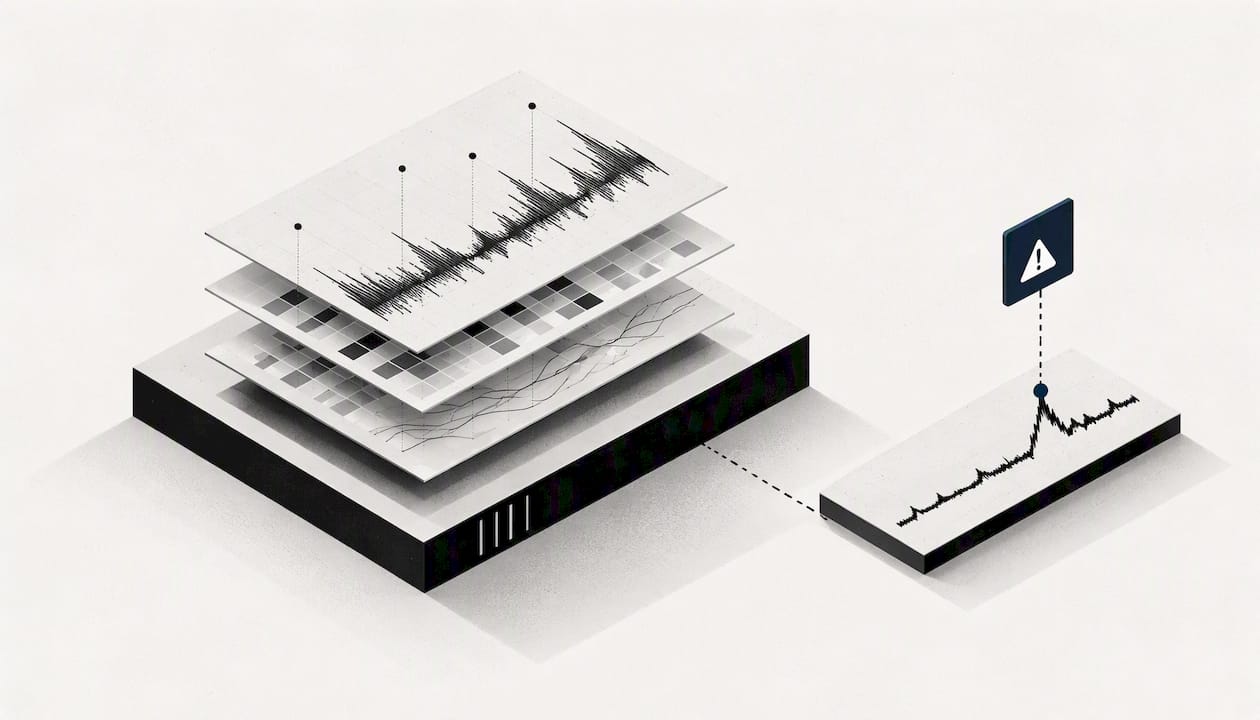
The best-known predictive maintenance datasets are NASA's C-MAPSS and N-CMAPSS turbofan sets, the AI4I 2020 synthetic set, the MetroPT metro compressor data, the SCANIA Component X truck data and the EDP wind turbine SCADA data. They are free or low-cost, they carry failure labels, and they differ a lot in realism, size and license. This guide compares them, shows how to check whether one fits your project, and covers what to do when public data is not enough.
TL;DR
- Start with the equipment type. Turbofans, relays, wind turbines, metro compressors and trucks each have a well-documented public dataset.
- Real data with enough failure events beats simulated data for validation. Simulated sets are still the fastest way to prototype.
- Check the license before you build on a dataset. CC0 and CC-BY allow commercial use, while some platforms charge a retrieval fee.
- Risk modeling data is a different category: it estimates business interruption and exposure, not component wear.
- If your company holds years of its own operational and business records, that data may be worth licensing to AI buyers.
Table of Contents
- What predictive maintenance datasets contain
- Notable public datasets compared
- Examples beyond aerospace
- Access, licenses and fees
- How to judge whether a dataset is reliable
- Risk modeling datasets: a different job
- Why real operational data stays scarce
- Perspective: your data may be the scarce dataset
- Find out what your data could be worth
- FAQ
- Sources
What predictive maintenance datasets contain
A predictive maintenance dataset records how equipment behaves over time and, ideally, when it failed. Most contain multivariate sensor time series (temperature, pressure, vibration, current), operating conditions, and labels such as fault codes, repair records or remaining useful life (RUL).
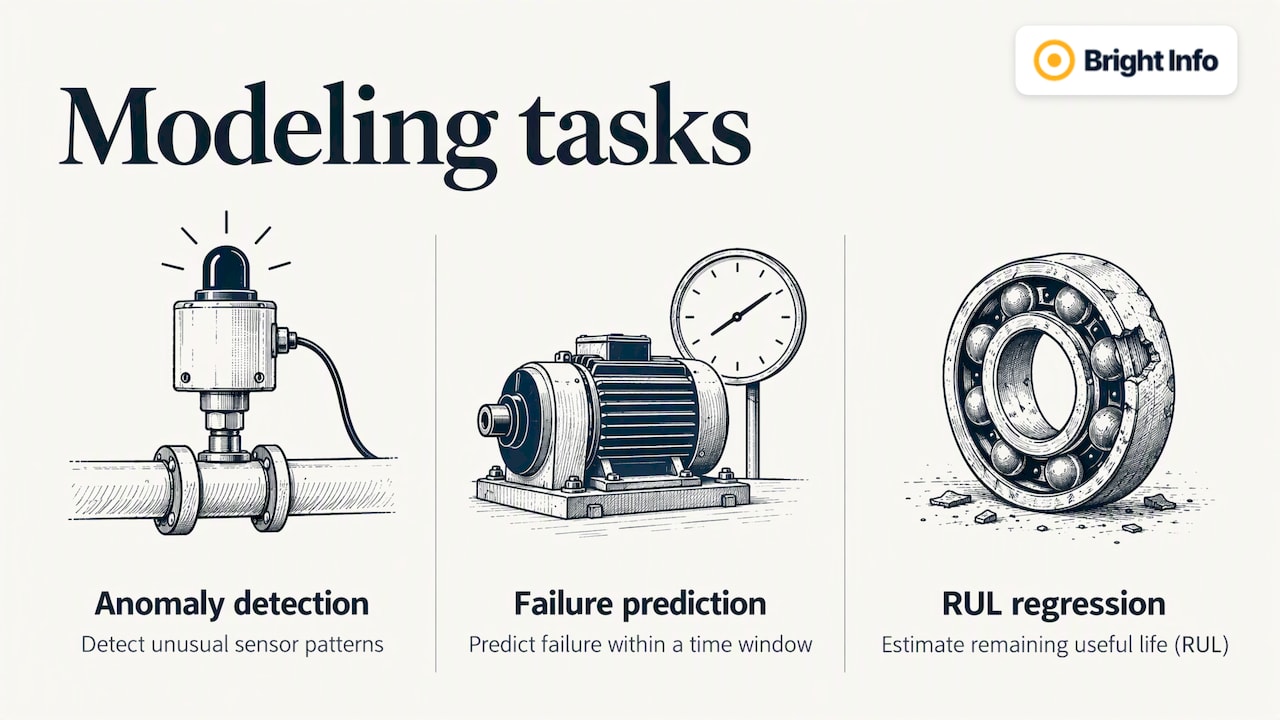
Those labels are what make the data useful for modeling. They support three common tasks: anomaly detection, failure prediction within a time window, and RUL regression. A 2025 overview of degradation datasets explains that degradation data is central to prognostics and health management because it shows failure modes and performance trends, which in turn guide maintenance schedules and operating decisions.
The business case is the reason people look for this data at all. A 2023 review of public datasets notes that effective implementation can cut maintenance costs by 12% and raise equipment availability by 9%. Treat those as study-level figures, not a promise for your plant.
Notable public datasets compared
The table below covers the sets that come up most often. Sizes and licenses come from each dataset's own page or paper.
| Dataset | Equipment | What it offers | Access |
|---|---|---|---|
| C-MAPSS | Simulated turbofan engines | Four sub-datasets (FD001 to FD004) with different operating conditions and fault modes | NASA Prognostics Center of Excellence repository |
| N-CMAPSS | Simulated turbofan fleet under real flight conditions | Eight data sets from 128 units and seven failure modes | CC0 1.0 license |
| AI4I 2020 | Synthetic manufacturing process | 10,000 data points and 14 features | UCI repository |
| Phoenix Contact relays | Electromechanical relays | Life data for 546 relays and more than 106 million switching cycles | IEEE DataPort |
| EDP-WT | Wind turbines | Two years of SCADA data from five turbines, with fault detections and event logs | Free registration on the EDP Open Data Platform |
| MetroPT | Urban metro compressor | Pressure, temperature, current and GPS data from a metro service in Porto, published in 2022 | Scientific Data article |
| SCANIA Component X | Anonymized truck engine component | Operational data and repair records across a fleet, released in 2025 | Scientific Data article |
| Home appliances | Refrigerators and washing machines | Current and vibration readings collected at a repair center, 2023 | CC-BY 4.0 record |
Which one to pick first
If you are learning RUL modeling, C-MAPSS is the classic benchmark, which is why most tutorials use it. It was introduced for the PHM 2008 Data Challenge and is simulated, so results do not automatically transfer to a real fleet. N-CMAPSS is a more demanding successor because it is built on real flight conditions.
If you need real-world behavior, MetroPT, EDP-WT and SCANIA Component X are the stronger choices. The SCANIA authors make the point directly: the scarcity of comprehensive, real-world multivariate time series is a primary hurdle for reliable failure prediction. That scarcity is why a single real fleet dataset gets cited so often.
For a quick proof of concept on tabular data, AI4I 2020 is small and clean. Do not expect it to prove anything about field performance, since it is synthetic.
Examples beyond aerospace
Aircraft engines dominate search results, but maintenance decisions look different in other settings. Relays fail through switching cycles. Wind turbines produce slow SCADA signals with sparse faults. Metro compressors produce high-frequency analog and digital sensor streams. Home appliances show how cheap sensors such as current and vibration can flag trouble in consumer equipment.
Once you have picked a dataset, the next step is usually operational: getting streams into a pipeline you can monitor. Teams building that layer often look at predictive data monitoring tools to see how analytics sit on top of live equipment data.
Access, licenses and fees
Most of these datasets are free, but "free to download" and "free to use commercially" are different questions.
- CC0 and CC-BY. N-CMAPSS is released under CC0 1.0, which allows public and commercial use. The review of energy-sector datasets found that most are published under licenses like CC-BY, which permit distribution, adaptation and commercial use as long as you credit the creator.
- Registration walls. EDP-WT is available to registered users through the EDP Open Data Platform, so you can use it, but you must sign up first.
- Retrieval fees. ORE Catapult's POD service offers requested access to Levenmouth 7MW turbine datasets, including SCADA and alarm logs, with a small fee based on request size or complexity.
- Aggregator libraries. The PHMD tool gives access to 59 prognosis and health management datasets and simplifies searching, loading and preprocessing.
Record the license, version and download date of every dataset you use. If a model built on it ever ships in a product, that record answers the first question a lawyer will ask.
How to judge whether a dataset is reliable
Public datasets vary in quality. The PHMD authors point out that they come in diverse formats such as CSV, HDF5, TXT and MAT, and may lack information about how the data is organized. Poor documentation also makes studies hard to reproduce, and researchers often validate on only one or two datasets.
Use a checklist before committing:
- Real or synthetic? Synthetic data is fine for prototyping, weaker for claims about field accuracy.
- How many failures? A million sensor rows with three failure events will not train a dependable classifier.
- Are labels defined? You need to know whether a label means a failure, a repair, or a scheduled replacement.
- Is the documentation complete? Column meanings, units, sampling rates and sensor placement should be written down.
- Is the license clear? See the section above.
- Does it resemble your assets? Operating conditions, duty cycles and sensor setups should be close to yours.
The Jovicic et al. review gives a concrete benchmark. Its top grade, Class I, requires real data, at least 1,000 instances, more than one variable, more than five faults, easy access, and complete documentation and licensing. EDP-WT and 3W meet that bar, and the authors single out 3W (oil and gas), EDP-WT and OREC (wind) as especially valuable.
Validate on at least two datasets with different characteristics, and hold out whole assets, not random rows, so the model is never tested on a machine it has already seen.
Risk modeling datasets: a different job
Some readers searching for predictive maintenance data actually want data for risk modeling. The goal there is to estimate how an asset failure or outside disruption turns into lost revenue, not to predict when a bearing will fail.
The inputs are broader. Natural catastrophe modeling for the United States, for example, estimates flood, wind and earthquake exposure and business interruption at the facility level. The same material argues that risk modeling should go beyond direct damage to dependencies such as logistics, power supply and regional infrastructure.
For a practical risk model, combine three layers:
- Asset condition data, such as the sensor sets above, which give failure likelihood.
- Operational and financial data, such as downtime cost per hour, production schedules and repair costs.
- External exposure data, such as weather hazard, supplier concentration and logistics constraints.
The second layer is where public data runs out, because downtime costs and supplier terms are specific to your company. Our guides on supply chain datasets and procurement data show what that kind of internal data looks like and what to check in it.
Why real operational data stays scarce
The PHMD authors name a primary limitation of the field: many operational datasets, particularly from manufacturing, remain private because of sensitivity about failure frequencies and sensor configurations. A company that publishes how often its machines fail is telling competitors something.
That is the reason clean, labeled, real-world data is hard to find, and the reason companies that hold it are in an interesting position. If you want to share operational data with anyone, whether researchers, a vendor or a buyer, run these checks first:
- Provenance. Do you own the data, or does a customer, equipment maker or contractor hold rights in it?
- Contract terms. Do your service agreements restrict secondary use of machine data?
- Identifiers. Strip or replace names, serial numbers, locations and anything that reveals a customer or site.
- Sensitivity. Failure rates and sensor configurations can be commercially sensitive on their own.
- Transfer. Decide how data moves and who sees it before anything leaves your systems. Our overview of secure data sharing covers the practical steps.
Your legal counsel should sign off on rights and privacy questions that depend on your contracts and jurisdiction.
Perspective: your data may be the scarce dataset
Researchers keep saying the same thing: real, labeled, well-documented operational data is hard to get. We see the other side of that. Companies with three or more years of maintenance tickets, support records, email, CRM history and equipment logs are sitting on exactly the kind of material AI builders struggle to find.
The mistake we see is taking one offer and calling it a market price. When a single buyer sets the terms, the owner has no way to know what the data is worth. We built Bright Info as a sell-side broker so that several qualified buyers bid against each other in sealed bids, and the owner chooses.
Our approach is built around control. We do not move company data until a deal is signed. De-identification goes through an independent, owner-approved partner. The license terms are yours to review and negotiate. We do not represent buyers, and we have no commission reason to favor one over another. The company never pays us, and we are only paid if a deal closes.
In our experience, owners are usually surprised by how many kinds of records carry value, not only sensor streams.
Erik
Find out what your data could be worth
If your company has years of operational and business records, you do not have to guess whether they are licensable. We offer a free valuation and act as your broker, inviting AI data buyers to bid on de-identified data. Our own figures put typical company data in a range of $100K to $4M, and the intake takes about two minutes. There are no upfront fees.
Request your free valuation. To see how our process handles privacy, read our security and data handling page. For background on how these deals work, our guide to AI data licensing is a good start.
FAQ
What is the best dataset for learning predictive maintenance?
C-MAPSS is the standard starting point because it has labeled run-to-failure trajectories and a large body of tutorials to compare against. AI4I 2020 is a lighter option if you want a small tabular problem. Move to a real dataset such as MetroPT or SCANIA Component X once you want to test your methods against field behavior.
Can I use these datasets commercially?
It depends on the license. N-CMAPSS is under CC0 1.0, and CC-BY datasets allow commercial use with credit. Others require registration or charge a retrieval fee, so read the terms on each dataset's page before you build a product on it.
How many failure events do I need?
There is no universal number, but more is better, and failures matter more than total rows. The Jovicic review's top grade asks for more than five fault types and at least 1,000 instances. Treat that as a minimum for a credible benchmark, not a guarantee of model quality.
Where do I find risk modeling datasets?
Risk models usually combine asset condition data with your own downtime costs and external hazard data such as flood, wind and earthquake exposure. Public sets cover the first and third layers partly. The financial and operational layer almost always has to come from your own records.
Can a company sell its own maintenance and operational data?
Some can, if they own the rights, the data is de-identified and the contracts allow it. A broker can invite several buyers to bid so you can compare offers. Have counsel review rights and privacy before any data moves.
Sources
- Publicly Available Datasets for Predictive Maintenance (Jovicic et al., IEEE Access, 2023)
- Overview of publicly available degradation data sets (arXiv)
- NASA Prognostics Center of Excellence Data Set Repository
- Aircraft Engine Run-to-Failure Dataset under Real Flight Conditions (N-CMAPSS)
- AI4I 2020 Predictive Maintenance Dataset, UCI
- Phoenix Contact Relay Data Set, IEEE DataPort
- The MetroPT dataset for predictive maintenance
- SCANIA Component X dataset
- POD Platform for Operational Data Services, ORE Catapult
- PHMD: An easy data access tool for prognosis and health management datasets
- Natural Catastrophe Data, Modeling and Analytics Solutions
- Predictive data monitoring and analytics tools
Recommended
- Data for AI Agents: What Agents Use and What Yours Is Worth
- Data Monetization Companies: 32 Compared (2026)
- AI Data Licensing: How Companies License Data for AI Training
More from the blog
- Data Licensing: What It Is and How Businesses Do It
- Invoice Datasets: What They Contain and What They're Worth
- Data for AI Agents: What Agents Use and What Yours Is Worth
- All posts
Find out what your company's data is worth
Bright Info runs a sealed bid among AI data buyers for your record. You pay nothing unless a deal closes.
Get your data valued