AI training costs run from a few hundred dollars to hundreds of millions, depending on what "training" means. Fine-tuning an existing model costs tens to thousands of dollars. Pretraining a small model from scratch costs tens of thousands to millions. A frontier run costs hundreds of millions. The part most cost charts leave out is the training data, which can cost far more than the compute. If your company holds years of email, CRM records or support tickets, that data is one of the things AI labs are paying for.
TL;DR
- "Training" covers three very different jobs: fine-tuning (tens to thousands of dollars), small-model pretraining (tens of thousands to millions) and frontier runs (hundreds of millions).
- Hardware is the biggest line in frontier budgets, followed by research staff. Energy is a small share, roughly 2 to 6 percent in Epoch AI's estimates.
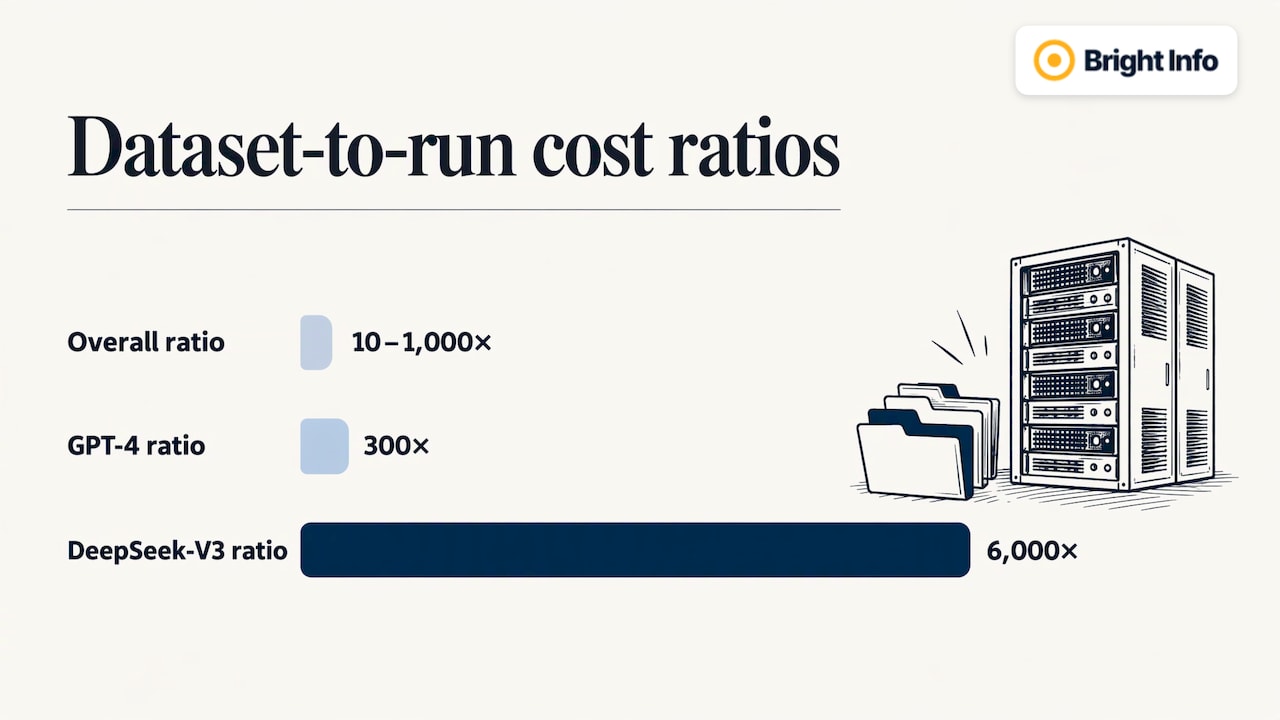
- A 2025 University of Toronto position paper estimates that training datasets cost 10 to 1,000 times more than the training runs themselves.
- Published figures are estimates with wide error bars, and disclosed data deals are not price quotes for your data.
- If you own proprietary business data, you can find out what AI buyers would bid before you sign anything.
Table of Contents
- What "training an AI model" actually costs
- How frontier training costs have climbed
- Where the money goes
- The part charts leave out: data costs
- What buyers pay for data
- Working out what your own data might be worth
- Why published numbers are shaky
- Promo: find out what your data is worth
- Perspective
- FAQ
- Sources
What "training an AI model" actually costs
The headline numbers you see online mix up three different activities. Keep them apart and the range stops looking absurd.
| Type of work | Typical cost range | What you are paying for |
|---|---|---|
| Fine-tuning an existing model | Tens to thousands of dollars | A few GPU hours plus curated examples |
| Pretraining a small model from scratch | Tens of thousands to millions | Weeks of cluster time, data pipelines, engineers |
| Frontier model run | Hundreds of millions | Tens of thousands of accelerators, networking, staff |
Those ranges follow CloudZero's 2026 cost guide, which also notes that Epoch AI projects the largest runs will pass $1 billion by 2027.
For a sense of the math at small scale, Nodus Compute estimates that at $2.60 per hour for an NVIDIA H100, a compute-optimal 1B-parameter model costs about $292 in compute and a 7B model about $14,300. Safeguard's worked estimates put a 100B model at roughly $2M to $9M and a dense 1-trillion-parameter model in the hundreds of millions.
These are compute-only numbers. They assume the training data already exists, which is the assumption that breaks down in practice.
How frontier training costs have climbed
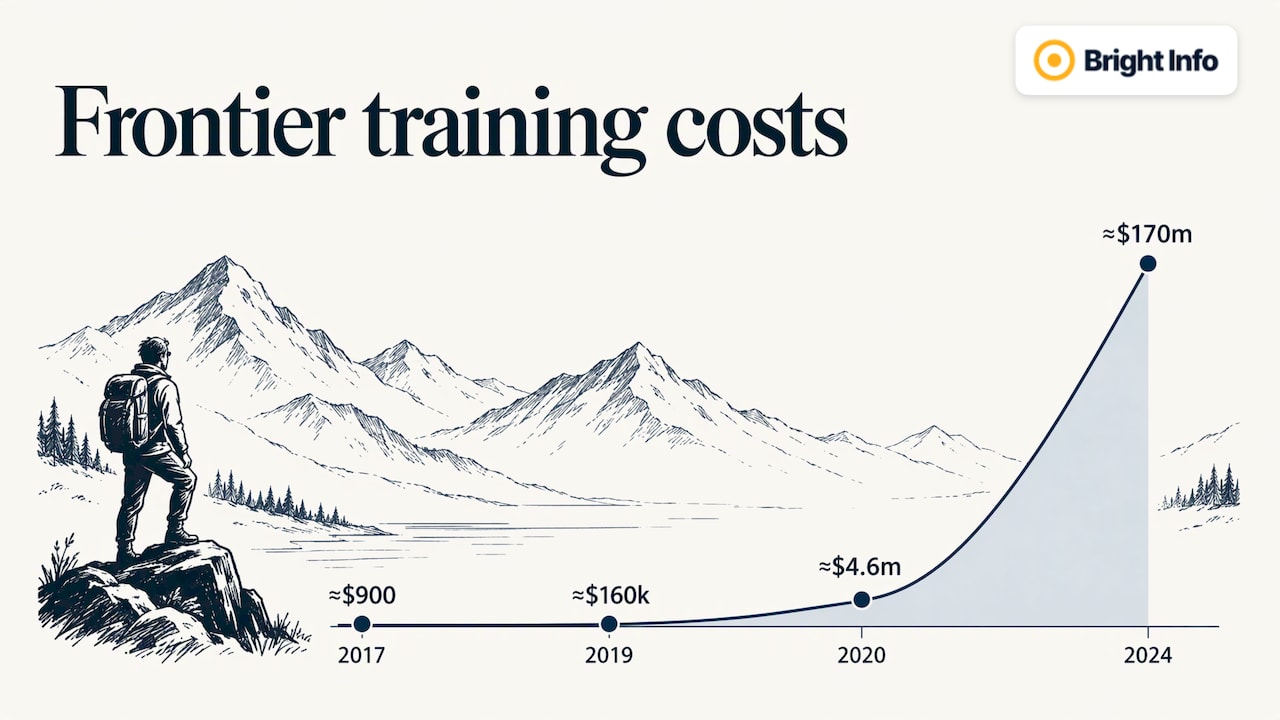
The cost curve is steep. The Stanford AI Index 2024, as reported by Virtualization Review, estimated about $900 for the original 2017 Transformer, $78 million of compute for GPT-4 and $191 million for Gemini Ultra.
CloudZero's table, which cites Stanford and Epoch AI, adds RoBERTa Large (2019) at about $160,000, GPT-3 (2020) at about $4.6 million and Llama 3.1 405B (2024) at about $170 million. It lists DeepSeek V3 at $5.6 million, but that is the final run only, a caveat DeepSeek itself states.
Epoch AI's paper The rising costs of training frontier AI models estimates that the amortized cost of the most compute-intensive runs has grown 2.4 times per year since 2016. A Bruegel working paper frames the same trend as a rise from about $1,000 in 2017 to nearly $200 million in 2024, with billions possible by 2030.
The companies footing these bills are also the ones with the revenue to match. For that side of the picture, see OpenAI revenue and statistics.
Where the money goes
A training bill is not one line item. Epoch AI's analysis of GPT-3, OPT-175B, GPT-4 and Gemini Ultra found the following shares of total amortized development cost:
| Cost component | Share of development cost |
|---|---|
| Computing hardware | 47% to 64% |
| R&D staff (including equity) | 29% to 49% |
| Server components | 15% to 22% |
| Cluster interconnect | 9% to 13% |
| Energy | 2% to 6% |
These come from the Epoch AI paper. The categories overlap, since server components and interconnect sit inside the hardware figure. Excluding equity compensation, staff drops to 19% to 33% and hardware rises to 61% to 76%.
The surprise for many executives is energy. Electricity matters for planning a data center, but in the total budget it is a rounding error next to chips and people.
CloudZero also points to a layer that is not physical at all: data. Scraping, cleaning, deduplicating and increasingly licensing training corpora is a cost center with its own staff.
The part charts leave out: data costs
Most "training cost" charts count compute. A 2025 position paper from the University of Toronto, The Most Expensive Part of an LLM Should Be its Training Data, looked at 64 LLMs released between 2016 and 2024. It estimates that datasets cost 10 to 1,000 times more than the models' training runs. For GPT-4 and DeepSeek-V3 the gaps are 300 times and 6,000 times.
The same paper finds that for 8 of 10 organizations that recently trained LLMs on large datasets, data cost exceeds 10 percent of annual revenue. For 3 of 10, it exceeds total annual revenue.
Human-produced data shows the same pattern at smaller scale. Daniel Kang's analysis describes a text-to-SQL model that cost about $360 in compute but roughly $60,000 in expert annotations. It is one author's estimate, but it points the same way as the academic work.
Why it matters to you: the public web is no longer enough for the buyers building agents and enterprise tools. They want data that shows how real work happens, such as threads, tickets, CRM histories and documents. That is what most companies already have.
What buyers pay for data
Public figures are patchy, but they show the shape of the market. Open Data Labs' research agenda, The Economics of AI Training Data, identifies five pricing mechanisms:
- Per-unit pricing. Examples include books at about $5,000 per title and video footage at $1 to $4 per minute.
- Aggregate licensing. Fixed fees for time-limited access to a curated corpus or feed.
- Service-based pricing. Annotation and labeling platforms.
- Commissioning. Buyers pay for new expert-generated data.
- Open commons. Free resources such as Common Crawl.
The paper says most licenses are non-exclusive, so a data owner can license to several buyers at once, while exclusivity commands a premium.
One rare primary-source datapoint comes from a 2025 SEC filing. It describes a buyer agreeing to pay a company $200 million in license fees over three years for a de-identified multi-modal oncology dataset, including a $50 million upfront payment.
Treat that as evidence that serious money changes hands, not as a price for your data. A specialized clinical dataset and a mid-sized company's sales emails are different assets.
Working out what your own data might be worth
No public formula turns a record count into a price. What moves value is more qualitative. These are the questions a buyer asks:
- Depth of history. Several years of continuous records are more useful than a few months.
- Realism and structure. Actual workflows (support tickets with resolutions, CRM notes tied to outcomes, code with commit history) train agents better than polished documents.
- Uniqueness. Domain-specific material that is hard to scrape beats generic content.
- Clean rights. Can you actually license it? Customer and vendor contracts, platform terms and data you hold as a processor all matter. Legal500's guidance on selling company data for AI training recommends reviewing those agreements first and controlling the choice of de-identification provider and protocol.
- Privacy handling. De-identified data is easier for a buyer to accept and for you to defend. Our security and data handling page explains how we approach it.
- Competition. One offer tells you what one buyer will pay. Several sealed bids tell you the market.
If you want the licensing mechanics first, our guide to how companies license data for AI training walks through terms, exclusivity and structure. Teams building agents may prefer what agents use and what yours is worth, and finance teams can start with financial dataset types, quality checks and value.
Why published numbers are shaky
Every figure above is an estimate. Epoch AI's dollar-cost trends analysis notes that true costs could be several times larger or smaller than published estimates, because training compute is itself inferred from several uncertain variables, including hardware utilization.
Method matters too. Final-run estimates using amortized hardware differ from estimates using cloud rental rates, and the Epoch AI paper reports cloud-based figures averaging about twice as large. Neither includes the experiments, evaluation and fine-tuning that surround a run unless the authors say so.
The practical rule is to compare like with like. A "$5.6 million" model and a "$170 million" model may be using different definitions of cost.
Promo: find out what your data is worth
If you run a company with an established data history, the question is less "what does it cost to train a model" and more "what would a lab pay for what we already have." We built Bright Info to answer it. We act as a sell-side broker for the data owner, inviting qualified AI buyers to bid competitively on de-identified company data. There are no fees for sellers, and we are paid only if a deal closes, by the winning buyer.
The intake takes about two minutes. Request your free valuation and see how competing bids compare with a single offer. If you are still comparing routes to market, see our comparison of data monetization companies.
Perspective
We see the training-cost story from the other side of the table. Everyone talks about GPUs, because chips are easy to count. But the buyers we speak to are short on something compute cannot fix: realistic, well-governed data from real businesses.
That changes who holds the leverage. A company with several years of email, CRM records, tickets and documents owns an asset that labs find hard to replace. The mistake we see is treating that asset as worth whatever the first inbound offer says. One buyer sets one price. Several buyers bidding against each other set a market price.
That is why we work as a sell-side broker rather than representing buyers. Our approach is built on competitive, sealed bids, owner-approved de-identification through an independent partner, and no company data moving until a deal is signed. We want you to keep control of the license terms and of the decision.
Training costs will keep rising, and data will take a bigger share of them. We think data owners should be the ones who benefit.
Erik
FAQ
How much does it cost to train an AI model from scratch?
It depends on size. Compute for a compute-optimal 1B-parameter model is estimated at a few hundred dollars, a 7B model at about $14,300, and a 100B model at roughly $2M to $9M. Frontier runs cost hundreds of millions. These figures usually exclude data and staff.
Is compute or data the bigger cost?
For many models, data. A University of Toronto position paper estimates that training datasets cost 10 to 1,000 times more than the training runs. Within compute, hardware is the largest share of frontier budgets and energy the smallest.
How fast are AI training costs rising?
Epoch AI estimates that the amortized cost of the largest frontier training runs has grown about 2.4 times per year since 2016. That is an estimate with a confidence interval, not a measured constant, and it covers final runs of the most compute-intensive models.
Can a company with no AI business sell its data to AI labs?
Yes, if it has the rights to do so. Buyers look for deep history, realistic workflows and clean licensing, and de-identification is a standard requirement. Review your customer and vendor contracts first, then request a valuation to see what buyers might bid.
Sources
- How much does it cost to train an AI model? (CloudZero)
- How much does it cost to train an LLM from scratch? (Nodus Compute)
- LLM Training Cost by Chip and Model Size (Safeguard)
- AI Report: Closed Models Outperform Open Models (Virtualization Review)
- The rising costs of training frontier AI models (Epoch AI, arXiv)
- The tension between exploding AI investment costs and slow productivity growth (Bruegel)
- Position: The Most Expensive Part of an LLM Should Be its Training Data (arXiv)
- Human Data is (Probably) More Expensive Than Compute (Daniel Kang)
- The Economics of AI Training Data: A Research Agenda (arXiv)
- SEC filing on a de-identified oncology data license
- Selling Company Data For AI Training: What To Know Before You Say Yes (Legal500)
- Trends in the dollar training cost of machine learning systems (Epoch AI)
Recommended
- Data for AI Agents: What Agents Use and What Yours Is Worth
- AI Data Licensing: How Companies License Data for AI Training
- Financial Dataset AI: Types, Quality Checks and Value
- Invoice Datasets: What They Contain and What They're Worth
More from the blog
- Predictive Maintenance Datasets: Where to Find Them and How to Choose
- Data Licensing: What It Is and How Businesses Do It
- Invoice Datasets: What They Contain and What They're Worth
- All posts
Find out what your company's data is worth
Bright Info runs a sealed bid among AI data buyers for your record. You pay nothing unless a deal closes.
Get your data valued