
Point of sale (POS) data is the record your checkout systems create every time a sale happens: what was bought, at what price, when, where and how it was paid for. Retailers use it to run the business. Increasingly, AI teams want it too, as training and forecasting material. If you hold years of it, you have an asset, and this guide covers what it contains, how feeds are structured, how to get it ready, and how licensing works.
TL;DR
- POS data covers transactions, products, inventory, payments, timestamps and locations, and sometimes customer details such as loyalty IDs.
- Feeds usually arrive as CSV, JSON or XML files, often one file per location per day, through an API or SFTP.
- Value depends on history, coverage, cleanliness and how well the records are de-identified, not on volume alone.
- Licensing is about the grant of rights in the contract, so read term, exclusivity and downstream uses before you compare headline prices.
- We broker de-identified company data to several AI buyers at once, at no cost to sellers, and we are paid only if a deal closes.
Table of Contents
- What point of sale data actually is
- What a transaction record contains
- How transaction data feeds are structured and delivered
- What people do with POS data
- Preparing your records so they hold their value
- What determines the value of POS data
- Licensing POS data: what the contract has to say
- Get a valuation of your transaction data
- FAQ
- Sources
What point of sale data actually is
POS data is the information collected during a customer sales transaction, whether that happens in a physical store, online or in a mobile app. Retail Velocity's guide breaks it into transaction data (items, prices, quantities, discounts, payment type, total), product data (names, SKUs, categories), inventory data, customer data, payment data, timestamps and location data down to the individual terminal.
The oldest form is scanner data. The UN Statistics Division notes that scanner data is high in volume and captures individual transactions, with date, quantities, values and detailed product descriptions, ever since barcode scanners arrived in the 1970s. The IMF adds that scanner data sets typically cover every item a retailer sells at all its locations, which is why statistical agencies use them to improve price indexes.
If you searched for retail transaction data, you are asking about the same thing seen from the buyer's side: line-level records of what sold, where and when.
What a transaction record contains
Different systems label things differently, but most records fall into the same groups.
| Data group | Typical contents | Why it matters |
|---|---|---|
| Transaction | Transaction ID, date, time, total, payment type, discounts | Shows demand patterns and basket size |
| Line item | SKU, quantity, price, returns | Shows what sells together and at what margin |
| Product | Name, description, category, attributes | Lets records be grouped and compared |
| Inventory | Stock levels, reorder points, movements | Links sales to supply |
| Customer | Loyalty ID, contact details, purchase history | Most sensitive group, needs de-identification |
| Payment | Card type, last four digits, authorization codes | Sensitive, usually stripped before sharing |
| Location | Store, terminal, address | Supports regional analysis |
Shopify's guide lists eight types, adding staff data, promotion and discount data, and returns and refunds. EHL also stresses temporal data such as peak hours and seasonal trends.
One point trips up many first-time sellers. A plain transaction record carries a product and a price but no buyer attached, which is why brands pair it with panel data. If your system also holds loyalty IDs or emails, that is where the extra analytical value sits, and also where the extra privacy work sits.
How transaction data feeds are structured and delivered
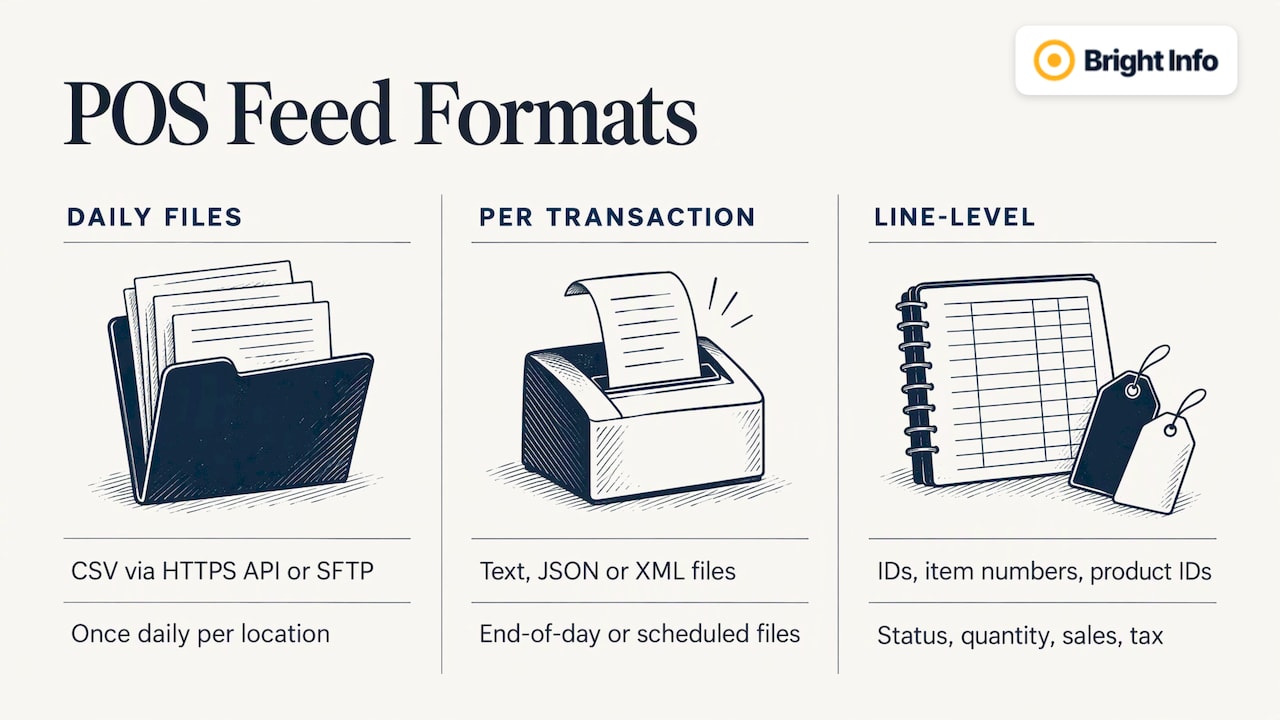
A transaction data feed is simply the way those records leave the POS system. Three patterns are common.
Daily files per location. Fourth's developer documentation says POS data is delivered as a CSV file, normally once a day per customer location, through a RESTful HTTPS API or SFTP, with separate folders per customer.
Per-transaction exports. Treazure's documentation describes a default feed in which every transaction is exported as its own Text, JSON or XML file, or as consolidated end-of-day and scheduled files.
Line-level feed layouts. Redpoint's layout definition shows how granular a feed can be: a transaction detail layout with source transaction ID, line item number, product ID, a status code (sale, returned, canceled or ordered), quantity, net sales amounts, retail price, unit cost, tax amounts and return reason codes.
For a buyer, the useful questions about a feed are practical. Are line items preserved? Are returns flagged? Is the product identifier stable over time? Are timestamps consistent across locations? A feed that answers yes to all four is far easier to use than one that needs rebuilding.
What people do with POS data
Inside a retail business, analysis usually starts simple and builds up. RSG describes a range from weekly sales reports to machine-learning models that forecast demand by item, store and hour, and says most businesses begin with descriptive and diagnostic questions (what happened, and why) before moving to predictive and prescriptive ones.
Typical uses:
- Demand forecasting by item, store and hour
- Inventory planning and reorder timing
- Promotion and discount analysis
- Store and regional performance comparison
- Returns and exception monitoring
AI changes the scale of this. Inference Systems explains that legacy tables such as transactions, line items, customers and inventory movements can feed AI once a governed data pipeline reconciles SKU variations, normalizes customer identifiers and enriches records. That is the same reason outside AI teams look for transaction data for AI work: long, granular histories of real purchasing behavior are hard to generate any other way.
Preparing your records so they hold their value
Before anyone outside your company sees a sample, a few jobs are worth finishing. Our experience with company data is that clean, well-documented records are easier to evaluate, and easier to evaluate means more confident bids.
- Map where the data lives. Many companies have more than one POS, an ecommerce platform and an older system from before a migration. List each, with date ranges.
- Reconcile product identifiers. If the same item has three SKUs across years, note the mapping. A walkthrough on using data for insights covers the same habits of reconciling SKUs, normalizing identifiers and enriching product data.
- Decide what is customer data. Names, emails, phone numbers, loyalty IDs and card details need to be removed or transformed. Free-text fields such as notes often hide personal details.
- Confirm what you are allowed to share. Check payment processor terms, customer-facing privacy policies, franchise agreements and any contract with a data vendor.
- Write down the basics. Date range, number of locations, number of transactions, known gaps and system changes.
Ownership, permissions and privacy
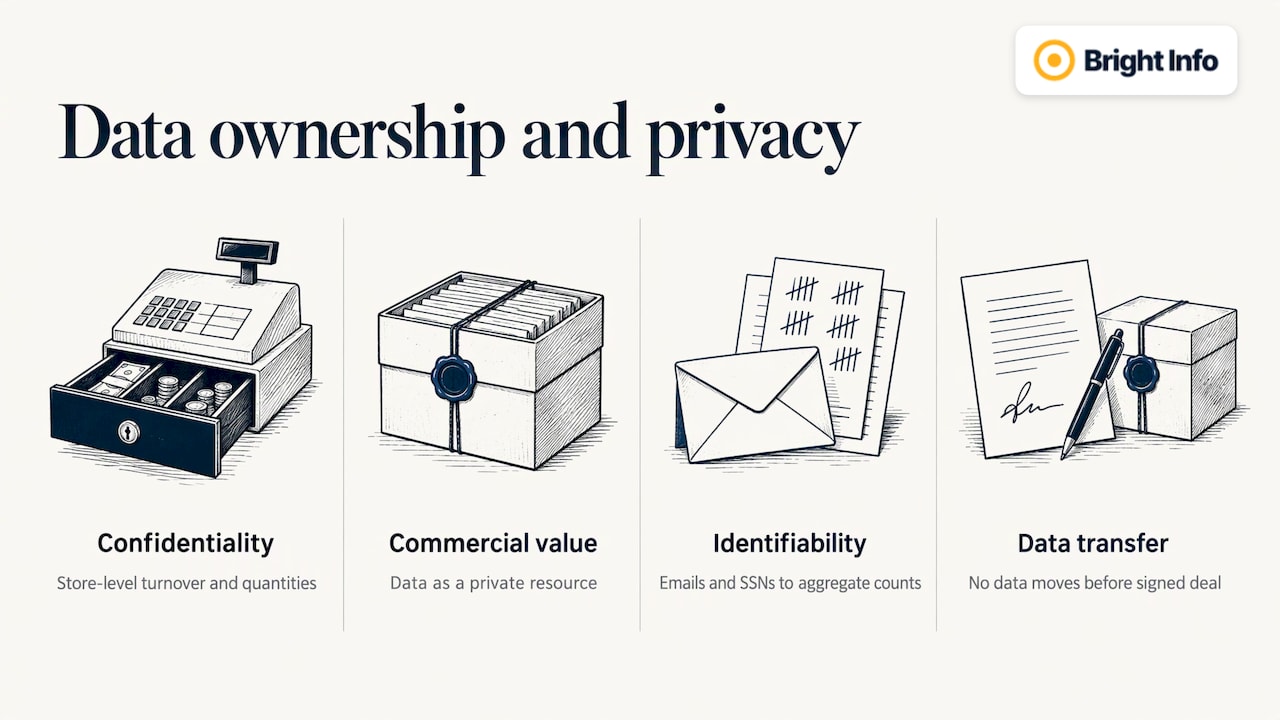
The UN paper on scanner data names the issues that keep businesses cautious: confidentiality of store-level turnover and quantities, the commercial value of data as a private resource, and legal and institutional settings. Those are reasonable concerns, and a sound process answers each of them before any data moves.
De-identification matters in the US because de-identified data often enjoys exemptions under federal and state privacy laws, but only if the de-identification is genuinely effective. The same source describes identifiability as a spectrum, from email addresses and Social Security numbers at one end to aggregate counts at the other. For anything involving customers in specific states or countries, have your counsel confirm the rules that apply to you.
Our approach is built around this. We use an independent, owner-approved de-identification partner, and we do not move any company data until a deal is signed. You can read how handling works on our security and data handling page.
What determines the value of POS data
No public price list exists for POS data, and any figure quoted without context should be treated cautiously. What we can say is what buyers tend to weigh. Across company data, we see values that typically range from $100K to $4M, and where a dataset lands depends on factors like these:
- History. Several years of continuous records show seasonality and trend. We work with companies that have more than three years of history.
- Coverage. More locations, channels and products make a dataset more representative.
- Granularity. Line-level records with timestamps, returns and discounts tell a buyer more than daily totals.
- Cleanliness. Stable identifiers, few gaps and documented system changes reduce the buyer's cleanup cost.
- Privacy posture. Records that are properly de-identified are easier to license and to defend.
- Rights. A clean chain of permission to license the data matters as much as the data itself.
- Context. POS data sitting next to other records, such as CRM history, support tickets or financial exports, can be more useful than any one on its own.
These are our working view of what moves bids, not a formula. The only way to know what your records are worth is to let several qualified buyers respond to them.
Licensing POS data: what the contract has to say
Deloitte's 2026 data monetization paper points out that for most companies the more durable opportunity is productized, repeatable offerings, such as refreshed datasets, rather than large one-off raw-data sales. If your POS system keeps generating data, that argues for thinking about terms that account for refreshes as well as the historical archive.
Whatever shape the deal takes, the contract is what counts. LicenseTheData advises mapping term, exclusivity, downstream uses, repeat-sale accounting, warranties and liability before comparing offers, and notes that calling a deal a "sale" or a "license" does not decide ownership. Ask to see the actual grant of rights and the definitions of the dataset and anything derived from it.
A useful checklist when you read an offer:
- How long does the license run, and does it renew?
- Is it exclusive, and for which uses or industries?
- Can the buyer resell or sublicense, and how are you paid if it does?
- Who carries liability if something in the data turns out to be a problem?
- What happens to derived models and outputs?
To see who is active in this market and what each type of buyer wants, our overview of AI data buyers and our comparison of data monetization companies are good starting points.
Our perspective
Most companies sit on POS data for years and never learn what it is worth, because the usual route is to answer one inbound offer. One buyer sets the price, the terms and the timeline, and you have nothing to compare it with.
We built Bright Info the other way around. We work as a sell-side broker for the data owner: we invite every qualified buyer to bid, we do not represent buyers, and we have no commission bias toward any of them. Buyers pay our commission after they win, so selling companies never pay us and are only in the process if they want to be.
Privacy is the part we are strictest about. De-identification goes through an independent partner you approve, and nothing moves until a deal is signed. Your license terms, not ours, are the point of the exercise.
The best POS datasets we can imagine are long, consistent and well documented. If that describes yours, let buyers compete for it.
Erik
Get a valuation of your transaction data
If you run a business with established systems, 20 to 500 staff and more than three years of history, you can find out what buyers would offer without paying anything up front. Intake takes about two minutes, and you only pay nothing at all: our commission comes from the winning buyer if a deal closes.
Start with the free valuation, and if you want to understand the market first, browse profiles of data marketplaces.
FAQ
What is an example of point of sale data?
A single coffee purchase produces one: a transaction ID, a timestamp, the store and terminal, the item SKU and quantity, the price, any discount, and the payment type. Multiply that by every sale over several years and you have a POS dataset. If a loyalty ID is scanned, the record can also link to a customer history.
What is the difference between POS data and transaction data feeds?
POS data is the underlying records. A transaction data feed is the delivery mechanism: the files, typically CSV, JSON or XML, sent daily or per transaction through an API or SFTP. A buyer cares about both, since a good feed layout keeps line items, returns and identifiers intact.
Can I sell POS data that includes customer information?
Only with care. Names, emails, loyalty IDs and card details should be removed or transformed, and your privacy policies, payment processor terms and applicable state laws need to allow the license. Have your counsel confirm this before any data is shared. Our process de-identifies through an owner-approved partner and moves nothing until signing.
How much is point of sale data worth?
There is no standard price. Value depends on history, coverage, granularity, cleanliness and rights. Company data in our market typically ranges from $100K to $4M, and competitive bidding is how we help you see where yours falls.
Sources
- Mastering POS Data: A Guide for CPG Brands, Retail Velocity
- Scanner Data Sources, UN Statistics Division
- Scanner Data, IMF
- What Is Point of Sale Data & Why It Matters, EHL
- POS Data Analysis, Shopify
- POS data: what it is and how it works, Trueloyal
- POS Gateway Guide, Fourth
- Data Collect, Treazure Docs
- Transaction detail feed layout definition, Redpoint
- POS Data Analysis, RSG
- AI Integration for POS Historical Data Analysis, Inference Systems
- Demystifying Data De-Identification for US Privacy Compliance
- Data monetization strategy, Deloitte
- Selling versus licensing business data, LicenseTheData
- How to use data for insights to drive growth in 2026
Recommended
- Actual Data: what they buy and what they pay
- DataSupply: what they buy and what they pay
- Procurement Data: What It Includes and How to Use It
- Sell My Company Data: what they buy and what they pay
More from the blog
- Enterprise Data Exchange: What It Is and How It Works
- AI Training Costs: What Models Cost and What Data Is Worth
- Predictive Maintenance Datasets: Where to Find Them and How to Choose
- All posts
Find out what your company's data is worth
Bright Info runs a sealed bid among AI data buyers for your record. You pay nothing unless a deal closes.
Get your data valued