
Supply chain datasets come in three practical forms. Open research and government files are free and good for learning and prototyping. Synthetic sets are good for testing models and pipelines. Commercial or private feeds carry live shipment and sensor data and come with license terms. This guide covers where to find each, what they contain, how to vet them, and what to do if you are the one holding valuable supply chain data.
TL;DR
- Start with free sources: the University of Cambridge's Supply Chain Data Hub, the U.S. Commodity Flow Survey, and open synthetic sets for routing, delay prediction and inventory work.
- A dataset is a fixed file. A data feed is a recurring delivery on a schedule, so check cadence, fields and whether each delivery is a full snapshot or an update.
- Before you rely on any set, check origin, license, freshness, completeness and documentation.
- If you own supply chain data, define who benefits, limit what you share and protect it before any buyer sees it.
- Companies with years of operational records can have them licensed to AI buyers through a sell-side broker. Valuation is free.
Table of Contents
- What counts as a supply chain or logistics dataset
- Free supply chain datasets worth opening first
- Quick comparison of the sources above
- Dataset or data feed: which do you need?
- How to vet a dataset before you build on it
- If you hold supply chain data: what to check before sharing it
- Our perspective
- Get a free valuation of your data
- FAQ
- Sources
What counts as a supply chain or logistics dataset
The terms "supply chain dataset" and "logistics dataset" overlap heavily. Supply chain data usually reaches upstream into procurement, suppliers and production. Logistics data focuses on moving and storing goods: shipments, carriers, warehouses, delays.
It helps to know the three layers most logistics data falls into. One practitioner guide splits logistics data into master data (SKUs, locations, carriers), transactional data (event logs such as receipts, picks and shipments) and reference data (calendars, status codes, units). Reference data matters more than it looks, because it standardizes meaning across systems so that two teams do not report incompatible numbers.
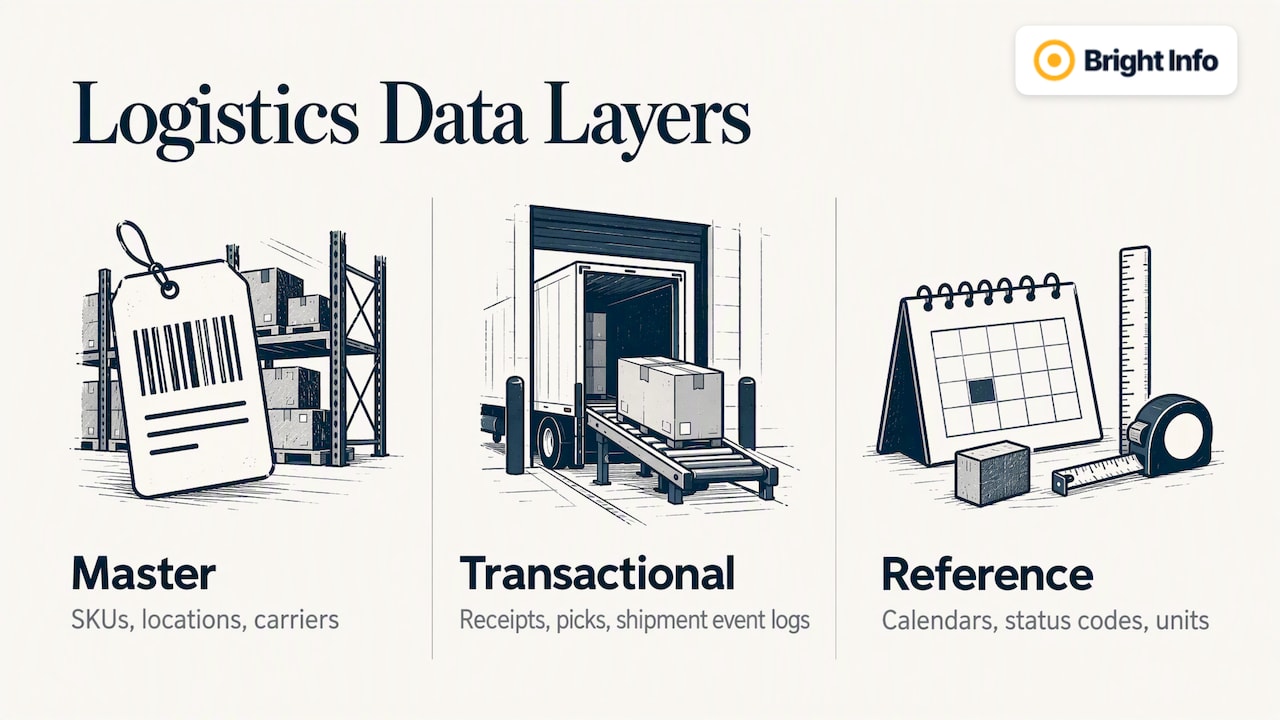
If you are building your own item and location tables, a clear item master and BOM record structure is the foundation the other layers hang on.
Strategic datasets go wider. GEP's practical guide describes procurement data (spend, supplier performance), transportation data (carrier rates, port congestion) and external risk data (geopolitical, weather, ESG scores). The same guide notes that merging internal warehouse data with external demand signals helps tame the bullwhip effect in inventory. For the procurement side in depth, see our guide to what procurement data includes and how to use it.
At the raw level, freight data can be quite plain. Australia's transport research bureau describes it in a freight data exchange pilot as business messages, such as GS1 transport instruction and status messages, that are extracted, stored in a database and aggregated into outputs like freight volumes and handling times.
Free supply chain datasets worth opening first
Real company data is hard to get. That is the recurring complaint in the forum threads that rank for this search: most companies will not release their operations data. So the practical options are public statistics, academic collections and synthetic sets built to behave like the real thing.
Academic hubs and research collections
The Supply Chain Data Hub was created by the Supply Chain AI Lab at the University of Cambridge. It brings together open datasets, curated research and global challenges where supply chain management meets AI. Its datasets page lists a disruption-monitoring dataset dated 15 April 2026, plus AnonNet, SimMD and SynDelay, all dated 4 September 2025. Between them they support disruption analysis, supply-network analysis, vehicle-routing problems and delivery-delay prediction.
For graph-based machine learning, the SupplyChainSimulation repository offers synthetic supply chain network datasets generated with SupplyNetPy and intended for training graph models.
Government statistics
In the United States, the 2017 Commodity Flow Survey Public Use File is the best-known open freight microdata. Its users guide says it holds 20 variables for nearly 6 million domestic shipment records, including commodity type, mode, value, weight and distance. One caution from the same guide: you need the shipment tabulation weighting factors to estimate total in-scope U.S. shipments. Skip the weights and your totals will be wrong.
Synthetic and educational sets
Synthetic data lets you test a pipeline without privacy concerns, though it cannot tell you how your own network behaves.
- Industrial distributor simulation. PrimaForja's dataset on Hugging Face models about 40 million rows across 62 interrelated tables, with a free one-month sample for June 2025. It suits testing joins, warehouse schemas and BI dashboards.
- Inventory and purchasing. The Inventory & Supply Chain Dataset is synthetic educational data covering 2023 to 2025, offered in Parquet, Excel, CSV and SQLite.
Practice sets for prediction
Two sets turn up constantly in search results because they are easy to start with.
The SCMS file sits in a public pharmaceutical delivery project. It frames on-time delivery of finished goods to international locations as a prediction problem, with weather delays, shipping damage, transport mode, inventory and demand as explanatory factors. The repository also lists a notebook and a data dictionary.
The Smart Logistics Supply Chain Dataset on Kaggle is a small file of about 106 kB covering 2024. Fields include timestamp, asset ID, latitude and longitude, inventory level, shipment status, temperature, humidity, traffic status and waiting time, with a logistics-delay target. The pages we reviewed do not state a price. A separate IoT dataset page describes related sensor data (GPS, RFID inventory, fleet telematics) aimed at route optimization, risk and cost analysis.
Quick comparison of the sources above
| Source | Type | Best for | Watch out for |
|---|---|---|---|
| Supply Chain Data Hub | Academic collection | Disruption, routing, delay research | Check each set's own documentation |
| Commodity Flow Survey PUF | Government survey | U.S. domestic freight volume analysis | Needs weighting factors; 2017 reference year |
| SupplyChainSimulation sets | Synthetic networks | Graph machine learning | Simulated, not observed behavior |
| PrimaForja sample | Synthetic distributor | Schema and pipeline testing | One month of simulated data |
| SCMS pharma file | Public project data | Delivery-timeliness classification | Narrow, sector-specific |
| Smart Logistics (Kaggle) | Small tracking file | Delay prediction practice | Small, one year only |
Dataset or data feed: which do you need?
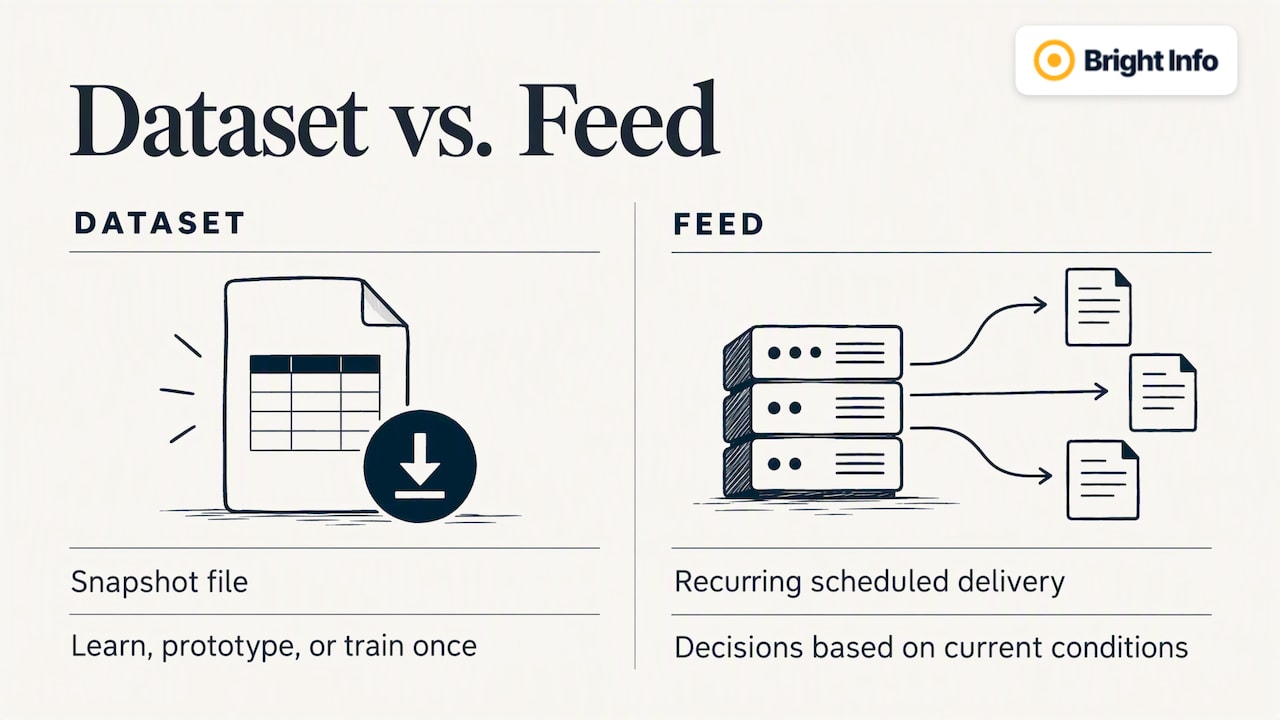
Searchers who type "logistics data feeds" want something different from a downloadable file. A dataset is a snapshot. A feed is ongoing.
Import.io defines a data feed as recurring delivery from a source to a destination on a schedule. Its contract should specify fields, record identity, cadence, destination, change semantics, and whether each delivery is a full snapshot or an incremental update.
Telematics shows how this works in practice. Geotab's developer documentation explains that a data feed synchronizes data from a telematics system to another system through an API, and that a token lets the receiver pick up new or updated records and resume where it left off.
Government is using feeds too. The U.S. Department of Transportation's FLOW program gives participating companies a daily feed of aggregated, anonymized imported-TEU data across asset-owner types.
A simple rule: use a dataset to learn, prototype or train a model once. Use a feed when decisions depend on current conditions, such as congestion, dwell time or carrier performance. Suppliers' performance and risk problems are a typical case where a feed beats a stale file.
How to vet a dataset before you build on it
A file that downloads cleanly can still be useless. The Open Data Institute's open data consumer checklist is a good frame. Work through it in this order:
- Access and format. Can you get it programmatically, and in a format your tools read?
- Origin and license. Who published it, may you use it commercially, and does it contain personal data?
- Currency. When was it last updated, and how often does it refresh?
- Accuracy and gaps. Is each field explained, and how are missing values handled?
- Documentation and compatibility. Is there metadata, and do the keys line up with other sets you plan to join?
The fourth step deserves emphasis in logistics. The same practitioner guide that describes the three data layers points out that master data errors, such as wrong SKU dimensions, recur as sources of operational failure. A dataset with wrong dimensions will produce a confident but wrong model.
For paid or negotiated sources, add delivery method, authentication, schedule, completeness, schema and access terms. One data-source valuation framework lists these as the characteristics to weigh. Get the answers in writing before you integrate.
If you hold supply chain data: what to check before sharing it
The other side of this search is the company that produces the data. Shipment histories, supplier records, procurement spend, support tickets and operations chats are exactly what researchers and AI developers look for and rarely find.
EY's guide to monetizing supply chain data gives a sensible checklist. Define who would benefit and the value proposition. Avoid indiscriminate or excessive sharing. Make sure your infrastructure is secure, scalable and compliant, with security controls for external sharing, and run rigorous quality and validation checks.
The Dutch BDI Network's Logistics Event Ontology shows one design pattern worth copying. It separates an event notification envelope from its payload, and the envelope can point to an owner's endpoint where more sensitive event data is released on a need-to-know basis. The principle applies to any sharing deal: expose the minimum first, release detail only to the party that earns it.
Practical steps before any conversation with a buyer:
- Inventory what you have and how many years it covers. Longer, consistent history is generally more useful to a buyer.
- Identify personal, customer and supplier-confidential fields that must be removed or masked.
- Check your contracts: carriers, suppliers and customers may restrict how related data can be used.
- Decide what stays out entirely.
Our guide to how companies license data for AI training walks through the deal mechanics, and the security and data handling page explains how we approach protection.
Our perspective
Most of the supply chain datasets people find online are small, synthetic or years old, and the reason is simple: the real ones sit inside companies. Email threads with carriers, CRM records, support tickets, call recordings and financial exports describe how supply chains actually behave, and AI builders want them.
What worries us is the single-offer trap. A company gets one inbound request, treats the first number as the market price and signs. Our approach is built around the opposite idea: act as the sell-side broker for the data owner, invite every qualified buyer to bid, and let them compete in sealed bids.
Privacy comes before price. We work with an independent, owner-approved de-identification partner, and no company data moves until a deal is signed. We have no commission bias toward any buyer, because the buyer who wins pays us and the seller pays nothing.
Our own view is that companies with 20 to 500 staff and more than three years of history often hold more valuable data than they realize. A free valuation is the cheapest way to find out.
Erik
Get a free valuation of your data
If your company has years of operational records, we can show you what they may be worth. Bright Info is a sell-side broker for company data licensing: you submit a short intake of about two minutes, qualified AI data buyers bid against each other, and you review de-identified terms with legal review before anything is signed. There are no upfront fees, and sellers never pay us. We are paid only if a deal closes, by the winning buyer.
Request your free valuation and see how we run the process on our sources and methodology page. If you are weighing the wider field of options first, our comparison of data monetization companies sets out how the models differ. Financial exports are often part of the same package, and our guide to financial datasets for AI explains the quality checks buyers apply.
FAQ
Where can I find realistic supply chain data for free?
Start with the Cambridge Supply Chain Data Hub for academic sets, the Commodity Flow Survey for U.S. freight, and synthetic sets such as the PrimaForja sample. Real company data is rarely public, so realistic simulations are the usual substitute for testing.
What is the difference between a logistics dataset and a data feed?
A dataset is a fixed file you download and analyze. A feed delivers data repeatedly on a schedule, either as full snapshots or incremental updates. Choose a feed when you need current conditions.
How do I know whether a dataset is good enough?
Check who published it, its license, when it was last updated, how missing values are handled and whether fields are documented. For logistics, verify master data such as SKU dimensions, since errors there spread into every result.
Can my company sell its own supply chain data?
Often yes, but plan first: decide who benefits, share only what is needed, remove personal and confidential fields, and review contract limits with carriers and suppliers. A broker can run a competitive process on your behalf.
Sources
- Logistics Data Basics: Master Data, Transactions, and Data Quality
- Supply Chain Data Sets: A Practical Guide for Logistics Leaders
- Freight Data Exchange Data Aggregation Pilot Project Report
- Supply Chain Data Hub
- Supply Chain Data Hub datasets
- SupplyChainSimulation training datasets
- 2017 Commodity Flow Survey PUF users guide
- PrimaForja supply-one-month-sample
- Inventory & Supply Chain Dataset for Analysis
- Supply_Chain_Management repository
- Smart Logistics Supply Chain Dataset on Kaggle
- Smart Logistics IoT Supply Chain Dataset
- Data feed definition, Import.io
- Geotab Data Feed documentation
- Freight Logistics Optimization Works, U.S. DOT
- The Open Data Consumer Checklist, ODI
- The QVR Framework for Data Source Valuation
- How monetizing supply chain data can drive new revenue streams, EY
- Logistics Event Ontology, BDI Network
Recommended
- Procurement Data: What It Includes and How to Use It
- Financial Dataset AI: Types, Quality Checks and Value
- AI Data Licensing: How Companies License Data for AI Training
More from the blog
- Secure Data Sharing: How to Share Business Data Safely
- Procurement Data: What It Includes and How to Use It
- Financial Dataset AI: Types, Quality Checks and Value
- All posts
Find out what your company's data is worth
Bright Info runs a sealed bid among AI data buyers for your record. You pay nothing unless a deal closes.
Get your data valued