
Product catalog data is the structured record of everything you sell: identifiers, titles, descriptions, attributes, prices, images and availability, kept in one authoritative place. If yours is clean, complete and several years deep, it is an asset that AI developers may want to license, and the way to learn its value is to have more than one buyer bid on it. At Bright Info we run that process for data owners: a free valuation, sealed bids from multiple AI data buyers, and no cost to you unless a deal closes.
TL;DR
- Product catalog data is the structured collection of your products and their attributes. It is not the same thing as a data catalog (an inventory of your databases) or a printed or flipbook catalog.
- Quality decides value: consistent, complete, accurate, standards-based and timely records are what AI use depends on.
- A single buyer’s offer tells you what that buyer will pay, not what the data is worth. Competing bids do.
- Companies we work with typically see data valued between $100K and $4M, with no upfront fees and a two-minute intake.
- Nothing moves until a deal is signed, and the data is de-identified by an independent, owner-approved partner.
Table of Contents
- What product catalog data actually is
- What a strong product dataset contains
- Why quality is the whole game
- How the catalog is organized and shared today
- What is it worth, and who decides?
- Catalog data rarely travels alone
- Preparing for a licensing process
- Perspective
- Find out what your data could earn
- FAQ
- Sources
What product catalog data actually is
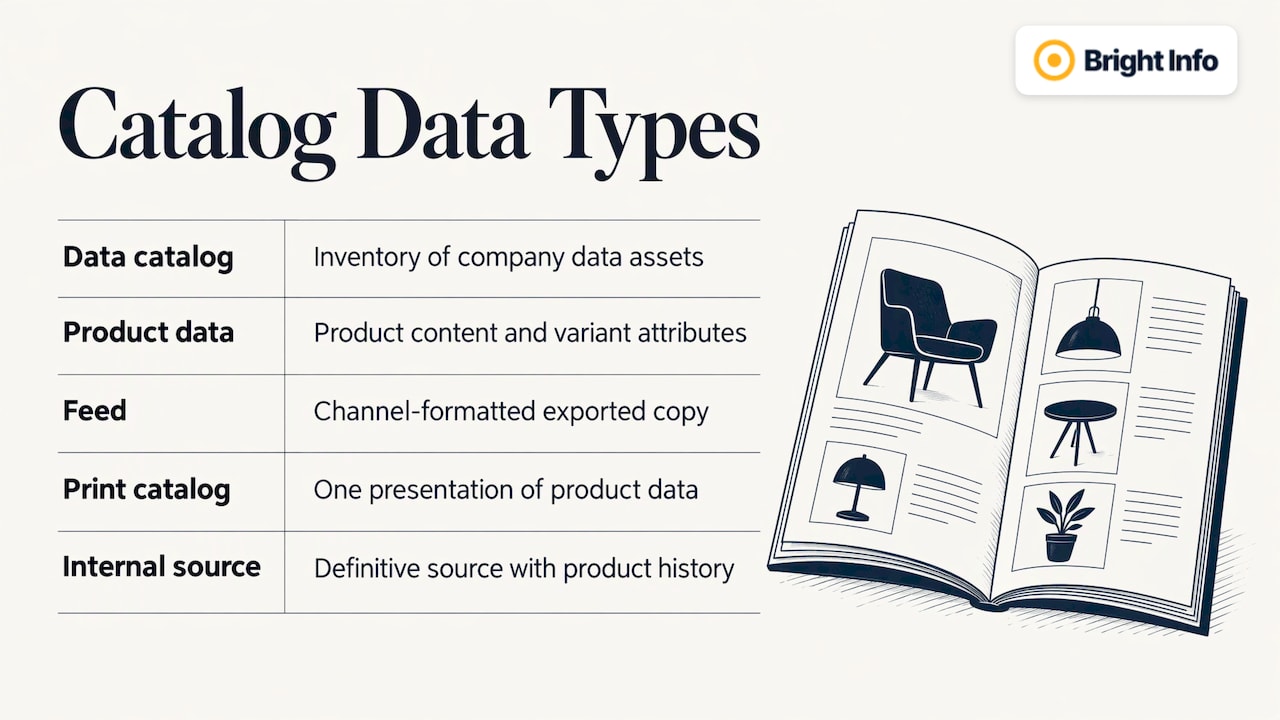
The search results for this phrase are crowded with a different thing: the data catalog. A data catalog is a searchable inventory of the data assets a company holds, built on metadata. AWS describes it as organizing and classifying collected data to support governance and discovery. It describes your data. It is not your products.
Product catalog data is the content itself. Shopify’s catalog management guide explains that attributes and standardized categories are how products get found on storefronts, marketplaces and search engines, and that each variant carries its own SKU, price and inventory. A printed or flipbook-style catalog is just one presentation of that data. Productsup draws a further line: the catalog is the definitive internal source, while a feed is an exported, channel-formatted copy sent to marketplaces or ad platforms.
For an owner thinking about monetization, that distinction matters. The asset is the internal source of truth, with its history, not the copy that goes to a marketplace.
What a strong product dataset contains
There is no single standard, but published specifications show the pattern. OpenAI’s product feed schema requires nine basic fields per item plus target countries and store country, accepts optional attributes, links variants through a shared group ID, and takes JSONL or delimited files such as CSV and TSV. It also rejects rows whose availability is missing or unrecognized, which shows how literal machine consumers are about completeness.
MongoDB’s guide to AI-ready catalogs sorts catalog fields into three tiers:
| Tier | What it holds | Examples |
|---|---|---|
| 1. Identity and price | The fields that say what the item is | GTIN, MPN, SKU, title, brand, price, currency, availability, taxonomy, image and product URLs |
| 2. Structured attributes | The detail that lets items be compared | Material, dimensions, weight, color, size, compatibility, certifications, ingredients |
| 3. Context | Information that helps an AI system reason about use | Use-case tags, question-and-answer pairs, substitutes, review summaries |
If you sell to other businesses, add the fields buyers in your channel expect. Distributor Data Solutions’ export guide documents regional pricing with effective dates, minimum order quantities, tariff codes, spec sheets, safety data sheets, certifications, and related or replacement products.
The pattern is simple. The more of Tier 2 and Tier 3 you hold, with history behind it, the more distinctive your data is.
Why quality is the whole game
Messy catalog data costs money before anyone licenses it. The Akeneo 2025 consumer survey of 1,800 consumers in eight countries found 40% had returned a product in the past year because of incorrect product information, and 53% had abandoned a significant purchase at least once because information was missing or inaccurate. In electrical distribution, the NAED’s product data journey map put the annual cost of poor product data at over $2 billion for that industry alone.
For a standard of what good looks like, use GS1 US’s National Data Quality Playbook, which characterizes reliable product data as consistent, complete, accurate, standards-based and timely, backed by organizational processes and validation.
A quick self-review against those five words is worth an hour:
- Consistent: do the same attributes use the same units and naming across every product line?
- Complete: what share of SKUs have all Tier 1 and Tier 2 fields filled?
- Accurate: does the price in your system match the price on your site?
- Standards-based: are GTINs and category paths used the same way everywhere?
- Timely: can you show how records changed over several years?
The last question is the one owners overlook. A history of changes, with prices, availability and attribute edits, says more about how a business works than a single snapshot. Our typical seller has 20 to 500 staff and more than three years of history, and that depth is part of what makes a data set worth bidding on.
How the catalog is organized and shared today
Most established companies already run some version of a single source of truth. A common setup, described in MicroPIM’s guide, keeps one canonical record per SKU in a product information management system (PIM), with version history and clear ownership of each attribute. Salsify’s guide for CIOs advises inventorying every source of product information, centralizing the core data model, and running data quality reports.
Outward-facing structure matters too. The markup that tells search and AI engines what your products are is covered well in this guide to ecommerce schema markup types. That is public-facing work. Licensing is a different question: it concerns the deeper internal record, including history that never appears on a product page.
What is it worth, and who decides?
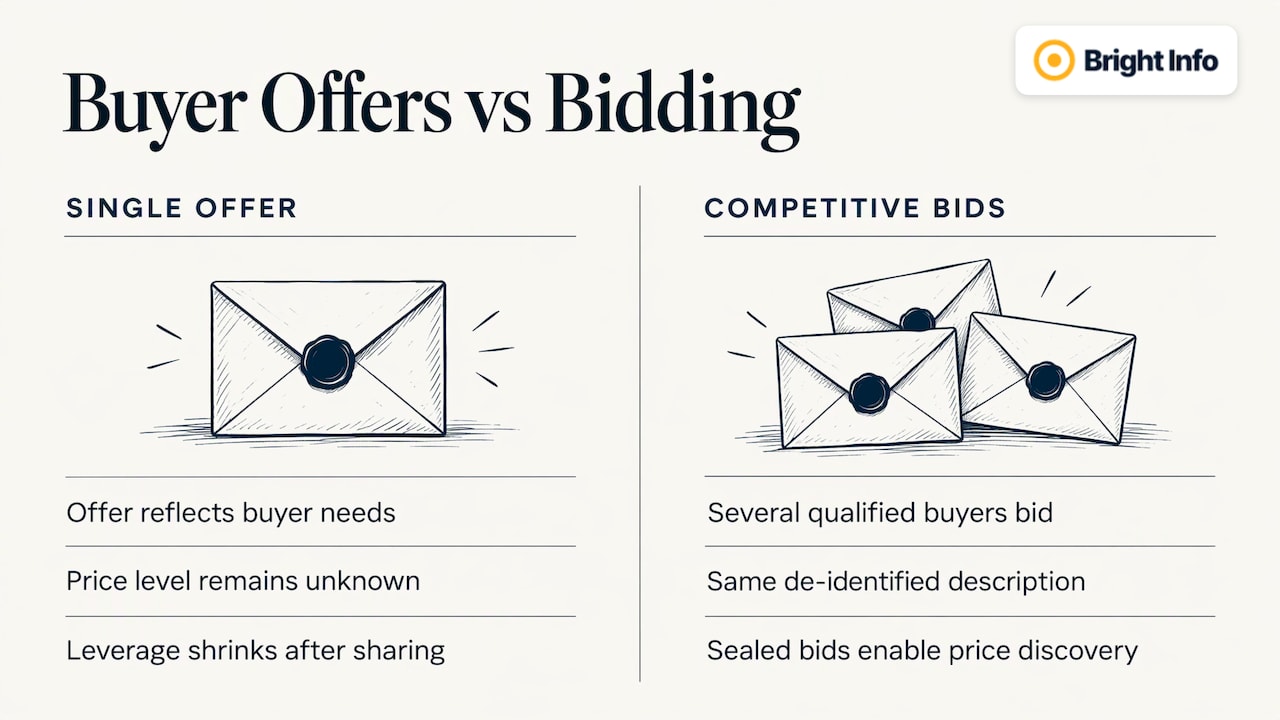
Here is the problem with asking one buyer. A buyer’s first offer reflects its own needs and its own budget. You have no way to know whether it is high or low, and once you have shared samples or details with one party, your leverage shrinks.
Competitive bidding fixes that. When several qualified buyers see the same de-identified description of your data and each submits a sealed bid, price discovery happens on your side of the table. That is the model Bright Info is built on. We act as a sell-side broker for the data owner, we do not represent buyers, and we have no commission bias toward any particular buyer. The commission is paid by the winning buyer, so it costs you nothing, and we are only paid if a deal closes.
Our own figures put company data typically between $100K and $4M. Where yours lands depends on volume, history, uniqueness and how cleanly it is documented, which is exactly why the quality checklist above is worth doing first. For a view of the market, our AI data licensing market report is the place to start, and the company data valuation page explains how we frame a valuation.
Catalog data rarely travels alone
A catalog describes what you sell. The rest of the business explains how you sell it: CRM records, support tickets, email history, team conversations, documents, call recordings and financial exports. These are the kinds of company data we broker, and a seller with a deep catalog and a deep operating record has more to put in front of buyers than either alone.
If customer relationships are the larger part of your story, see our page on CRM data monetization for AI training. To see the kinds of companies that bid, our AI data vendor profiles and data marketplace profiles show what each category buys and what it pays.
Preparing for a licensing process
You do not need a perfect data room to start. You do need clear answers to a handful of questions:
- What do you own? Catalog content you authored is different from supplier-provided content or licensed images. Know which is which.
- What is the span? Years of history, number of SKUs, number of attribute fields.
- What is the format? CSV, JSON, XML, a PIM export or a database dump. Buyers can work with most formats, but you should know what you have.
- What needs to come out? Customer names, personal contact details and anything contractually restricted must be removed before any data is shared.
- What terms matter to you? Scope of use, duration, exclusivity and deletion.
On the fourth point, our process uses an independent, owner-approved de-identification partner, and no company data moves until a deal is signed. On the fifth, license terms are where value is won or lost, so read our seller checklist for AI data licensing agreements before you see a draft.
Perspective
The catalog is the data owners most often undervalue, because it feels like marketing material. Every competitor and marketplace already sees the public face of it. What they do not see is the history behind it: years of edits, pricing changes, attribute corrections and the operating record around it.
Our view is that price should come from competition, not from a single conversation. A single offer can sound generous and still leave money on the table, and you cannot tell which without a second bid. That is why we invite every qualified buyer to bid, keep the bids sealed, and work only for the seller.
We also think privacy should be settled before price. An independent, owner-approved de-identification partner handles the data, and nothing moves until you sign. Owners should not have to trade control for a number.
Erik
Find out what your data could earn
If you hold years of product and operating data, the quickest next step is the free valuation. It starts with a two-minute intake, carries no upfront fee, and you pay nothing unless a deal closes, because the winning buyer pays our commission.
Start on the Bright Info home page, or read how we sell company data to AI companies first.
FAQ
Is product catalog data the same as a data catalog?
No. A data catalog is a metadata inventory that tells an organization what data it has and where it lives. Product catalog data is the actual record of your products: identifiers, attributes, prices and media. The two often sit side by side in a mature company.
What fields do AI systems expect in ecommerce product datasets?
At minimum, identity and price fields such as SKU, GTIN, title, description, price, currency, availability and links. Stronger datasets add typed attributes like material, dimensions and compatibility, and variant relationships. OpenAI’s feed schema is a concrete public example of required fields.
Does licensing my data cost anything upfront?
Not with us. There are no upfront fees for sellers, and Bright Info is only paid if a deal closes, with the commission coming from the winning buyer.
Is my data shared before I agree to a deal?
No company data moves until a deal is signed. Where data is prepared for a buyer, an independent, owner-approved de-identification partner handles it.
Sources
- What is a Data Catalog? (AWS)
- Your Ecommerce Catalog Management Guide (Shopify)
- Ecommerce catalog (Productsup)
- Product feed schema (OpenAI)
- AI-Ready Product Catalogs for Agentic Commerce (MongoDB)
- DDX Export Implementation Guide (Distributor Data Solutions)
- 2025 B2C Survey Results Report (Akeneo)
- NAED’s Journey Map of Product Data
- GS1 US National Data Quality Playbook
- Single Source of Truth for Product Data (MicroPIM)
- The Brand CIO’s Guide to Product Data Architecture (Salsify)
Recommended
- Pricing Intelligence Data
- Point of Sale Data: What It Is and What It Can Be Worth
- Loyalty Program Data
- Procurement Data: What It Includes and How to Use It
More from the blog
- Pricing Intelligence Data: What It Is and What It's Worth
- Loyalty Program Data: What It Is Worth and How to Sell It
- Point of Sale Data: What It Is and What It Can Be Worth
- All posts
Find out what your company's data is worth
Bright Info runs a sealed bid among AI data buyers for your record. You pay nothing unless a deal closes.
Get your data valued