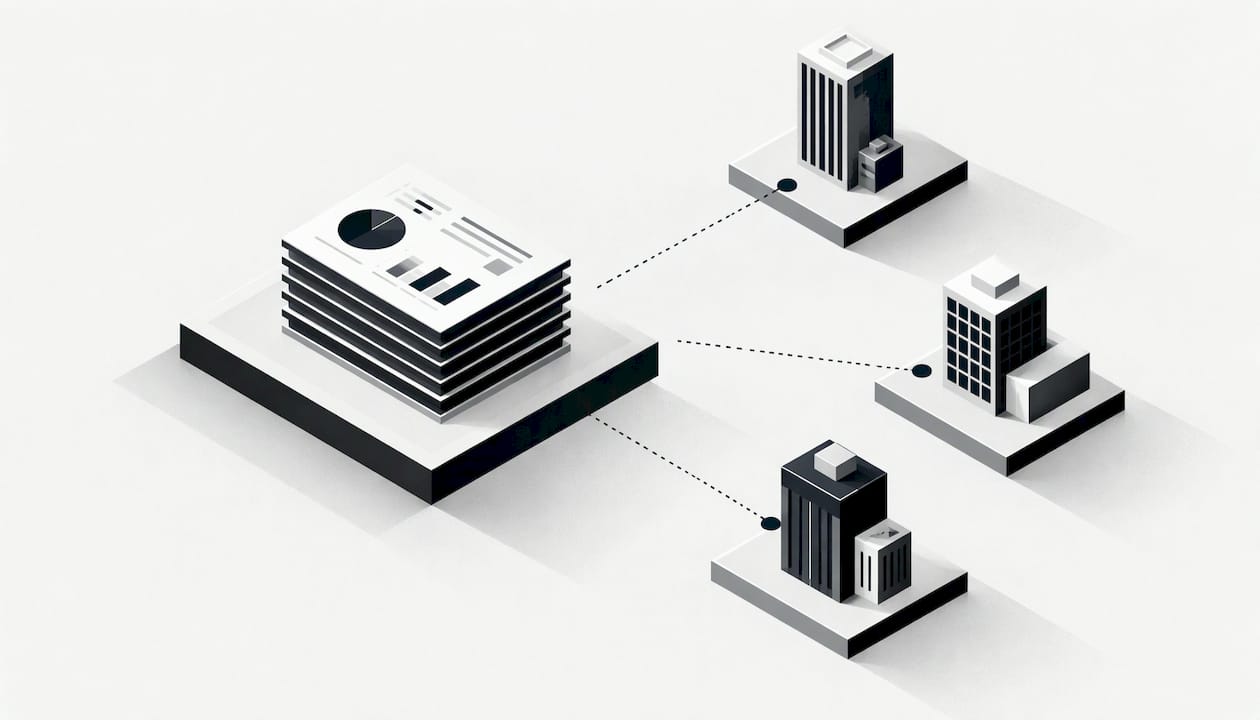
You sell company data to AI companies by licensing a de-identified copy of your records (email, Slack, CRM, support tickets, documents, call recordings) to buyers who train models on it, while you keep the originals. The best price comes when several qualified buyers bid against each other, not when one buyer names a number. At Bright Info we act as the sell-side broker for the data owner: buyers compete in sealed bids, you pay nothing unless a deal closes, and a free valuation is the first step.
TL;DR
- Most deals are licenses, not sales. You keep your data and the buyer gets a de-identified copy on agreed terms.
- Buyers want years of real operating records: email, chat, CRM, tickets, code, documents, call recordings and financial exports.
- Price depends on volume, history, scarcity, cleanliness and rights, and our own range for company data is typically $100K to $4M.
- Privacy and rights come before price. Buyers check ownership, origin and personal data first.
- Several buyers bidding at once protects you from underselling to the first offer.
Table of Contents
- Who buys company data and what they want
- What your data can be worth
- How to sell your data step by step
- Privacy and regulation in plain terms
- What a deal can look like
- Perspective
- Start with a free valuation
- FAQ
- Sources
Who buys company data and what they want
The buyers fall into a few types. Frontier AI labs sit at the end of the chain. OpenAI, for example, has publicly said it seeks large-scale datasets that reflect human activity and are not easily found online, in any format, and that it offers a private-datasets route for proprietary models. Between the labs and you are intermediaries: data vendors, builders of agent-training environments and data marketplaces that license records from operating businesses, clean them and deliver them on.
What they want is evidence of how work actually gets done. A model learning to act as a support agent, a sales assistant or a software engineer needs real conversations, real tickets, real pipelines and real code, not public web pages. That is why the data a company already holds is worth more than most owners assume.
The sources buyers ask for most often:
- Email history and team chat such as Slack
- CRM records and sales notes
- Support tickets and call recordings
- Codebases and technical documents
- Financial exports and operational spreadsheets
The companies that fit best have a few hundred staff or fewer, more than three years of history and records kept in established systems. Longer, cleaner history gives buyers more to work with.
What your data can be worth
There is no list price, and anyone who quotes one without seeing your data is guessing. Public reporting shows the scale, though. A pitch that reached WIRED described AI labs paying one-time fees of $350K to $1.8M for copies of old work records such as documents, emails, Slack messages and tickets. Our own experience-based range for company data is $100K to $4M, and where you land inside it depends on a handful of factors.
| Factor | What raises the value | What lowers it |
|---|---|---|
| Volume and history | Many years of continuous records | A few months of thin data |
| Variety | Several source types in one package (email plus CRM plus tickets) | A single narrow export |
| Scarcity | Niche industry or workflow that is rare online | Content that resembles public data |
| Cleanliness | Consistent formats, documented origin | Scattered files, unknown provenance |
| Rights | Clear ownership and permission to license | Third-party data or unclear contracts |
| Exclusivity | Non-exclusive terms priced for repeat licensing, or exclusivity priced for what you give up | Exclusive terms at a non-exclusive price |
Continuous data can support a recurring fee, while a closed archive usually earns one payment. Knowing which of the two you have shapes how you set up the deal.
We built a company data valuation page for owners who want to see how these factors apply to their own records.
How to sell your data step by step
1. Inventory what you hold
List every system that stores business records: mailboxes, chat workspaces, CRM, helpdesk, code repositories, shared drives, call recording tools, accounting. Note the date range, the approximate size and who administers each. The mistake here is looking only at the obvious system. A helpdesk with six years of tickets is often worth more than a mailbox with two.
Our free valuation starts from a short intake of about two minutes, so you do not need a finished inventory to begin.
2. Confirm you have the right to license it
Buyers check rights before they discuss price. According to one licensing guide, labs look at four things: that you own or control the rights, that the origin of the data is documented, that personal data is removed or covered by consent, and what exclusivity and warranties you offer. Digica’s licensing guide also advises capping the rights warranty and staying non-exclusive unless the price clearly pays for giving up future buyers.
Practical points to check yourself:
- Customer contracts that restrict secondary use of their information
- Employee agreements and privacy notices
- Data that came from vendors or partners and is not yours to license
- Regulated content such as health or financial records
Our seller checklist for AI data licensing agreements walks through the terms to look for. We run a legal review as part of the process, and your own counsel should still sign off on the final license.
3. De-identify before anything moves
AI buyers do not want your customers’ names, and you do not want to hand them over. De-identification means removing or masking anything that points to a person or an account: names, emails, phone numbers, account numbers, addresses. The hard part is free text. Names and account numbers hide inside support tickets, emails and chat logs, so a simple find-and-replace on obvious fields is not enough.
In the US, health data has its own formal standard under HIPAA, which allows two routes: an expert documents that re-identification risk is very small, or 18 listed identifiers are removed. If any of your records touch protected health information, involve a qualified privacy professional or healthcare compliance counsel before licensing anything.
In our process, de-identification is done by an independent partner that you approve, and no company data moves until a deal is signed.
4. Get several buyers to bid, not one
This is where most owners lose money. A single inbound offer tells you what one buyer will pay, not what your data is worth. Buyers anchor their first offers on their own costs, which tends to be the lowest defensible number. When several qualified buyers submit sealed bids on the same package, each has to price against competitors it cannot see.
Doing this alone means finding the buyers, signing a separate confidentiality agreement with each, preparing a sample for each and comparing offers that are structured differently. We take that off your hands: we invite every qualified buyer, collect sealed bids and lay out the license terms side by side. Our directory of data marketplaces gives a sense of the buyer types in play.
5. Compare terms, not just price
Two bids of the same size can be very different deals. Compare:
- Exclusivity: can you license the same data to others?
- Permitted use: model training only, or resale and derivative products too?
- Duration and territory: a 12-month license or perpetual, one country or worldwide
- Payment structure: one-time fee, recurring fee, revenue share or a mix
- Warranties and liability: what you promise about rights, and the cap on it
- Audit and deletion: what happens to the data when the license ends
We keep strict control over license terms, and because we are paid by whichever buyer wins, we have no reason to favor any particular one.
6. Sign, then deliver
Only after the license is signed does the de-identified data move to the buyer. Payment structure, delivery format and acceptance checks should all be written into the agreement, not agreed by email afterward.
Privacy and regulation in plain terms
Two rules of thumb cover most of what a business owner needs.
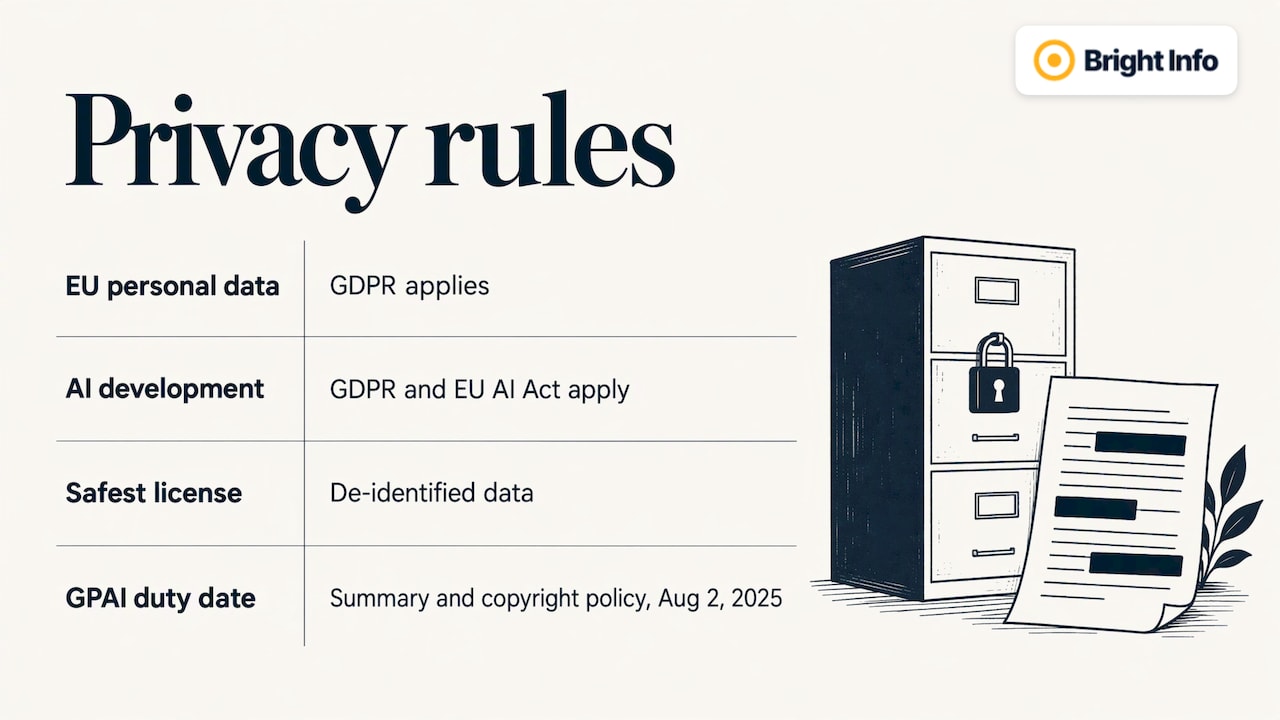
First, personal data raises the stakes. If your records include people in the EU, the GDPR applies, and the French regulator CNIL has stated that where personal data is used to develop AI, both the GDPR and the EU AI Act apply, with data minimization and individuals’ rights over the data. De-identified data that can no longer be tied to a person is the safest package to license.
Second, buyers face their own obligations. Under the EU AI Act, providers of general-purpose AI models have had to publish a summary of their training content and keep a copyright policy since August 2, 2025. That pushes serious buyers to ask for documented provenance, which rewards sellers who have their records in order.
Rules differ by country and by industry, and they change. Treat this section as orientation, and have your lawyer confirm what applies to your data.
What a deal can look like
Structures vary. Archives are often licensed for a one-time fee, while ongoing data feeds can carry recurring or usage-based fees. A published example from the book world shows the low end for individual content: HarperCollins authors who opted in were offered $2,500 per book. Company operating records are a different asset, because of their depth and because several sources can be combined into one package.
A worked example, using round numbers for illustration only: a 150-person services firm has seven years of email, a CRM and a helpdesk. One buyer offers a flat fee for the email alone. In a competitive process, the same firm could package all three sources, let buyers bid on the whole and compare non-exclusive terms against an exclusive one. The point is not the specific number but that the package, the terms and the competition are all things you can shape.
Perspective
Owners tend to ask us the same thing first: who will pay for this? The better question is how many buyers will see it. Data licensing is a young market with no price list, so the only reliable way to learn what your records are worth is to make qualified buyers compete for them.
That is why we work only for the seller. We do not represent buyers, we have no commission bias toward any of them, and we keep a firm hand on the license terms. Your data stays put until a deal is signed, and de-identification is handled by an independent partner you approve.
It also changes the economics for you. There is no upfront fee, and the commission comes from the winning buyer, so we are only paid when you are. We think that is the right alignment for a first-time seller who cannot yet tell a fair price from a low one.
Erik
Start with a free valuation
If you hold years of email, CRM records, tickets or code, the quickest way to learn what they could fetch is our free valuation. The intake takes about two minutes, you pay nothing upfront, and we are paid only if a deal closes, by the winning buyer. If your main asset is customer records, see our page on CRM data monetization for AI training.
When you are ready, request your free valuation and we will take it from there.
FAQ
How do I find AI data buyers?
Buyers include frontier labs, data vendors, agent-training environment builders and data marketplaces. Most do not advertise how to approach them, and each has its own intake process. Through Bright Info, every qualified buyer is invited to bid on your package at once.
Is selling company data to AI companies legal?
It can be, when you own or control the rights, remove personal data and follow the privacy laws that apply to your records. Contracts with customers and employees matter as much as statutes. Have your attorney review the license before you sign.
Will AI companies see my customers’ information?
Not if the data is properly de-identified first. With us, an independent de-identification partner that you approve prepares the records, and nothing is transferred until a license is signed.
How much does it cost to sell my data through Bright Info?
Sellers pay no upfront fees. We earn a commission from the winning buyer only if a deal closes.
Sources
- OpenAI Data Partnerships
- WIRED: AI Companies Really, Really Want to Buy Your Work Files and Emails
- Digica: How to Sell Data to AI Companies, A Licensing Guide
- CNIL: AI system development recommendations
- The Verge: HarperCollins is asking authors to license their books for AI training
Recommended
More from the blog
- LLM Data Licensing: How Companies Sell Data to AI Labs
- Sell Company Data to AI Companies
- Can Companies License Slack Data for AI Training?
- All posts
Find out what your company's data is worth
Bright Info runs a sealed bid among AI data buyers for your record. You pay nothing unless a deal closes.
Get your data valued