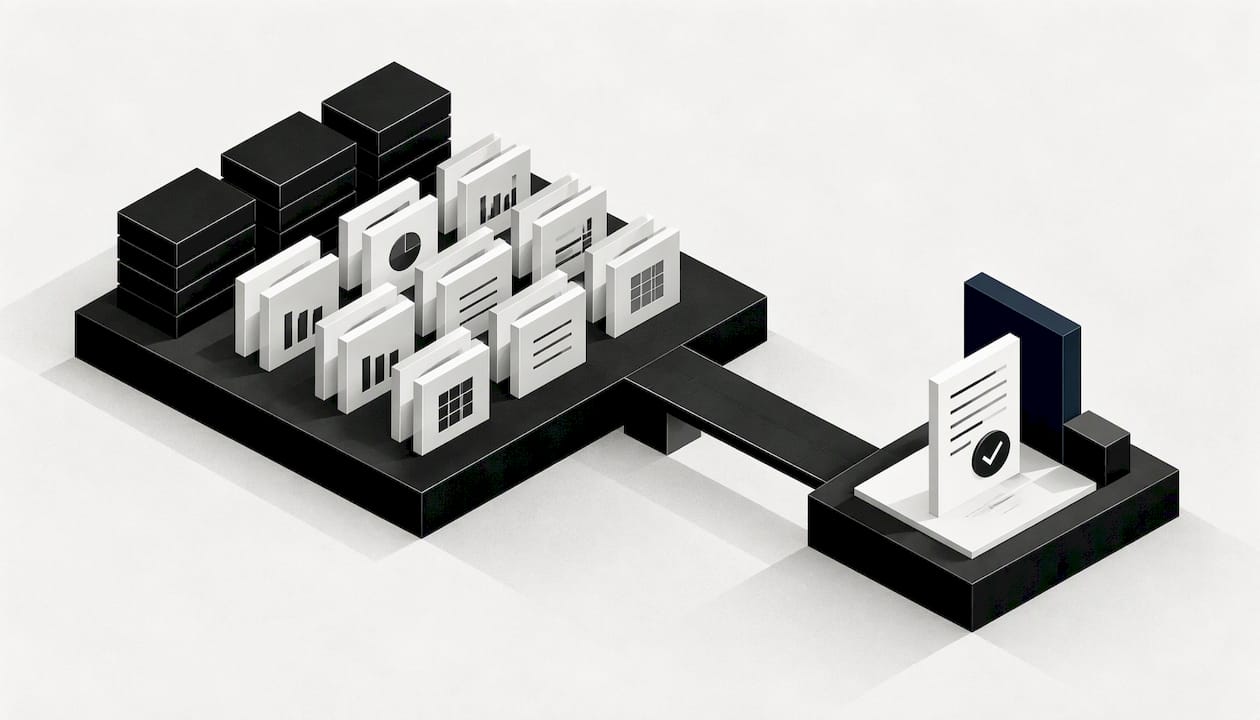
Enterprise data governance is the set of rules, roles and controls that decide who owns your company’s data, who can use it, how it is protected and how its quality is checked. Done well, it does two jobs at once: it lowers risk, and it turns scattered records into an asset you can prove the value of. That second job matters if you want to license your data to AI buyers. Buyers pay for data that is clean, documented and legally clear, and we built our brokerage around companies that have reached that point.
TL;DR
- Data governance sets the rules (ownership, access, quality, privacy). Data management carries them out day to day.
- A working program names owners and stewards, classifies data, controls access and keeps an audit trail.
- Start small: pick two or three priority data domains, set measurable goals, then scale.
- Governed data is easier to de-identify, document and license, which is what AI data buyers look for.
- If your data systems are established, you can ask us for a free valuation. There are no upfront fees, and we are paid only if a deal closes.
Table of Contents
- What enterprise data governance means
- Why it matters to the bottom line
- The core components of a program
- How to build and measure a program
- Protecting company data and business privacy
- From governance to revenue: licensing your data
- Get a valuation of your governed data
- Our perspective
- FAQ
- Sources
What enterprise data governance means
The most useful definition is an operating model. Snowflake describes it as the policies, roles, processes and technology that decide who owns data, what it means, how it is classified, who can access it, how quality is measured and how usage is audited.
In plain terms, governance answers four questions about every important dataset:
- Who is accountable for it?
- What does each field actually mean?
- Who may see or change it, and under what conditions?
- How do we know it is accurate and where it has been?
A company with 20 to 500 employees and several years of email, CRM records, support tickets and documents already has answers to these questions, even if they live in people’s heads. Governance writes the answers down and makes them enforceable.
Governance versus data management
The two terms get mixed up, and Adobe’s business guide notes that this confusion is a documented cause of failed programs. The split is simple. Governance decides who is responsible and what standards apply. Data management is the technical handling: pipelines, storage, quality checks, access configuration. Databricks puts it as governance setting the rules and management implementing the data lifecycle in line with them.
IBM treats governance as a subset of data management, with a focus on quality, security and availability. Either way, you need both. Policies nobody executes are paperwork. Execution without policy gives you inconsistent results.
Why it matters to the bottom line
Governance is often sold as a compliance cost. The evidence points further than that.
- BCG’s 2019 study documented a European bank freeing up several billion dollars of capital through better exposure data, and a steel manufacturer cutting costs by hundreds of millions of dollars by streamlining supply chain data.
- An IDC survey from October 2024 (807 respondents) found that organizations further along in data and AI governance reported 1.9 times higher overall improvement from their investments than those still evaluating.
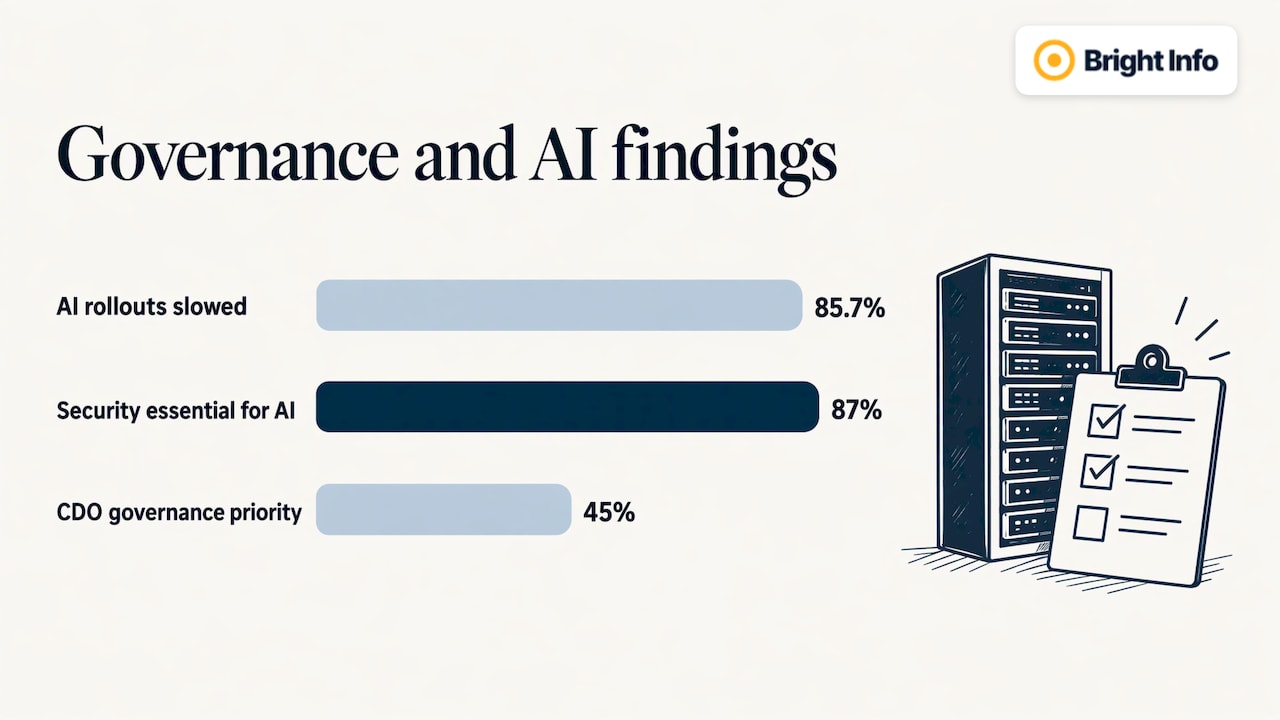
- According to the MIT CDOIQ survey as reported by AWS, 45% of chief data officers name data governance a top priority.
The AI angle is now the sharpest. An Osterman Research study for AvePoint found that 85.7% of organizations are slowing generative AI rollouts because of bad data and data security worries. The IBM Institute for Business Value’s 2025 CDO study found 87% of executives say effective data security is essential to getting value from AI, while only half say they can protect sensitive data in most AI use cases.
The lesson for an owner: the companies that can show their data is controlled are the ones positioned to use it, internally or commercially. Governing AI-related processes is a wider challenge than data alone, as controlling AI in high-volume hiring shows for one business function.
The core components of a program
Frameworks differ in vocabulary, but they converge on the same parts.
| Component | What it does | Typical owner |
|---|---|---|
| Strategy and policy | Defines goals, rules and decision rights | Executive sponsor or data council |
| Ownership and stewardship | Names who is accountable and who monitors quality | Data owners and stewards |
| Classification and access | Labels data (public, confidential, restricted) and applies least-privilege access | IT and security |
| Metadata and cataloging | Records what data exists, what it means and where it came from | Data stewards |
| Quality standards | Sets thresholds for completeness, validity, timeliness, consistency | Stewards, with engineering |
| Compliance controls | Aligns handling with privacy laws and contracts | Legal and compliance |
This follows Splunk’s five-component breakdown and the PwC framework, which also stresses people and culture, process, and tools as the foundation.
The three roles you actually need
IEEE’s Technology Navigator separates three roles:
- Data owner: an executive accountable for a data domain, such as sales records.
- Data steward: the person who monitors day-to-day quality and enforces policy.
- Data custodian: the technical person or team that runs the infrastructure.
In a 100-person company one person may wear two of these hats. What matters is that every important dataset has a named person against each role.
Operating models
Large enterprises commonly choose centralized, federated or hybrid models. McKinsey describes a typical structure with a central data office led by a chief data officer, governance roles organized by data domain, and a data council that links data strategy to corporate strategy and approves funding. For a mid-sized company, a small council of the owner or CEO, the head of IT and whoever handles legal is enough to start.
How to build and measure a program
The NSW Government Data Governance Toolkit lays out a cycle that works for companies as well as agencies. Here it is, adapted for a business owner.
- Define the business problem. “We want to license our data without exposing customers” is a real goal. “Improve governance” is not.
- Assess where you are. Inventory your systems: email, chat, CRM, support desk, code repositories, document stores, call recordings, finance exports. Note who owns each and how long history goes back.
- Choose focus areas. McKinsey recommends rolling out two to three priority domains first rather than everything at once.
- Write the policies. Cover classification, access, retention, and what may leave the company.
- Set SMART goals. Specific, measurable, achievable, relevant, time-bound.
- Tell staff what changed and why. Governance that employees do not know about does not hold.
- Repeat and expand. The Queensland Government’s data governance guideline says governance should be everyday practice rather than a one-off project, and warns that too much governance becomes an expensive overhead while too little raises risk.
Metrics worth tracking
Domo’s glossary offers sample targets you can adapt: every critical data element with a named owner, a 95% policy compliance rate, 80% of datasets certified, access approvals in under two days and a falling trend in audit findings. Treat these as starting points and set your own thresholds.
Protecting company data and business privacy
Protection is where governance becomes concrete. According to IEEE, a program uses validation rules when data enters a system, automated monitoring for anomalies, classification, masking and anonymization, role-based access, audit trails and breach response procedures.
Privacy and security are related but different. Per Snowflake’s guide, privacy covers how personal data is collected, used, retained, shared and deleted, while security covers protection from unauthorized access. Both rest on classification, ownership and auditability.
The US privacy picture
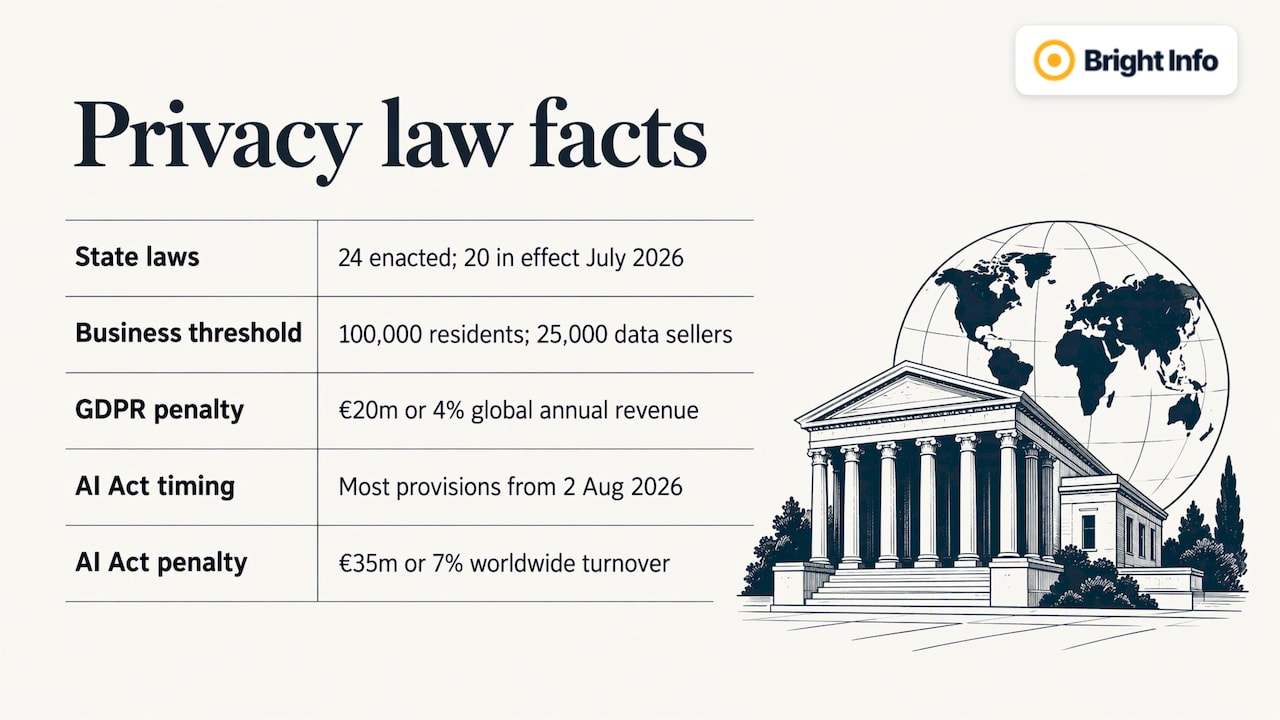
There is no single federal privacy law for businesses in general. Instead, CDP’s 2026 guide reports that 24 states have enacted comprehensive consumer privacy laws, with 20 in effect as of July 2026. Most give residents rights to access, correct, delete and opt out of the sale of their data, and many apply once a business handles records of 100,000 or more residents (25,000 where revenue comes from selling data). Thresholds and exemptions differ by state, so ask your counsel which laws reach you.
If you operate abroad, the same guide notes the GDPR carries maximum penalties of €20 million or 4% of global annual revenue. White & Case reports that the EU AI Act applies in stages, with most provisions enforced from 2 August 2026 and penalties up to the greater of EUR 35 million or 7% of worldwide turnover.
Balance access and control
AWS frames governance as balancing two levers. Too much control locks data in silos and encourages shadow IT. Too much access risks unauthorized exposure. The OECD’s 2022 policy guide makes a similar point, advising a culture of risk management and transparency and technological and organizational control measures. It also observes that generating, cleaning and curating data takes substantial investment. That investment is exactly what a data license pays you back for.
From governance to revenue: licensing your data
Most governance articles stop at risk reduction. If you run a company with years of email, CRM history, support tickets and documents, the next question is whether that data has a buyer. AI developers need real business data to train and test their systems, and they compete for it.
Governance decides how smoothly that goes. Here is what each governance layer gives you at the point of sale:
- Ownership and catalog: you can say precisely what you have, how far back it goes and who can approve its use.
- Classification: you know which records hold personal or confidential content that must be de-identified before anyone sees it.
- Access logs and retention rules: you can show the data has been handled consistently.
- Contracts and policies: you know whether customer agreements allow licensing at all, a question for your lawyer before any deal. Our AI data licensing agreement seller checklist walks through the license terms that matter.
We also write about the related practical questions: how to share business data safely, CRM data monetization for AI training and what makes a financial dataset valuable.
Why more than one buyer matters
A single offer tells you what one buyer will pay, not what your data is worth. We work as a sell-side broker for the data owner. We invite every qualified buyer to bid in sealed bids, so buyers compete against each other for your data, and we do not represent the buyers. Our published range for company data deals is typically $100K to $4M. Where a deal falls depends on your data, which is why a company data valuation is the sensible first step. You can also see who buys company data and what they pay.
Keeping the data protected
Governance only counts if the process respects it. In our process the data is de-identified by an independent, owner-approved de-identification partner, and no company data moves until a deal is signed. You keep control over license terms, and we have no commission bias toward any buyer. Details are on our security and data handling page.
Get a valuation of your governed data
If your systems are established, with several years of history in email, CRM, support or documents, we can tell you what competing buyers might pay. Intake takes about two minutes. It costs you nothing upfront, and we are paid only if a deal closes: the winning buyer pays our commission, never you. Start with a free valuation.
If you want to compare your options first, our guide to selling company data to AI companies explains what buyers look for.
Our perspective
Governance is usually framed as a defensive project. We see it as the thing that decides whether your data is an asset or a liability.
A company that knows what it holds, who owns it and what is inside it can say yes to a buyer with confidence. A company that cannot has to guess, and guessing is how data gets underpriced or exposed.
That is why we built a process around the seller. We invite multiple buyers to bid, we keep company data where it is until a license is signed, and we use an independent de-identification partner the owner approves. The owner keeps control of the terms. Nobody should have to sell their most distinctive asset on the strength of one offer.
Our advice: do the basic governance work, name your owners, classify your data and know your contracts. Then find out what the market will pay.
Erik
FAQ
What is the difference between enterprise data governance and enterprise data management?
Governance sets the policies, ownership and standards. Data management is the technical work of collecting, storing, moving and checking data under those rules. You need both: policies without execution are only documents, and execution without policy produces inconsistent results.
Does a small or mid-sized company need data governance?
Yes, in a lighter form. You do not need a chief data officer or a large council. Name an owner for each important dataset, classify what is sensitive, control who has access and write down the retention rules. Then expand domain by domain as the company grows.
How does governance help protect company data?
It makes protection systematic. Data is classified, access follows the least-privilege principle, changes leave audit trails, and sensitive fields can be masked or anonymized before sharing. Breach response procedures are defined in advance rather than improvised.
Can well-governed data be monetized?
Yes. Clean, documented, de-identified data with clear ownership and license terms is what AI data buyers look for. Before any deal, have your lawyer confirm that your customer contracts and applicable privacy laws allow licensing. A free valuation shows what competing buyers may offer.
Sources
- What is Data Governance? | IBM
- What Is Data Governance? A Comprehensive Guide | Snowflake
- What Is Data Governance? | Adobe
- Data Governance vs. Data Management | Databricks
- Good Data Starts with Great Governance | BCG
- Closing the Gap Between Governance for Data and AI | IDC
- What is Data Governance? | AWS
- Go Beyond the Hype to Navigate Trust, Security and Value | Osterman Research
- 2025 CDO Study | IBM Institute for Business Value
- Data Governance vs. Data Management | Splunk
- Global and industry frameworks for data governance | PwC
- Data governance | IEEE Technology Navigator
- Designing data governance that delivers value | McKinsey
- NSW Data Governance Toolkit
- Data governance guideline | Queensland Government
- Data Management vs Data Governance | Domo
- Data Privacy Laws by Country and U.S. State (2026) | CDP
- Data Protection 2025/2026 | White & Case
- Going Digital Guide to Data Governance Policy Making | OECD
Recommended
- Enterprise Data Exchange: What It Is and How It Works
- Secure Data Sharing: How to Share Business Data Safely
- AI Data Licensing Agreement: Seller Checklist
- Data Monetization Strategy
More from the blog
- How to Sell Data to AI Companies: A Guide for Business Owners
- Enterprise Data Exchange: What It Is and How It Works
- Startup Shutdown Data Monetization Guide
- All posts
Find out what your company's data is worth
Bright Info runs a sealed bid among AI data buyers for your record. You pay nothing unless a deal closes.
Get your data valued