
AI data sourcing is the process by which AI developers find, acquire and prepare the data their models learn from. The public web is only one source. A growing share comes from licensed, third-party data, and that is where a company with years of email, CRM records and support history sits on a valuable asset. If you hold that data, you are on the supply side of this market, and the best outcome comes from letting several qualified buyers bid against each other for it. We built Bright Info around that idea: a free valuation, no upfront fees, and sealed bids from multiple AI data buyers.
TL;DR
- AI developers source training data from public web content, licensed third-party data, user-generated data and their own interactions, and they typically combine several of these.
- Licensed business data is in demand because scraped web data carries copyright, privacy and quality questions.
- Companies with 20 to 500 staff and several years of history often hold email, CRM, ticket and document data that buyers want. Our listed range for such data is typically $100K to $4M.
- A single buyer’s offer tells you little. Sealed competitive bids, de-identification and clear license terms protect both price and privacy.
- Bright Info charges sellers nothing. We are paid only if a deal closes, and the winning buyer pays the commission.
Table of Contents
- How AI developers actually source data
- Where the commercial supply comes from
- What makes your data valuable to a buyer
- Why one offer is the wrong way to sell
- Protecting sensitive information
- A practical path from idea to signed license
- Perspective
- Start with a free valuation
- FAQ
- Sources
How AI developers actually source data
The OECD’s October 2025 paper on AI training data maps four routes: direct or observed collection, voluntary data donations, commercial third-party licensing, and non-commercial open-data or scraping practices. Developers often use several at once.
OpenAI describes the same pattern in plain terms. Its foundation-model explainer lists publicly available internet information, data from third-party partners, and information provided or generated by users, human trainers and researchers. Microsoft’s Trust Center names public, acquired, first-party, synthetic and human-feedback data as the categories it uses.
For a business owner, one line matters most: “acquired” and “third-party” data is data somebody sold or licensed. Those buyers have budgets, and they need supply.
Why buyers are moving toward licensed data
Scraping is widely used to meet demand, but the OECD notes that lawsuits and investigations allege web-scraped datasets break copyright, privacy and data-protection laws. Raw web text also needs heavy cleaning. A data engineering handbook points out that web collections contain navigation, ads, spam and boilerplate, so filtering and deduplication come before training.
Enterprise data is the opposite profile. The same handbook describes it as relevant and information-dense, with rights, privacy and confidentiality questions to manage. Those questions are exactly what a well-run licensing process answers: who owns the data, what has been removed, and what the buyer may do with it.
Where the commercial supply comes from
The OECD describes commercial data licensing, data marketplaces and brokers as the routes to third-party data, alongside public and private open datasets. It also says no single marketplace or repository supplies everything, and that sources differ in accessibility, reliability and quality.
That fragmentation is why buyers who need specific material, such as real customer conversations, support tickets, codebases or call recordings, look for it at companies that generate it in the normal course of business.
The kinds of company data buyers ask for include:
- Slack and email history
- CRM records
- Support tickets
- Codebases and documents
- Call recordings
- Financial exports
If you run a business with years of this history, you are not just a customer of the AI economy. You are a source for it.
What makes your data valuable to a buyer
Buyers do not pay for volume alone. A Fraunhofer ISST practitioner framework for valuing enterprise data lists the factors that drive value: completeness, accuracy, timeliness, lineage, metadata, bias, representativeness and refresh frequency. The same paper’s sequence is worth following before you talk to anyone:
- Define the asset and the purpose it could serve.
- Assess the rights and constraints on it.
- Assess quality and provenance.
- Identify the mechanism by which it creates value.
- Select a valuation method.
- Connect the valuation to your governance.
In practice, three questions decide most of the price:
- How long is the history? Our target sellers have more than three years of records, and continuity over time is easier for a buyer to use.
- How clean and structured is it? Consistent fields in a CRM or ticketing system are worth more than scattered exports.
- Can it be licensed at all? Customer contracts, employee agreements and platform terms can restrict what you may license. Settle that first.
Our company data valuation page explains how we frame the worth of a dataset to AI labs, and our CRM data guide covers the most common starting point.
Why one offer is the wrong way to sell
When a single buyer approaches you, that buyer sets the frame: the price, the use, the term. You have no way to know whether the number is high or low, because you have nothing to compare it to.
The usual alternatives each leave something on the table. Accepting an inbound offer gives you one price. Working with a buyer-side intermediary means the party helping you may be paid by, or aligned with, the buyer. Doing it alone means learning who the buyers are, negotiating license terms and arranging privacy protection without having done it before.
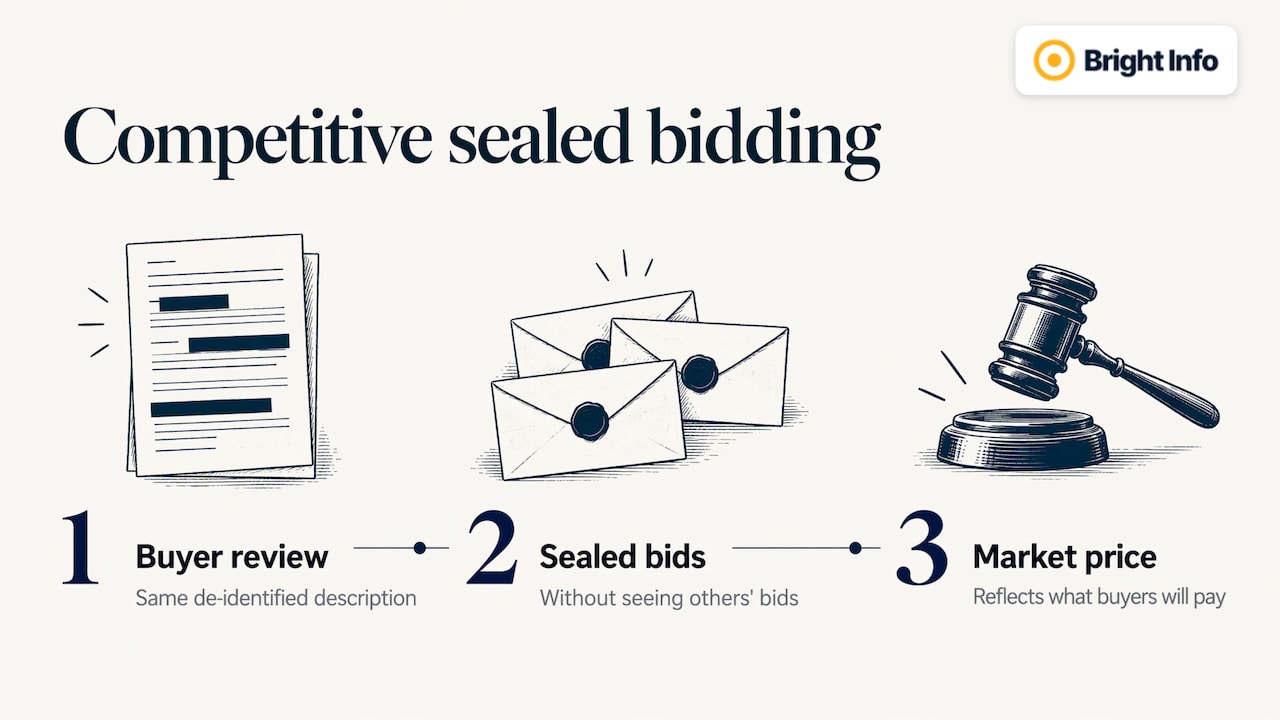
Competitive sealed bidding fixes the information problem. Several qualified buyers each see the same de-identified description of your data and each submit a bid without seeing the others. The price then reflects what the market will pay, not what the first caller chose to offer.
What the license terms decide
Price is only half the deal. The license schedule decides what the buyer can do and for how long. A 2026 due-diligence guide for dataset buyers recommends securing, among other records, a permitted-use schedule, a change-notification clause and deletion or exit terms. As a seller, the mirror image applies: define permitted use, term, and what happens when the license ends. Our seller checklist for AI data licensing agreements walks through those points.
The scale of license confusion in the wider data world shows why this matters. A 2024 audit in Nature Machine Intelligence of more than 1,800 text datasets found license omissions above 70% and license errors above 50% on popular hosting sites (Nature Machine Intelligence, 2024). Clear, signed terms are not a formality in this market. They are the product.
Protecting sensitive information
Company data contains customer names, employee messages and confidential figures. Before any buyer sees real content, it has to be de-identified, meaning personal and identifying details are removed or masked.
The OECD paper also notes that data from AI interactions, including customer-service conversations, can become training inputs, which is why governance and privacy are part of every sourcing decision.
Our process is built around that. We use an independent, owner-approved de-identification partner, and we do not move any company data until a deal is signed. Buyers bid on a description, not on your raw files.
The regulatory backdrop
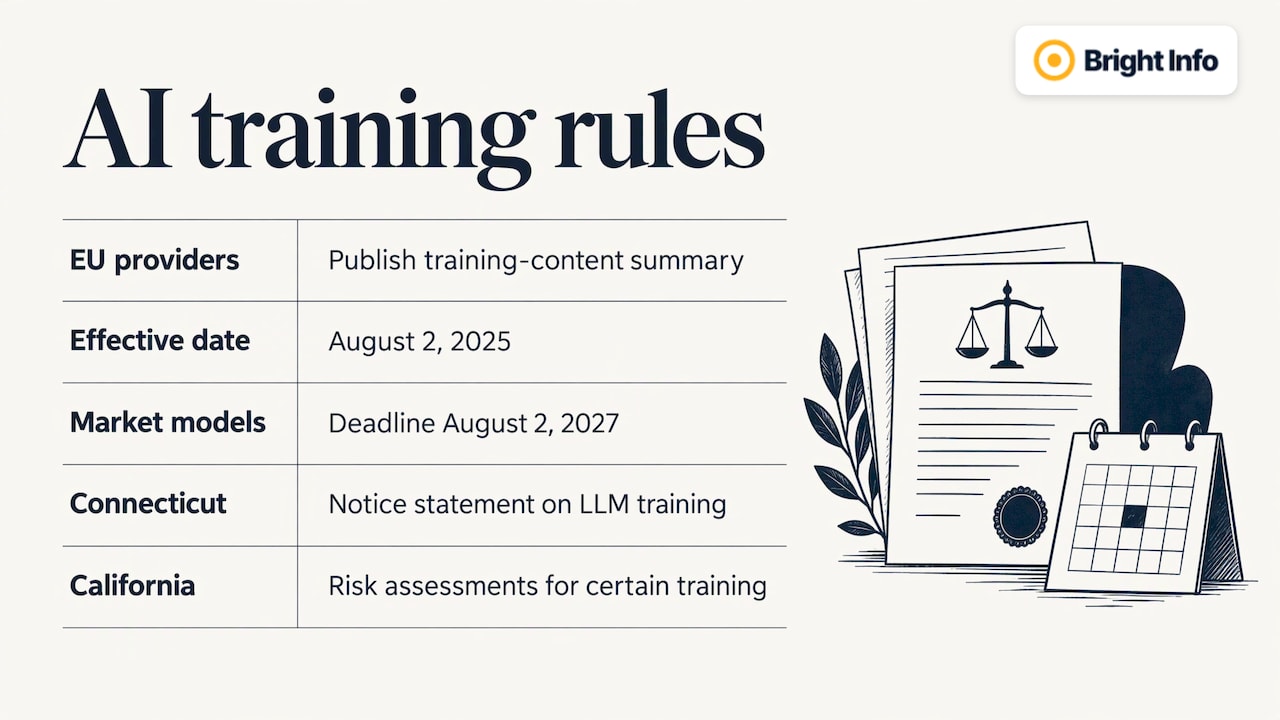
Rules are tightening on the buyer side too. In the EU, the requirement for general-purpose AI providers to publish a summary of their training content took effect on August 2, 2025, with models already on the market given until August 2, 2027. In the US, state rules are a patchwork: a tracker of US AI privacy laws notes that Connecticut requires a privacy-notice statement about training large language models and that California requires risk assessments for certain training.
The practical consequence is that serious buyers want documented provenance and clean licenses. Data that arrives with both is easier to bid on. Have your counsel review any license before you sign, and if your data includes health or financial records, involve legal and compliance advisers early, because sector rules such as HIPAA apply.
A practical path from idea to signed license
- Inventory what you hold. List systems, date ranges and record counts for email, chat, CRM, tickets, documents, code, recordings and finance exports.
- Check your rights. Review customer contracts, employee policies and third-party platform terms for limits on use.
- Get a valuation. A free valuation tells you the range the market may support before you commit to anything. The intake takes about two minutes.
- Let buyers bid. Qualified buyers submit sealed bids on the de-identified description. You compare price and terms side by side.
- Review the terms. Legal review covers permitted use, term, exclusivity, deletion and exit.
- Sign, then de-identify and deliver. Nothing moves until the license is signed.
At each step, a sell-side broker takes work off your plate: we invite the buyers, run the bidding, arrange the de-identification partner and keep license terms under your control. You pay nothing unless a deal closes.
Perspective
We hear the same question from owners again and again: is my data worth anything? Usually the honest answer is yes, and the real problem is not the data but the lack of a market view. One offer is a quote. Several sealed bids are a price.
We act only for the data owner. We invite every qualified buyer, we do not represent buyers, and we have no commission bias toward any particular one. The winning buyer pays us, so you never do, and we are paid only when a deal closes.
Privacy should not depend on trust in a stranger. That is why an independent, owner-approved de-identification partner handles the data and why none of it moves before signature. Our view is simple: your data is an asset, and assets deserve a competitive process.
Erik
Start with a free valuation
If you have three or more years of email, CRM, ticket or document history, the quickest next step is to find out what buyers might bid. Our free valuation takes a two-minute intake, carries no upfront fee, and shows you what your company’s data could be worth to AI labs before any data is shared.
If you want more detail first, our guides on selling company data to AI companies and AI data licensing explain the process in depth, and our market report covers what buyers are paying.
FAQ
What are the main sources of AI training data?
Common sources are the open web, forums and Q&A sites, encyclopedic knowledge, code, academic papers, books, enterprise data and user feedback. Developers usually mix several. Enterprise data is valued for relevance and density, provided rights and privacy are handled properly.
How do I find commercial datasets for an AI project?
The main routes are commercial licensing, data marketplaces and brokers, plus public and private open datasets. No single repository covers everything, so define the task first, then check each candidate’s terms of use, gaps and bias, as Google’s PAIR guide advises. If you are the one holding the data, a sell-side broker brings buyers to you.
Can a company really sell its internal data to AI buyers?
Yes, if it has the rights to do so and the data is de-identified first. Buyers license business data such as email, CRM records, support tickets and documents. Our typical range for such data is $100K to $4M, depending on volume, history, quality and terms.
Does it cost anything to find out what my data is worth?
No. Our valuation is free, sellers pay no upfront fees, and we are paid only if a deal closes, with the commission coming from the winning buyer.
Sources
- Mapping relevant data collection mechanisms for AI training (OECD, October 2025)
- How ChatGPT and our foundation models are developed (OpenAI)
- Data for AI Training (Microsoft Trust Center)
- Data Sources, Acquisition, and Copyright (Data Engineering handbook)
- A practitioner framework for enterprise data valuation (Fraunhofer ISST, 2025)
- A large-scale audit of dataset licensing and attribution in AI (Nature Machine Intelligence, 2024)
- European Commission template for public disclosure of AI training data (WilmerHale)
- AI and Data Privacy Laws: US overview
- Data Collection + Evaluation (Google PAIR)
Recommended
- Sell Company Data to AI Companies
- CRM Data Monetization for AI Training
- Data Acquisition Services for AI
- AI Training Data Broker: What They Buy and What They Pay
More from the blog
- AI Data Licensing: How Companies License Data for AI Training
- AI Training Costs: What Models Cost and What Data Is Worth
- Company Data Valuation for AI Licensing
- All posts
Find out what your company's data is worth
Bright Info runs a sealed bid among AI data buyers for your record. You pay nothing unless a deal closes.
Get your data valued