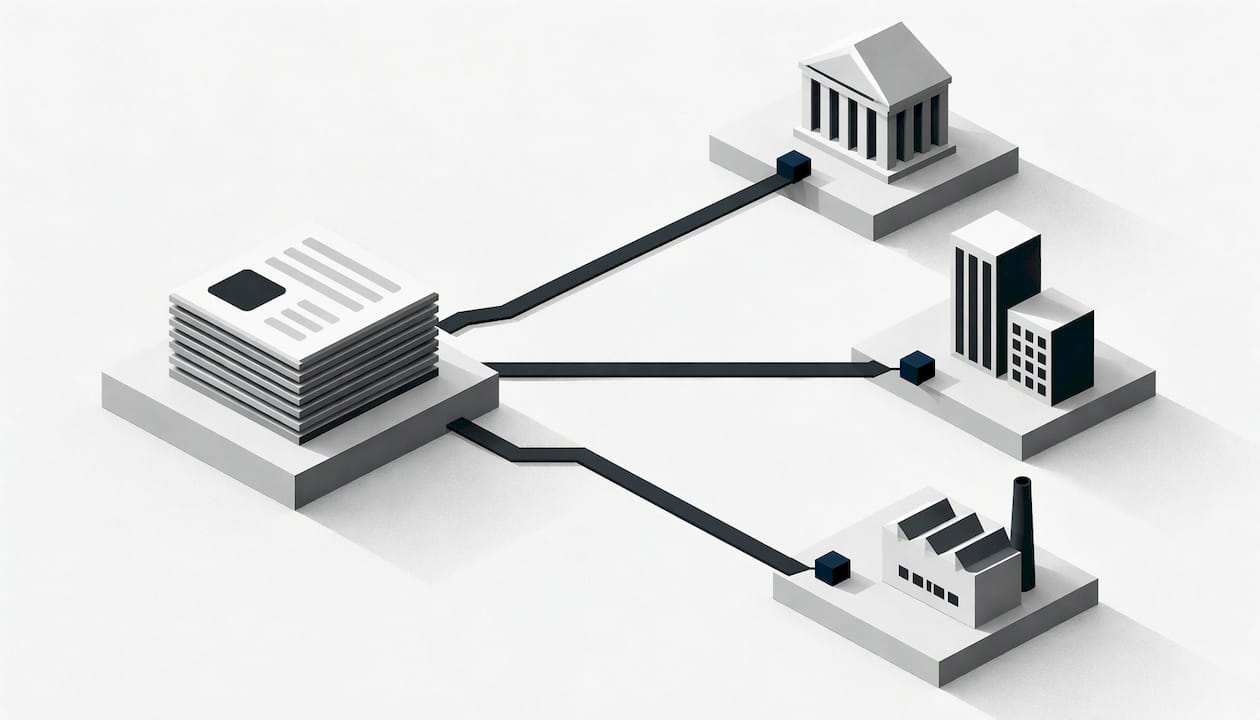
You can monetize Slack data by licensing a de-identified copy of your workspace history to AI buyers, and the best price usually comes from letting several of them bid against each other instead of accepting the first offer. Slack’s terms say the messages and files in your workspace are your data, which is what makes a license possible. We work as a sell-side broker for exactly this: companies present their data once, qualified buyers submit sealed bids, and the company never pays a fee unless a deal closes.
TL;DR
- Monetizing Slack data means licensing your workspace history, with threads, replies and files, to AI labs and agent-training builders, after personal information is removed.
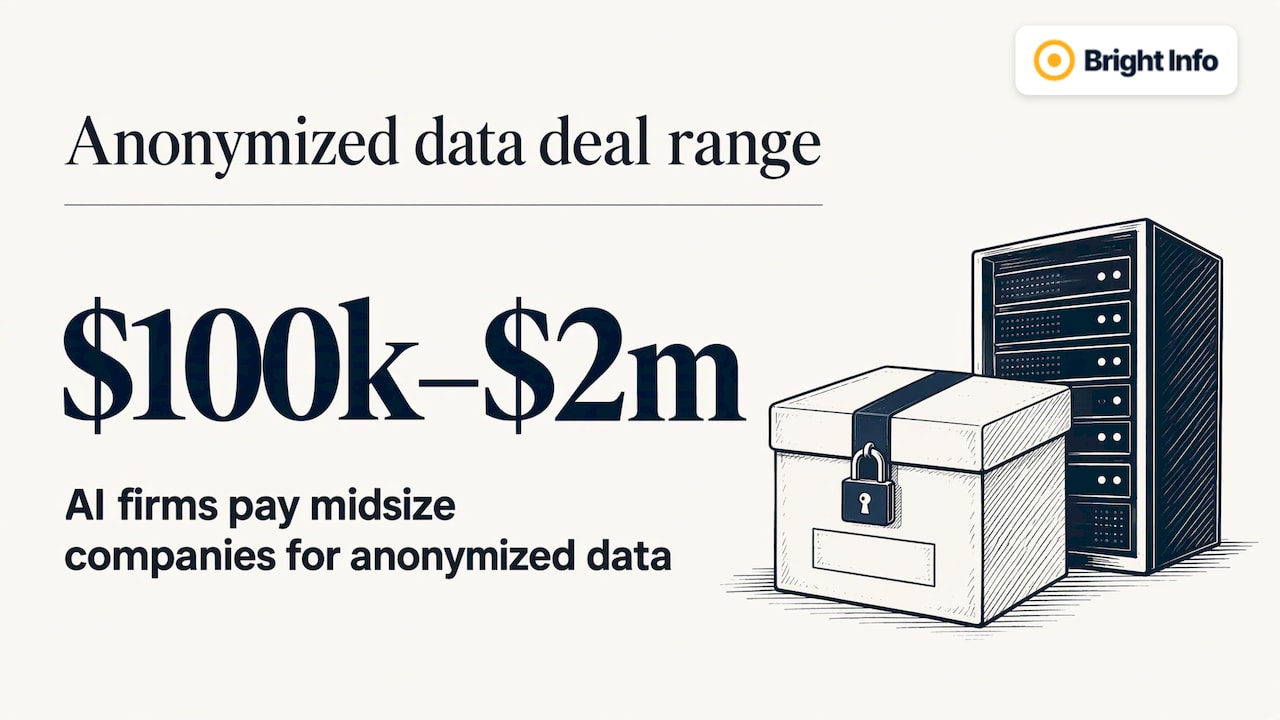
- Reported deals range from about $10,000 to $100,000 for small archives up to $2 million for midsize companies. Our own typical range is $100K to $4M. The spread depends on volume, depth and sector.
- Slack’s terms treat messages and files as customer-owned, but you are responsible for the permissions, notices and lawful transfer that a sale needs.
- Sealed competitive bids protect you from underselling. Nothing leaves your systems until a license is signed.
- Start with a free valuation. Sellers pay nothing, and our commission comes from the winning buyer only if a deal closes.
Table of Contents
- What it means to monetize Slack data
- Who owns the data and who can license it
- What Slack lets you export
- What drives the value of Slack data
- Preparing the data: de-identification and risk
- Why sealed bids beat a single offer
- How a Slack data sale works with us
- Get a free valuation of your Slack data
- Our view: your data is an asset, so run it like a sale
- FAQ
- Sources
What it means to monetize Slack data
For years a Slack workspace was a place where work happened and then sat. Now AI developers want it. Models and autonomous agents that are meant to act inside companies need examples of real work moving from a problem to a resolution. A support escalation, an engineering debate, a pricing decision with the disagreement left in: this is what polished public text cannot supply.
According to Business Insider’s October 2026 reporting, AI data firms are paying midsize companies between $100,000 and $2 million for anonymized data. Value tracks how well the data shows real work: decision-making context, problem-solving threads and long records of how work gets done.
The same article reports that one data-company CEO expects licensing data to AI labs to become one of the most common revenue sources for businesses worldwide. That is a forecast, not a guarantee. It does show why buyers are now approaching companies that were never in the data business.
A second use explains much of the demand. Gizmodo reports that Slack messages and emails are used in “reinforcement learning gyms”. These are simulated workplaces built from real company data where AI agents practice office tasks. That is a different kind of buyer from a classic dataset shopper, and each buyer type values different material. One offer cannot tell you which of them wants your archive most.
Who owns the data and who can license it
Before anything else, settle the rights question. Slack’s User Terms say that Customer Data, meaning messages and files, is owned by the customer. Slack’s data management page says the same: the content your workspace submits is owned and controlled by you, while Slack controls its own usage and account information.
Ownership is not the whole answer. The same terms make the customer responsible for informing users of relevant policies. The customer must also obtain the rights, permissions or consent needed for lawful use, ensure lawful transfer and processing, and resolve disputes about that data. In practice, a seller should be ready to answer these questions:
- Do employment agreements and internal policies cover this use of workplace communications?
- Do channels contain customer data, partner data or Slack Connect conversations that belong to other organizations?
- Which regions are your employees and customers in? Privacy law differs by country. In May 2026, for example, Italy’s data protection authority warned a workplace AI vendor that its Slack and Teams plug-in would likely violate both the GDPR and the EU AI Act.
For these questions, involve your company’s counsel. Our process includes legal review and transparent license terms, and our AI data licensing agreement seller checklist lists the clauses you should expect to see before you sign.
What Slack lets you export
Slack’s rules decide what can reach a buyer at all. Slack’s export documentation says that all plans let Workspace Owners and Admins export public-channel messages and file links. Private-channel and direct-message exports are available on Business+ and Enterprise after owners apply. Free-plan workspaces can export file links only from the last 90 days.
On Free and Pro plans, downloading everything is allowed only in limited circumstances, according to Slack’s data management page. The owner must pass a review and show valid legal process, member consent, or a requirement or right under applicable law. Business+ full-content requests go through an application that checks employment agreements, corporate policies and legal permissibility.
Two practical points follow. First, a standard export is not a complete archive. Private conversations require the extra approvals above, and the plan you are on affects the depth of history you can offer. Second, the route matters. In August 2025 Salesforce changed its Slack API terms to prohibit bulk exports, persistent copies and use of API data in large language models. A seller who plans a license should confirm with counsel that the way the data is collected fits both Slack’s terms and the buyer’s license. We help sellers sequence this, and we do not move any company data until a deal is signed.
What drives the value of Slack data
There is no standard price list, but the reporting points to a handful of factors.
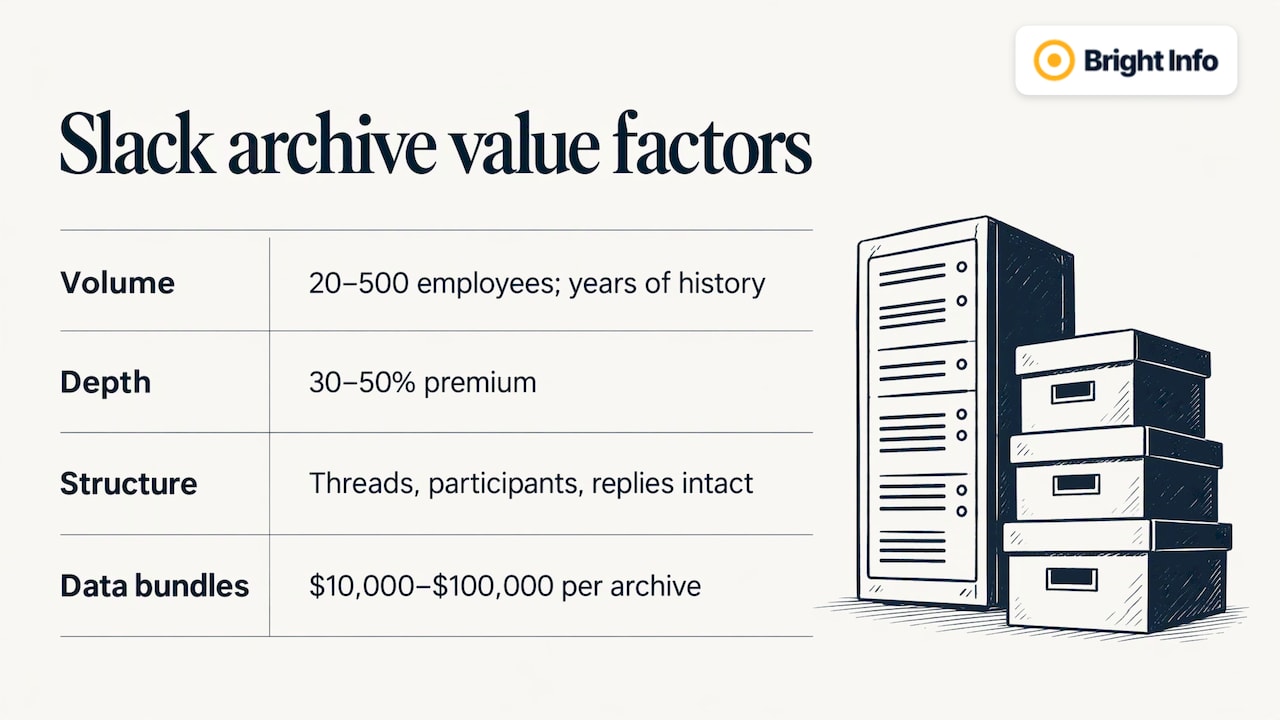
Volume. Business Insider reports that data is priced by the terabyte, and that the more white-collar employees a company has, the more valuable its corpus tends to be. Years of history for 20 to 500 people is the profile we see as the sweet spot for the companies we serve.
Conversational depth. Startup Fortune reports that archives rich in developer dialogue or executive planning are commanding premiums of 30 to 50 percent over standard asset liquidation prices, per estimates circulating in data brokerage. One 2026 archive sale was driven by what buyers called “conversational density”: years of informal technical problem-solving and strategic decision-making.
Structure preserved. Buyers want full conversations with threads, participants and reply structure intact, because a message stripped of its context teaches an agent little. A workspace where people used threads and channels consistently is easier to price well.
Sector and adjacent data. heise online, citing Forbes, reports typical deals of $10,000 to $100,000 per archive for Slack, email and source code, with larger sums for data from liquidated healthcare or financial companies. Slack rarely sells alone. Email, CRM records, support tickets and documents make the package richer, and our CRM data monetization page explains how that side is valued.
Teams that build their own models on workplace records will recognize why this matters. Organizations working with machine learning development services learn quickly that training data quality, not just quantity, decides results. Buyers apply the same logic when they price your archive.
Treat any published range as a headline, not a quote. The reported figures cover very different situations, from shutdown archives to active midsize companies. The honest way to learn your number is a valuation of your own data. Our company data valuation page shows what goes into one.
Preparing the data: de-identification and risk
Buyers do not want your employees’ personal details, and you should not want to hand them over. Intermediaries typically scrub items such as Social Security numbers and home addresses before data goes to AI developers, as the Business Insider report notes.
Internal chat is messy, though. People paste phone numbers, health remarks and customer names into channels without thinking. Privacy advocates, including Marc Rotenberg of the Center for AI and Digital Policy, have said that internal communications concern identifiable individuals. That is why sellers should treat de-identification as a core step and not an afterthought. A sensible preparation routine looks like this:
- Inventory the channels. Separate public channels, private channels, direct messages and anything shared with outside organizations.
- Decide the scope. Many sellers offer only selected channels, for example engineering and support, and leave HR, legal and finance out.
- Check permissions. Confirm employment terms, policies and customer contracts allow the use, and brief counsel.
- De-identify with an independent party. Names, contact details, identifiers and sensitive content must be removed or masked before a buyer sees real records.
- Lock the license terms. Define permitted use, duration, exclusivity and what the buyer may not do with the data.
On our side, de-identification is handled through an independent, owner-approved partner, and no company data moves until a deal is signed. Our security and data handling page sets out how we treat your information.
Why sealed bids beat a single offer
The easiest way to leave money on the table is to take the first inbound message. Reported prices for similar archives span a wide band, and a lone buyer has no reason to open at the top of it. Buyers also differ in what they want: some train models, some build agent environments, some resell through marketplaces. Each places a different value on the same threads.
A competitive process fixes that. You present the dataset once. Every qualified buyer sees the same description and submits a sealed bid. You compare price, license scope and conditions side by side, then choose. Because we act for the data owner and do not represent buyers, we have no commission bias toward any particular buyer, and the commission is paid by the winning buyer, not by you.
You do not have to run that auction yourself, chase each buyer’s legal team, or arrange the privacy work separately. The data licensing market report tracks what buyers are doing and what they want.
How a Slack data sale works with us
- Two-minute intake. You tell us what systems you use, how many people and how many years of history.
- Free valuation. We estimate what your data may be worth to AI buyers.
- Preparation and legal review. Scope, permissions and license terms are reviewed, and de-identification is arranged through the owner-approved partner.
- Sealed bids. Qualified buyers bid competitively on your dataset.
- You choose. You pick the winning offer. Data moves only once the license is signed.
If Slack is your main asset, our guide to licensing Slack data for AI training goes deeper on the specifics. If you are winding a company down, our startup shutdown data guide covers that situation.
Get a free valuation of your Slack data
If you run a company with 20 to 500 people and more than three years of Slack, email and CRM history, you are the kind of seller buyers look for. A free valuation from Bright Info takes a two-minute intake and costs you nothing. We are paid only if a deal closes, and the winning buyer pays our commission.
We typically see company data valued from $100K to $4M. Your number depends on volume, depth and the buyers who respond, which is why we ask for a few facts first and let the bids set the price.
Our view: your data is an asset, so run it like a sale
Most executives we talk to have never priced the archive sitting in their workspace. They know what the software costs, but not what years of real decisions, problem-solving and customer escalations are worth to someone building an AI agent.
Our view is simple. A data license is an asset sale, and asset sales get better results when more than one qualified buyer is in the room. That is why we work for the seller only, invite every qualified buyer to bid, and keep license terms under the owner’s control.
Privacy is part of the price, not a cost against it. A buyer pays more for clean, well-documented data, and an owner sleeps better knowing that identifying details were removed by an independent partner the owner approved, and that nothing moved before signature.
Slack is often the richest part of the package because it holds the context other systems miss. Start by learning what yours is worth. A free valuation costs nothing, and the decision stays yours.
Erik
FAQ
Can a company legally sell its Slack data?
Slack’s terms state that messages and files are owned by the customer. The customer is also responsible for permissions, notices and lawful transfer, so employment agreements, policies and privacy laws in your regions need review with your counsel before a sale. Our process includes legal review and transparent license terms.
How much is Slack data worth?
Reported deals vary widely: about $10,000 to $100,000 per archive in some cases, and $100,000 to $2 million for midsize companies. Our typical range is $100K to $4M. Volume, conversational depth and sector set the price, and a free valuation gives you a figure for your own data.
Do I need to export my Slack workspace first?
Not to get a valuation. The two-minute intake asks about your systems and history, and no company data moves until a deal is signed. Slack’s plan limits on private channels and direct messages matter later, when the scope of the license is set.
Does it cost anything to sell through Bright Info?
No. Sellers pay nothing upfront. Our commission is paid by the winning buyer, and only if a deal closes.
Sources
- Business Insider: AI labs are fueling a market for your emails and Slack
- Gizmodo: failed companies are selling old Slack chats and email archives
- Startup Fortune: failed startups are becoming data mines
- heise online: AI firms buy internal data from liquidated companies
- Slack: export your workspace data
- Slack: data management
- Slack: user terms of service
- National Law Review: Salesforce limits Slack API data use
- PPC Land: Italy warns AI startup over Slack plug-in
Recommended
More from the blog
- Sell Company Documents: How to License Them for AI
- LLM Data Licensing: How Companies Sell Data to AI Labs
- How to Negotiate a Data Sale and Avoid Underselling
- All posts
Find out what your company's data is worth
Bright Info runs a sealed bid among AI data buyers for your record. You pay nothing unless a deal closes.
Get your data valued